Wireless Electric Vehicle Charging Breakthrough in Japan
Researchers have made a breakthrough in wireless electric vehicle (EV) charging technology, enabling vehicles to charge by parking on specially equipped roads or in designated spaces.
Researchers in Japan have made a breakthrough in wireless electric vehicle (EV) charging technology, paving the way for EVs to charge simply by parking on specially equipped roads or in designated parking spaces.
The new system integrates seamlessly with existing wireless power transfer technology found in modern smartphones and consumer electronics, which uses an oscillating magnetic field generated by a transmitter coil inside the ground pad to induce an electric current in a receiver coil underneath the vehicle.
This induced current then recharges the EV's battery cells, eliminating the need for cumbersome plug-in infrastructure. However, previous wireless charging systems have been limited by small misalignments between the coils, which can affect charging speed and efficiency.
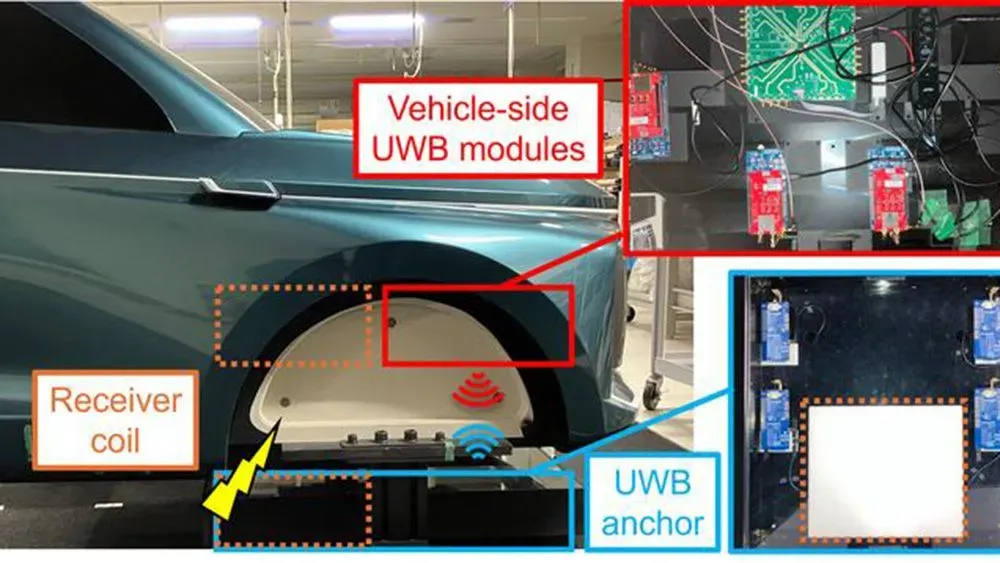
To address this issue, the new system employs short-range radio signals to accurately determine the position of the vehicle's magnetic charging coil relative to the ground-based charging device, taking into account distance and angle.
The new positioning system is designed to improve the accuracy and efficiency of wireless electric vehicle (EV) charging by eliminating the need for precise alignment between the vehicle's magnetic charging coil and the ground-based charging device.
This innovative approach relies on ultra-wideband radio devices mounted around the vehicle's charging coil, which communicate with antennas placed around the charging pad. By measuring the time it takes for radio waves to travel between these devices and detecting tiny differences in signal arrival times at each sensor, the system can accurately determine the position and angle of the EV's charging coil relative to the ground.
The researchers behind this study have identified key limitations of existing methods for wireless EV charging, including magnetic systems that work best when the coil is close to the pad and cameras that struggle with rain, poor lighting, or dirt obscuring the pad. These challenges can hinder the widespread adoption of wireless EV charging technology.
To overcome these issues, the new system uses a network of ultra-wideband radio devices to create a precise map of the vehicle's surroundings, allowing it to pinpoint the position and angle of the charging coil with great accuracy. This approach enables efficient wireless charging even in complex or dynamic environments.
The study's findings have significant implications for the development of wireless EV charging technology, which could potentially enable vehicles to charge simply by parking over a charging pad, much like smartphones placed on wireless chargers.
Researchers have successfully developed a new positioning system that could make wireless electric vehicle (EV) charging more efficient. This technology uses short radio pulses to detect when an EV is close by, allowing it to charge without the need for physical contact.
The team behind the study made significant improvements to the positioning accuracy of the system, correcting for distortions in the radio signals and reducing the error rate by around fivefold. The researchers acknowledged that further testing is needed outdoors on full-size EVs under real-world charging conditions.
Facts based on reporting originally published by Live Science.
You may republish this story, in full or in part, if you credit News Central Site and link to it (licence CC BY 4.0). Photos are not included.