UVSOR Synchrotron Facility Researchers Observe Xenon 4d Core Hole Decay Directly
Researchers at the UVSOR Synchrotron Facility in Japan have made a groundbreaking discovery regarding the decay of xenon 4d core holes, observing this process directly in the time domain.
Researchers at the UVSOR Synchrotron Facility in Japan have made a groundbreaking discovery regarding the decay of xenon 4d core holes. Using pairs of phase-coherent extreme ultraviolet pulses from a synchrotron, they were able to observe this process directly in the time domain.
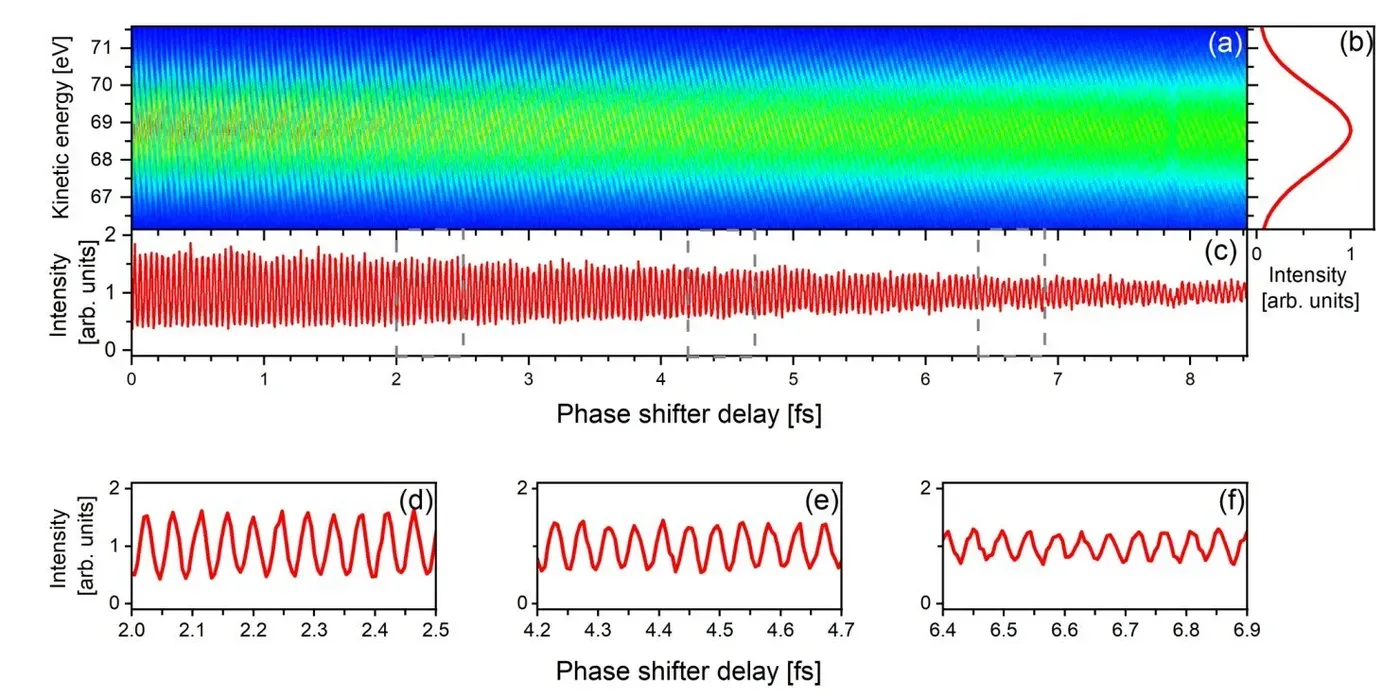
The team used these pulse pairs to create photoelectron wave packets that interfered with each other, resulting in a pattern of interference fringes. As the delay between the pulses increased, the contrast of these fringes decreased rapidly over a few femtoseconds.
This decay was found to be consistent with a model using literature core-hole lifetimes of around 6 femtoseconds. The researchers' approach offers an alternative to attosecond streaking, which has been widely employed for time-domain observations of Auger processes.
The study focuses on the ultrafast process known as Auger decay, where a valence electron fills an inner-shell vacancy and another electron is ejected. This process dominates the decay of xenon 4d holes.
By extending photoelectron wave-packet interferometry to core holes created by photoionization, the research team has made significant progress in understanding this complex phenomenon.
The research team used a unique setup at beamline BL1U of the UVSOR-III synchrotron to generate phase-coherent pulse pairs from two undulators in tandem. The photon energy was 93.4 eV, with a relatively narrow bandwidth of about 3%. A phase-shifter magnet adjusted the delay between pulses with attosecond resolution.
The researchers used these pulse pairs to ionize xenon 4d electrons and recorded photoelectron spectra as a function of delay using a hemispherical analyzer. For comparison, they also measured helium, which has no comparable decay process. The results showed that both gases exhibited fringes spaced 40 attoseconds apart, matching the optical cycle of the light.
The contrast in the helium spectrum decreased slowly over time, primarily due to the electron beam's energy spread and emittance. However, in xenon, the contrast dropped much more quickly, indicating a femtosecond lifetime for the core hole. This rapid decay is likely responsible for the observed decrease in contrast.
Furthermore, the xenon data showed oscillations with a period of about 2 fs, which can be attributed to the coherent excitation of the spin-orbit splitting. Model calculations that incorporated reported lifetimes successfully replicated both the decay and beat patterns, confirming that this interferometric method directly reflects ultrafast core-hole dynamics.
The study marks a significant achievement in using photoelectron wave-packet interference to observe ultrafast core-hole dynamics.
This is the first time this method has been applied to a short-lived core-hole state, and it demonstrates that coherent pulse pairs from a synchrotron can be used with ordinary electron spectroscopy to follow these dynamics. The researchers propose taking their approach further by applying it to molecules and condensed matter systems.
Facts based on reporting originally published by Phys.org.
You may republish this story, in full or in part, if you credit News Central Site and link to it (licence CC BY 4.0). Photos are not included.