Trump Ends Taxpayer Funding for Campaign Ads
US President Donald Trump announced that he will no longer use taxpayer money to fund his campaign advertisements.
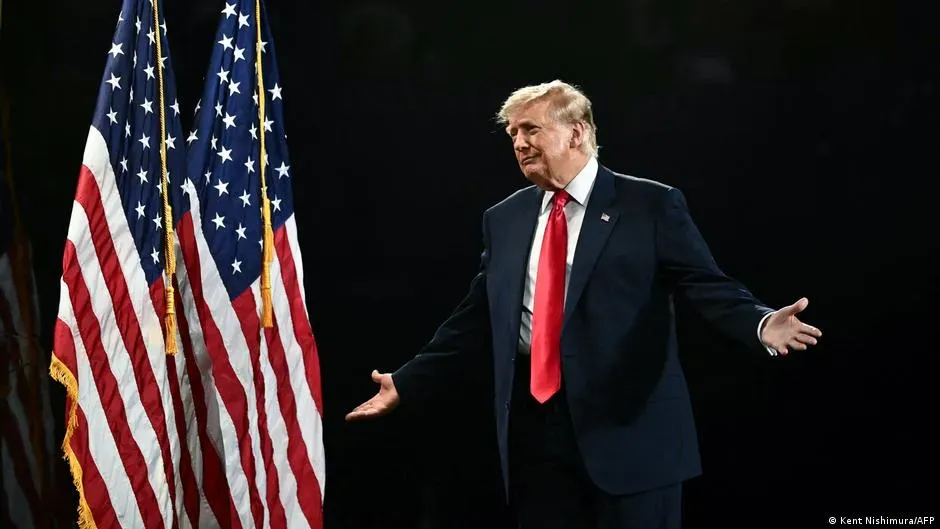
US President Donald Trump has made an unexpected announcement regarding his campaign advertisements. In a recent statement on his Truth Social platform, he revealed that taxpayer money would no longer be used to fund these ads.
The decision comes after controversy surrounding the paid-for-by-the-US-government commercials aired in September during popular TV shows and sports events. These ads prominently featured Trump himself and included combative messages against perceived threats to American values. The inclusion of the US government's funding source sparked debate about the use of taxpayer money for partisan advertisements.
Trump claimed that it is a "rather standard thing to do" to fund such ads with public funds, but he will now rely on donations to finance future commercials. He stated this in response to criticism from those on the left who have expressed their discontent over the use of public funds for these promotions.
The ads themselves drew attention for showcasing scenes of US troops capturing Venezuelan President Nicolas Maduro earlier this year, alongside images and videos of Trump with messages that promise to "expel the warmongers" or "throw off the sick political class."
The US Department of Homeland Security has been accused of misusing taxpayer funds for political advertisements supporting President Trump's re-election campaign.
Critics argue that the ads, which were paid for by a $20 million contract with an agency, are not public service announcements as claimed by the White House but rather partisan political propaganda.
Public Citizen, a US non-profit consumer advocacy group, has lodged a complaint with the Federal Communications Commission (FCC) over the misuse of public funds.
The organization claims that federal law explicitly prohibits using taxpayer money for government self-aggrandizement or partisan political advertising.
The timing of Trump's campaign tactics is becoming increasingly crucial as the US midterm elections approach. Weeks before the midterms, the issue of using taxpayer dollars for campaign-related activities has become a major concern.
Voters will be electing members of Congress on November 3, including all seats in the House of Representatives and roughly a third of the Senate seats. In addition to these federal positions, some states will also be choosing governors. This mix of local and national contests adds complexity to the electoral landscape.
The Republicans currently hold a majority in both houses of Congress, with 53 out of 100 seats in the Senate and 219 out of 435 seats in the House of Representatives. This has allowed Trump's proposals to pass relatively easily, but recent polls suggest that his party may be struggling to maintain its advantage.
A recent poll has revealed a shift in voter preferences ahead of the US midterm elections, which could potentially impact Republican candidates' chances.
According to the survey, voters aged 50 or older now prefer Trump's party by just two percentage points over the Democratic Party, with 44% backing the Republicans and 42% supporting the Democrats. This is a significant drop from December, when the Republicans held an eight-point advantage in this age bracket.
Older Americans typically make up a large share of the electorate during midterm elections, making this demographic particularly crucial for Republican candidates.
Meanwhile, among voters under the age of 50, the Democratic Party holds a significant lead of 18 points over Trump's party.
The poll also found that opinions on Trump's presidency remain low, with only 32% of Americans expressing approval.
A number of Republican candidates have been skipping out on President Trump's campaign events in recent weeks, even though these gatherings could be valuable opportunities to boost their own campaigns.
Notable absences include Susan Collins from Maine and Dan Sullivan from Alaska, both of whom are facing re-election as senators and would benefit from increased visibility. Similarly, candidates running for the House of Representatives in swing states like Arizona, Iowa, and Michigan were also absent from the event.
One major reason Trump's campaign events have become less appealing to some Republican candidates is his increasingly unusual tactics. At a recent party convention, he urged supporters to "pretend" that he was on the ballot, as if voting for him would somehow make a difference in the outcome of midterm elections.
This approach has been met with skepticism by many observers, who see it as another example of Trump's tendency to promise unrealistic rewards or penalties. In this case, his vow to give each eligible US voter $5,000 if Republicans maintain control of Congress is being viewed with particular scrutiny.
The effectiveness of Trump's campaign tactics is still uncertain as the US midterm elections approach. His use of expensive commercials and promised payouts may not guarantee majority Republican support.
The outcome will depend on how these strategies resonate with voters, and whether they can overcome any potential backlash from critics who view them as unconventional.
Facts based on reporting originally published by DW English.
You may republish this story, in full or in part, if you credit News Central Site and link to it (licence CC BY 4.0). Photos are not included.