Newly Discovered Crab Species Found in South China Sea
A newly discovered crab species from the South China Sea has sparked interest in the evolutionary history of deep-sea creatures.
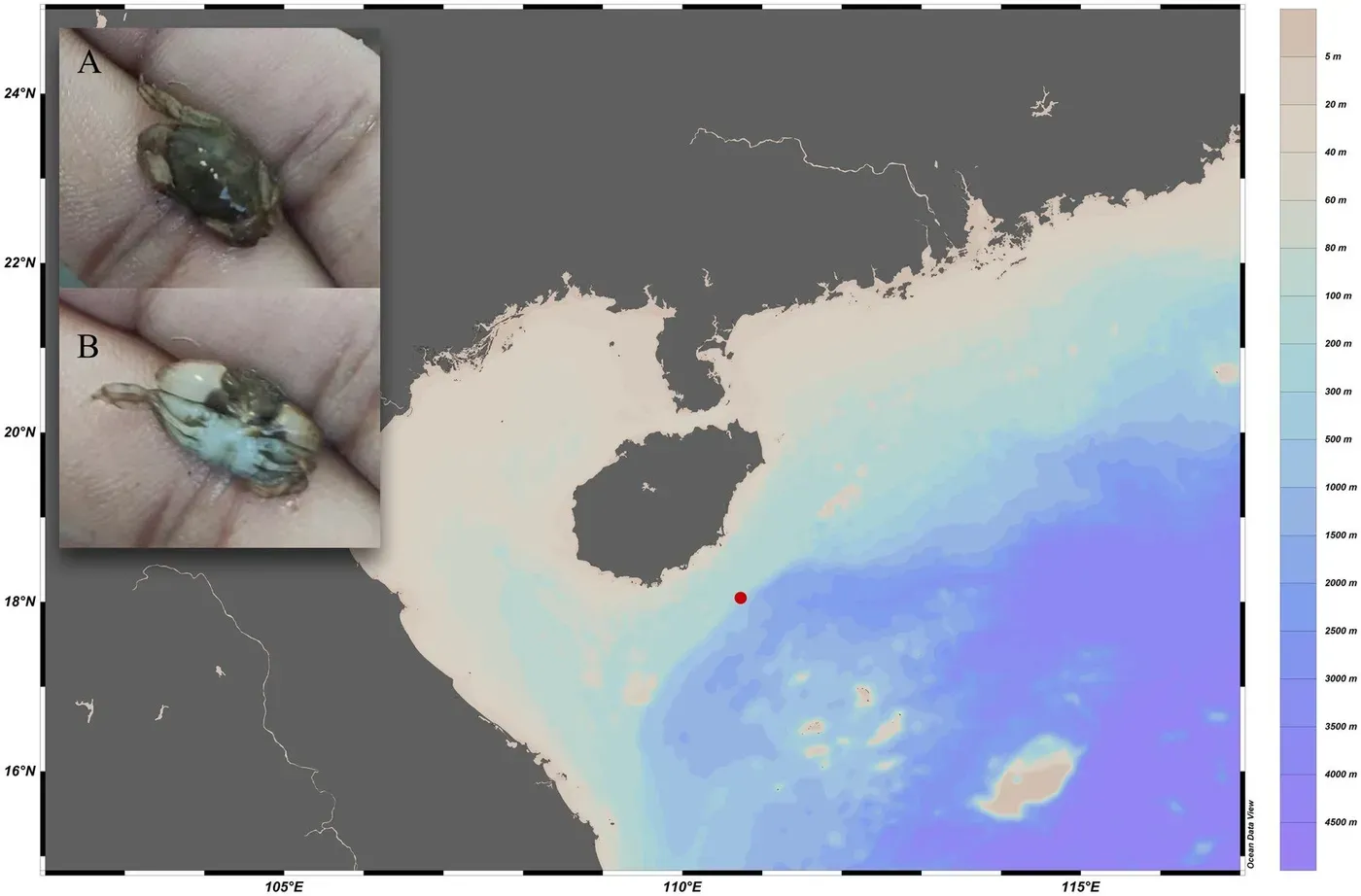
A newly discovered crab species from the South China Sea has sparked interest in the evolutionary history of deep-sea creatures.
The crab, known as Macromedaeus putrimanubriatus, was found at depths of approximately 330-980 feet, a vast difference from its closely related cousin M. orientalis which inhabits intertidal zones.
Led by Sha Zhongli from the Institute of Oceanology of the Chinese Academy Sciences (IOCAS), a research team has described this new species in the Xanthidae family and published their findings in Zoological Journal of the Linnean Society.
The fact that modern deep-sea fauna has traditionally been seen as resulting from ancient colonizations dating back to the middle Paleozoic to early Cenozoic era may not be entirely accurate, new evidence suggests.
Macromedaeus species have long been known to inhabit nearshore rocky intertidal zones with broad, flattened carapaces and robust walking legs; however, Macromedaeus putrimanubriatus stands out with its narrower carapace and slender walking legs.
Phylogenetic analyses have placed Macromedaeus putrimanubriatus firmly within its genus and confirmed its close relationship to M. orientalis, a species found in intertidal zones. The research highlights the significance of genetic data in understanding the evolutionary history of this group.
Studies suggest that M. putrimanubriatus and M. orientalis diverged from their common ancestor approximately 13 million years ago, around the time when the Antarctic ice sheet expanded rapidly and the climate cooled significantly. This period saw a significant drop in sea level and reorganization of ocean circulation patterns.
The researchers propose that changes in shallow-water environments or the availability of deep-water niches may have driven the ancestors of M. putrimanubriatus out of their intertidal habitats and into deeper waters. This shift could be linked to variations in food supply or vacant ecological spaces.
Comparative studies across other Xanthoidea groups reveal a similar trend: deep-water species tend to possess narrower carapaces and more slender legs, features that are thought to have evolved independently as adaptations to soft bottoms, dispersed resources, and reduced predation pressure. These traits facilitate movement over sediment and minimize energy expenditure.
Convergent evolution is evident in the shared morphological traits of deep-water Xanthoidea species, which have developed similar body plans despite their distinct evolutionary paths. This phenomenon underscores the importance of environmental pressures in shaping the physical characteristics of organisms.
The discovery of a new crab species in the South China Sea has shed light on the rapid evolution of deep-water organisms.
This newly described species is part of a relatively recent colonization event, where shallow-dwelling creatures adapted to life in deeper waters. The study highlights that this shift has led to the formation of younger lineages alongside ancient ones within modern deep-water fauna. Such findings underscore the significant impact of environmental pressures on shaping the physical characteristics of organisms.
The researchers chose to name the new species after a Chinese legend, symbolizing how rapidly morphology can diverge under selective pressures in deep-water environments. According to Dr. Yuan Ziming, first author of the study, this choice underscores the remarkable adaptability of deep-sea creatures.
These findings provide crucial evidence for understanding the evolution and formation history of deep-sea fauna.
Facts based on reporting originally published by Phys.org.
You may republish this story, in full or in part, if you credit News Central Site and link to it (licence CC BY 4.0). Photos are not included.