Quantum Computers Utilize Light Particles for Complex Calculations
Researchers at Paderborn University have been studying the potential of photonics-based quantum computers, which use light particles to perform calculations beyond traditional computer capabilities.
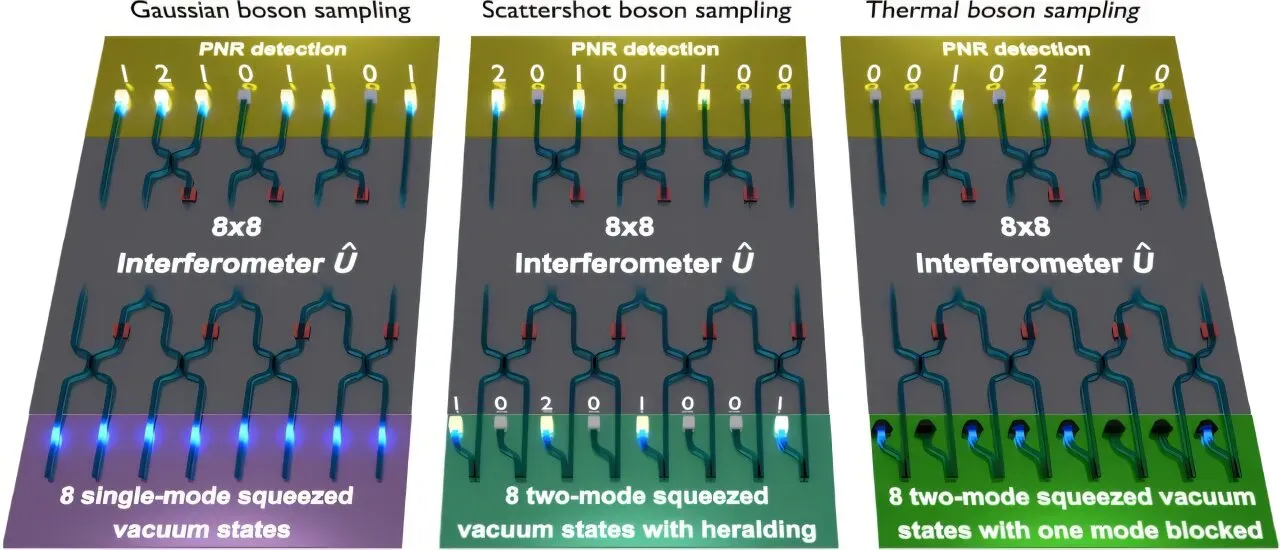
Researchers at Paderborn University in Germany have been exploring the potential of photonics-based quantum computers to tackle complex problems that are beyond the capabilities of even the most powerful supercomputers. These devices utilize the unique properties of light particles to perform calculations that would be impossible for traditional computers, opening up new avenues of research in fields like energy and chemical research.
The team, led by Dr. Christine Silberhorn, has been using Germany's first scalable photonic quantum computer, a "Gaussian boson sampler, to investigate the fundamental question of which quantum resources are most important for its performance. This device is designed to process and sample complex light patterns, but understanding how individual quantum resources contribute to its capabilities is crucial for optimizing its use.
The researchers have published their findings in the journal PRX Quantum, using data obtained from the Paderborn Quantum Sampler (PaQS). The new research builds on previous work demonstrating a large-scale quantum system, and takes a more nuanced approach by examining the individual components that enable the device's capabilities.
This investigation is an important step towards developing practical applications for photonics-based quantum computers, which could have significant impacts on various fields of study and industry. As researchers continue to refine their understanding of these devices, we can expect new breakthroughs in areas such as energy research, chemical analysis, and secure communication systems.
The development of the photonic quantum computer was made possible by combining expertise in integrated photonics from Paderborn with insights from computer science and theoretical quantum optics. This collaboration led to the creation of a flexibly programmable device based on scalable components, along with new methods for evaluating the role of various quantum resources in its performance.
Researchers working within a Germany-wide research collaboration made significant contributions to this project. They not only developed and integrated specialized hardware but also created novel data analysis methods and a theoretical framework for interpreting measurement results. This comprehensive approach is essential for advancing the field of quantum computing.
According to Dr. Michael Stefszky, understanding how properties such as squeezed light, photon statistics, and entanglement impact computational performance is crucial for developing the next generation of quantum technologies. The results underscore that building useful quantum computers involves far more than simply scaling up a system," he explains.
PaQS, a machine designed to sample Gaussian bosons, measures the points at which photons leave a complex photonic network through which they are guided. This task becomes increasingly difficult for conventional computers as the number of photons increases and the network complexity grows.
Determining these patterns can be computationally intensive, with simulations on a supercomputer taking thousands of years for large systems. The development of such devices like PaQS is crucial in advancing our understanding of quantum resources and their role in computational performance.
The PaQS system offers a high degree of programmability, allowing researchers to configure its photonic network for various experiments. This flexibility turns the system into an adaptable research platform rather than a single-purpose device. As a result, the team can explore new approaches and potential applications as the field of research continues to evolve.
The researchers are currently expanding the system to support more complex calculations and investigate further potential applications for photonic quantum computing. By doing so, they aim to contribute both a high-performance experimental system and new insights into the quantum resources that will shape the performance of future photonic quantum computers.
In their work, the Paderborn team is shedding light on the fundamentals governing the performance of photonic quantum computers.
Facts based on reporting originally published by Phys.org.
You may republish this story, in full or in part, if you credit News Central Site and link to it (licence CC BY 4.0). Photos are not included.