Drip Irrigation Method Found to Stabilize Crop Yields in Arid Regions
A new study has found that combining drip irrigation with additional watering in autumn or winter can help control soil salinity in northwestern China's arid regions.
A new study has found a way to ensure stable crop yields in arid regions by combining drip irrigation during the growing season with additional watering in autumn or winter.
The research, led by Professor Chen Yaning at the Xinjiang Institute of Ecology and Geography, suggests that this approach can help control soil salinity in northwestern China's arid regions. The study was conducted in collaboration with experts from the Chinese Academy of Engineering and the Xinjiang Agricultural University.
Drip irrigation has been widely used in northwestern China for over three decades to improve agricultural water-use efficiency and support more intensive crop production. However, concerns have been raised about its long-term effects on soil salinity.
The debate surrounding drip irrigation's impact on soil salinity centers around two opposing views. Some researchers argue that the lack of sufficient leaching and evaporation-driven salt accumulation can lead to secondary salinization in irrigated oases.
While others believe that drip irrigation effectively moves salts away from crop roots, thus maintaining a balance between salt accumulation and stable crop yields.
The researchers' systematic case analyses revealed a complex interplay between salt accumulation and crop yields under long-term drip irrigation in arid regions.
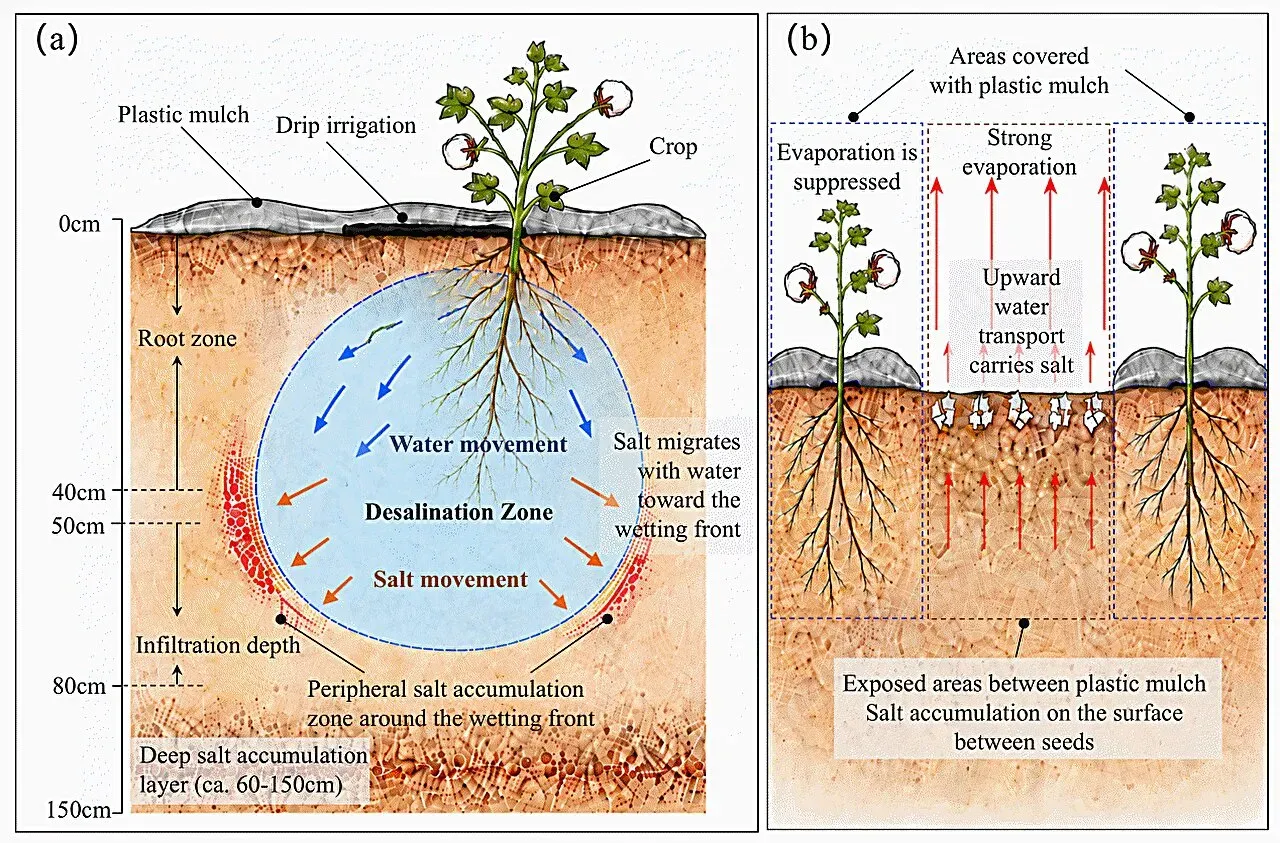
Salts carried by irrigation water can accumulate at the outer edge of the wetted zone, while evaporation causes salts to concentrate near the soil surface in exposed areas. This uneven distribution of salts increases the risk of secondary soil salinization when leaching is insufficient.
However, autumn or winter irrigation can help mitigate this issue by allowing water to infiltrate through the soil profile and push accumulated salts into deeper layers. Additionally, applying water at the soil surface enables it to redistribute through the soil during winter and spring freeze-thaw cycles.
The combination of these processes helps maintain a long-term balance between soil water and salt levels in the root zone, supporting the sustainability of drip irrigation and stable crop yields. This delicate equilibrium is crucial for arid regions where water scarcity is already a significant challenge.
Limited reservoir storage also influenced the use of winter irrigation for salinity control. With limited capacity to retain excess water, these reservoirs can only store part of the available winter water for the following growing season. Using this stored water for autumn or winter irrigation makes better use of scarce resources and provides an opportunity to manage soil salinity effectively.
Farmers in arid regions can maintain high crop yields under long-term drip irrigation by coordinating their water usage across seasons. This approach involves saving water during the growing season and using it for salt leaching during the off-season.
By pairing these two strategies, farmers can manage soil salinity effectively and make better use of scarce resources. This practical model offers a solution to irrigated agriculture in other arid regions where water conservation is crucial.
Facts based on reporting originally published by Phys.org.
You may republish this story, in full or in part, if you credit News Central Site and link to it (licence CC BY 4.0). Photos are not included.