Japan Launches Pioneering Spacecraft on Mission to Mars' Moon Phobos
The Japan Aerospace Exploration Agency is set to launch a spacecraft to collect samples from Phobos, one of Mars' two small moons.
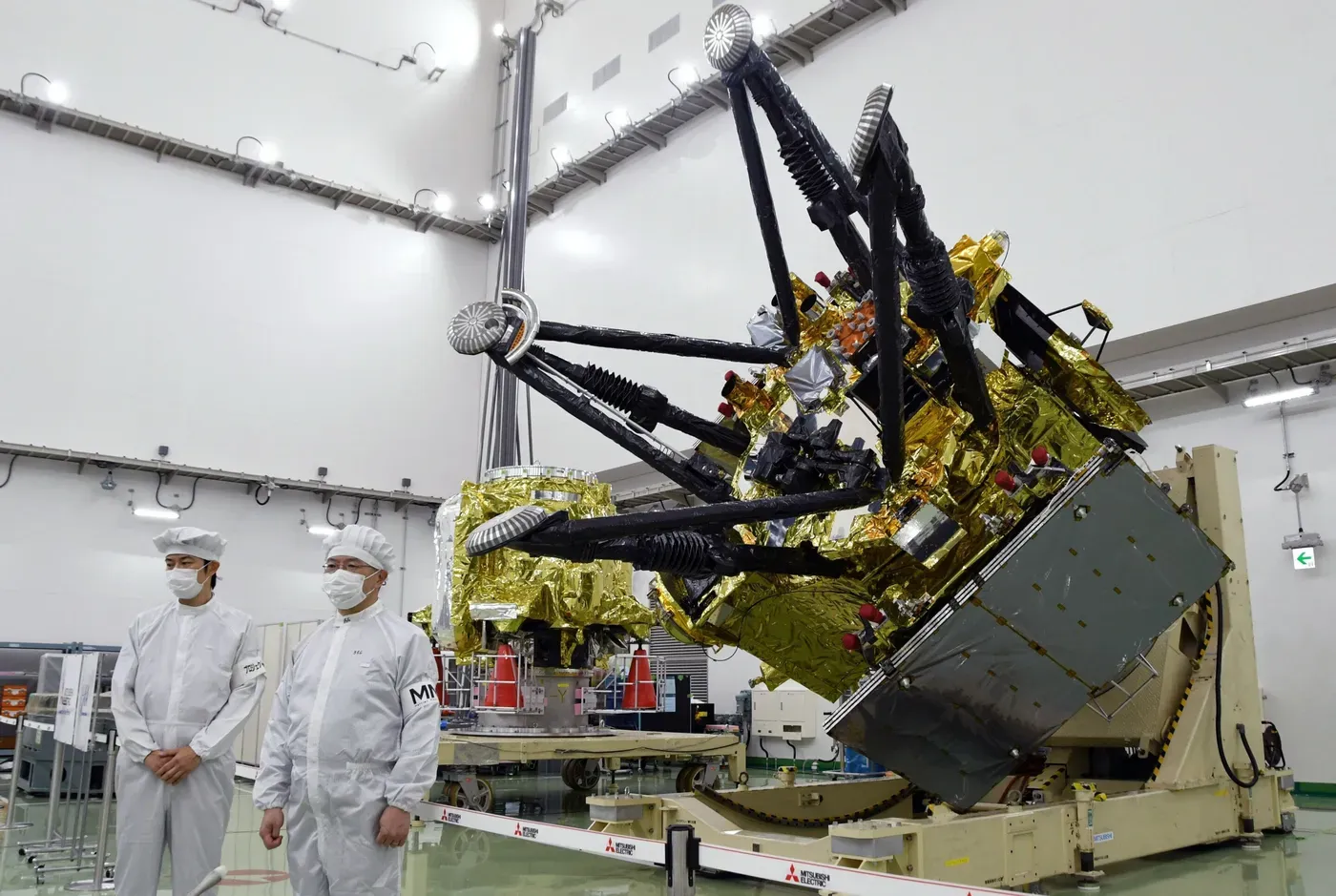
Japan is gearing up to launch a pioneering spacecraft on a historic mission to collect samples from Phobos, one of Mars' two small moons.
The ambitious five-year undertaking aims to uncover the secrets surrounding the formation of Phobos and its smaller sibling Deimos, as well as shed light on the origins of life in our solar system.
The Japan Aerospace Exploration Agency is set to launch the spacecraft using a new Japanese H-3 rocket, marking a significant milestone in space exploration.
As the world watches, other nations like the US, China, and others are also contemplating sending astronauts to Mars, with samples from Phobos potentially serving as crucial data for future crewed missions to the planet.
The Japanese space agency, JAXA, is leading an international mission that includes equipment and communications support from NASA and other national space agencies to collect samples from a Martian moon.
Phobos and Deimos, the two moons of Mars, have been largely unexplored despite numerous missions sent to the planet since the 1960s. These irregularly shaped bodies are thought to be either remnants of debris formed after a massive celestial object crashed into Mars or asteroids that originated elsewhere in the solar system.
Several attempts by Russia to land on Phobos have failed, including one in 2011, but Japan's mission is expected to shed light on the composition and formation of these enigmatic moons. Scientists believe that samples from Phobos will provide valuable insights into the history of Mars.
JAXA officials expect that material from Mars will make up about 0.1% of the material collected from Phobos, which will also include data on the Martian environment and potential biosignatures.
Phobos, one of two moons orbiting Mars, is a small celestial body approximately 20 to 30 kilometers in diameter and 6,000 kilometers away from Mars at its closest point.
The mission's scientists believe that samples collected from Phobos could provide valuable insights into the origin of Deimos, with both moons thought to share similar roots. This connection will be explored further through observations made during a flyby of Deimos as part of the mission.
The vast distance between Earth and Mars means that the spacecraft will have to travel an estimated 500-600 million kilometers to reach its destination. At their closest point, the red planet is approximately 55 million kilometers away from our planet.
After launching on the H3 rocket in the near future, the spacecraft will arrive at the Mars region around August 2027. Once there, it will spend three years gathering data and collecting samples from Phobos before embarking on its return journey to Earth in 2031.
The MMX spacecraft is composed of three modules: propulsion, exploration, and return. The third module will be responsible for bringing the samples back to Earth, stored in a capsule weighing approximately 5 tons.
The MMX spacecraft will collect soil samples from Phobos using a combination of U.S. and Japanese methods. The sampling attempts will involve collecting at least 10 grams of soil from two different locations on the Martian moon.
JAXA's coring method is designed to collect samples from a depth of about 2 centimeters, while NASA's device uses pressurized gas to lift surface dust into a container. This dual approach increases the chances of obtaining a representative sample and reduces the risk of contamination.
The first sampling attempt will involve collecting both surface and underground samples using both devices, followed by additional underground samples in the second landing. By collecting samples from multiple locations, scientists hope to obtain any potential traces of past microbial life on Mars.
The collected samples will be stored in a heat-protected capsule designed to withstand reentry into Earth's atmosphere. The capsule is expected to land in Australia before being sent back to Japan for further analysis and study.
The spacecraft will need to select a suitable landing site on the Martian moon Phobos based on topographical data provided by the rover, and then collect samples within a two-hour timeframe.
Landing on Phobos is particularly challenging due to its extremely low gravity, which is only one two-thousandth of Earth's. To mitigate this issue, the MMX's exploration module features four-legged landing gear with shock absorption capabilities. The rover itself has wheels designed for traction in low-gravity environments and can even right itself if it tips over, moving at a slow pace.
Facts based on reporting originally published by Phys.org.
You may republish this story, in full or in part, if you credit News Central Site and link to it (licence CC BY 4.0). Photos are not included.