Solar Power in Space Becomes Feasible with Advancements
Researchers are reassessing the feasibility of space-based solar power due to growing concerns about climate change and the need for renewable energy sources.
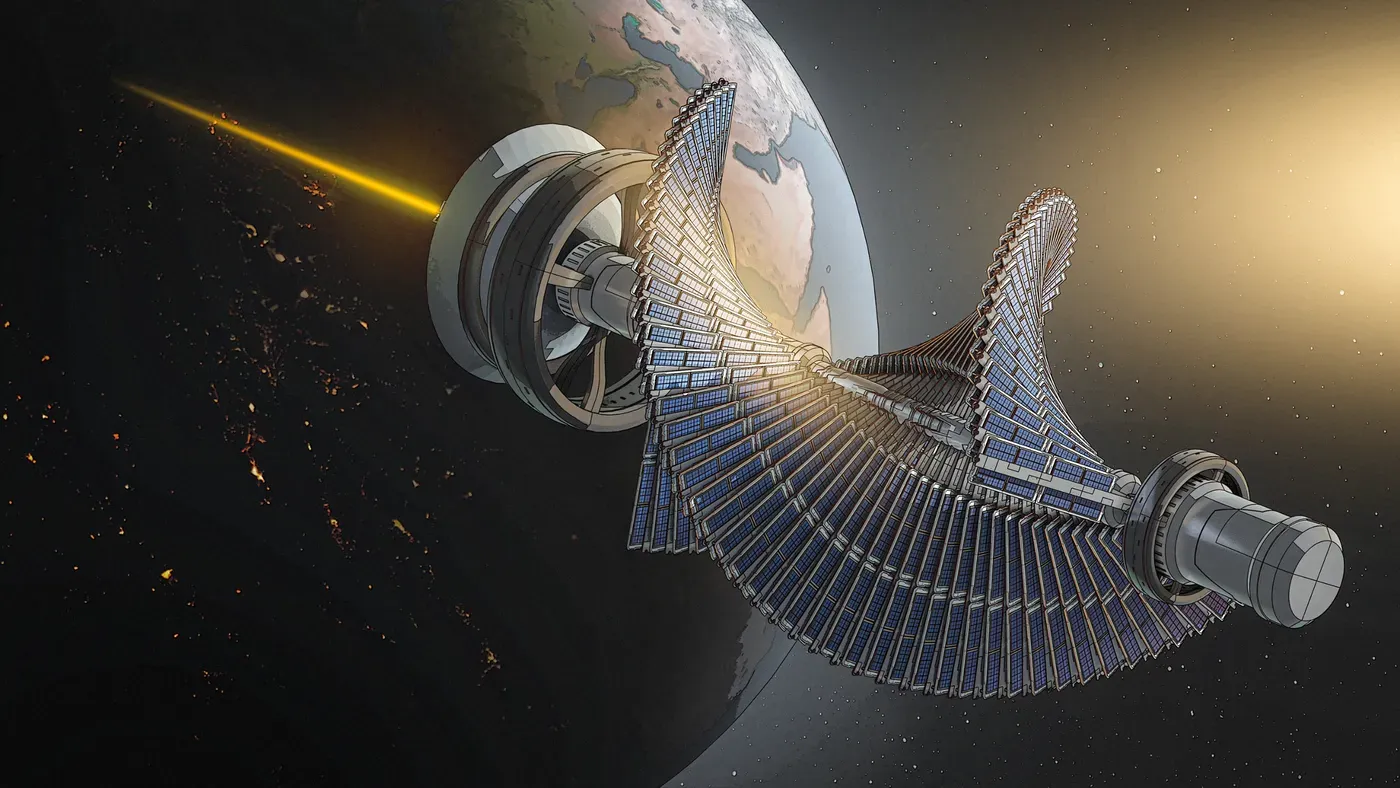
The concept of harnessing solar power in space has long been considered science fiction, but researchers are now taking a closer look at its feasibility. In the year 2050, satellite clusters will be harvesting the sun's rays and beaming them back to Earth as part of a project called space-based solar power (SBSP). This idea was once dismissed as impractical, but now several countries including the United States, Japan, China, and South Korea are developing projects with test launches planned for the next five years. Proponents claim that SBSP has the potential to meet global energy needs while causing minimal environmental harm.
The concept of space-based solar power originated in the 20th century as a techno-utopian idea popularized by writers and visionaries. However, for decades it was viewed with skepticism due to its perceived complexity and high costs. But researchers are now reassessing the feasibility of SBSP, driven by growing concerns about climate change and the need for renewable energy sources. While critics argue that the technology is still in its infancy and faces numerous challenges, proponents believe it has the potential to provide a sustainable solution to the world's energy needs.
The main challenge facing SBSP is getting the massive solar-panel-covered satellites into space, assembling them, and ensuring that the solar panels are constantly pointed at the sun. Additionally, researchers must find ways to convert, concentrate, and transmit the collected power back to Earth. These technical hurdles have led some critics to dismiss SBSP as a viable option for meeting the world's energy needs.
Despite these challenges, researchers continue to explore the potential of space-based solar power. One expert notes that the most crucial step in generating energy is already being done by the sun itself, which fuses hydrogen atoms every second to expel an enormous amount of energy equivalent to nine trillion atomic bombs. All that remains is to harness this energy and transmit it back to Earth.
The technology has the potential to provide a significant boost to renewable energy sources while minimizing environmental harm. According to proponents, SBSP can meet global energy needs many times over without causing pollution or contributing to climate change. However, critics argue that the high costs associated with launching and maintaining satellites in space will make it difficult for SBSP to become a viable option.
The development of SBSP is not intended to compete with fusion power but rather to provide an additional source of renewable energy. Researchers are working on several projects to overcome the technical challenges and bring this technology to fruition, with test launches planned for the next five years.
The concept of harnessing solar power in space has been around for nearly a century, and its origins can be traced back to Russian rocket scientist Konstantin Tsiolkovsky. In 1923, he proposed deploying space-based mirrors that could concentrate sunlight on Earth with enough intensity to boil water.
Tsiolkovsky's proposal was not just a theoretical concept; it was the result of his extensive work on designing steerable cargo airships. Although his designs for these vessels were never built, they laid the groundwork for future ideas in space exploration. His fascination with space travel and energy production would eventually influence the development of more advanced concepts.
In 1937, British writer Olaf Stapledon popularized the idea of using concentrated solar energy in his novel "Star Maker. He described an alien civilization harnessing escaping solar energy to focus it for intelligent use. This concept was later formalized by theoretical physicist Freeman Dyson as a Dyson sphere, which is essentially a massive structure that surrounds a star and captures its energy.
The concept of space-based solar power gained further traction in 1941 when science fiction writer Isaac Asimov published his short story Reason. In the tale, a robot colony operates on a power station that collects solar energy and beams it back to Earth as microwaves. While Asimov's focus was on the robots' worship of their vessel rather than its engineering details, he laid the groundwork for future proposals.
The transformation from science fiction to concrete proposal happened relatively quickly. In 1968, aerospace engineer Peter Glaser developed an engineering design for a solar power satellite. His concept consisted of three key elements: a ray-collecting device, a converter and a transmitter. The collector was designed as a disk of photovoltaic panels that would be placed 22,400 miles off the ground.
The distance of 22,400 miles is crucial in understanding Glaser's design. It is far enough away from Earth to allow for efficient energy transmission back to our planet while minimizing interference with other space-based systems.
The satellite would be situated in a geostationary orbit above Earth, allowing it to harness solar energy continuously while minimizing interference with other space-based systems. Its location also enables efficient transmission of energy back to our planet.
Once the energy is harvested and converted into microwaves, it will be transmitted through the atmosphere to receiving antennae on the ground. These antennae would then convert the microwaves back into electricity for distribution across the grid.
The assembly of the satellite's microwave transmission antenna has been completed, showcasing one of its key components. This technology is crucial for transmitting energy from space to Earth with minimal loss or interference.
Despite initial promise, Glaser's design faced significant technical and financial challenges due to its enormous size. A study by the Department of Energy estimated that a meaningful contribution of 300 gigawatts would require 60 satellites, each spanning over 21 square miles and weighing 50,000 tons.
This massive scale made the project unaffordable, and subsequent assessments continued to raise doubts about the feasibility of space-based solar power. However, some reports suggested that advances in technology could make the concept more viable.
Advances in rocketry and satellite manufacturing have led to a decrease in costs, with reusable rockets like SpaceX's Falcon 9 reducing launch expenses significantly. This shift has also made satellites cheaper due to mass production and improved clean room facilities.
The development of space-based solar power (SBSP) technology is gaining momentum, and several companies are working on satellite designs that can harness unlimited energy from the sun in orbit around the Earth.
SpaceX's Starship rocket, which is currently under construction, promises to significantly reduce the cost of launching satellites into space. With a payload capacity more than five times greater than its Falcon rocket, SpaceX aims to make space travel even more affordable and accessible.
The SBSP concept involves beaming energy from a satellite in orbit around the Earth back to the planet's surface using microwaves or lasers. This technology has been deemed feasible by experts, who believe it could provide a reliable source of renewable energy without any greenhouse gas emissions.
Several companies have received funding to develop SBSP technology, including Space Solar, which is working on a satellite design that can generate 2 gigawatts of constant power from solar radiation. The company's design, called CASSIOPeiA, uses a unique shape and sun-synchronous orbit to maximize energy collection without the need for moving parts.
The CASSIOPeiA design is based on a concept known as a giant DNA strand," which allows the satellite to constantly receive and transmit solar energy. This innovative approach has been chosen as the reference architecture by experts, who believe it could be an efficient way to harness solar power in space.
SBSP technology has several advantages over traditional forms of renewable energy, including lower costs and the ability to generate power in remote locations. While the initial investment may seem high, the long-term benefits of SBSP could make it a cost-effective option for countries looking to transition away from fossil fuels.
The efficiency of space-based solar power systems is significantly improved once the satellite reaches orbit, as it avoids the limitations imposed by the Earth's atmosphere.
Unlike terrestrial solar panels, which are subject to deflection and attenuation caused by atmospheric conditions, the light hitting a space-based power station remains unimpeded, allowing for more efficient energy production.
This advantage translates into reduced material requirements and optimized use of resources, according to Sam Adlen, co-founder and co-CEO of Space Solar, one of the companies involved in developing this technology.
However, the process of beaming down gigawatts of energy from space remains a significant technical challenge, with multiple methods being considered for its implementation.
One approach involves using lasers to transmit energy across vast distances, while another utilizes microwaves to achieve the same goal.
The microwave transmission method has shown promise in laboratory settings, with some companies demonstrating the feasibility of beaming kilowatts of power from orbit or even from an airplane.
The development of space-based solar power systems is gaining momentum, with several projects worldwide opting to use microwave-beaming technology to transmit energy back to Earth.
This approach has its limitations, however, as microwaves have longer wavelengths compared to other forms of electromagnetic radiation, causing their beams to diffract more widely over distance. As a result, Earth-based receivers would need to be enormous, covering dozens of square miles, to capture the transmitted energy effectively.
The scale of transmitters required for microwave-beaming is equally impressive, with current technology necessitating massive constructions in space to successfully beam microwatts to larger receivers on Earth.
Despite these challenges, researchers remain optimistic that advancements in power-beaming efficiency will eventually overcome the hurdles, paving the way for gigawatt-scale energy transmission from space.
Facts based on reporting originally published by Live Science.
You may republish this story, in full or in part, if you credit News Central Site and link to it (licence CC BY 4.0). Photos are not included.