FAST radio telescope discovery
Astronomers have made a groundbreaking discovery using China's FAST radio telescope, detecting a compact cloud of hydrogen without any visible stars or galaxy surrounding it.
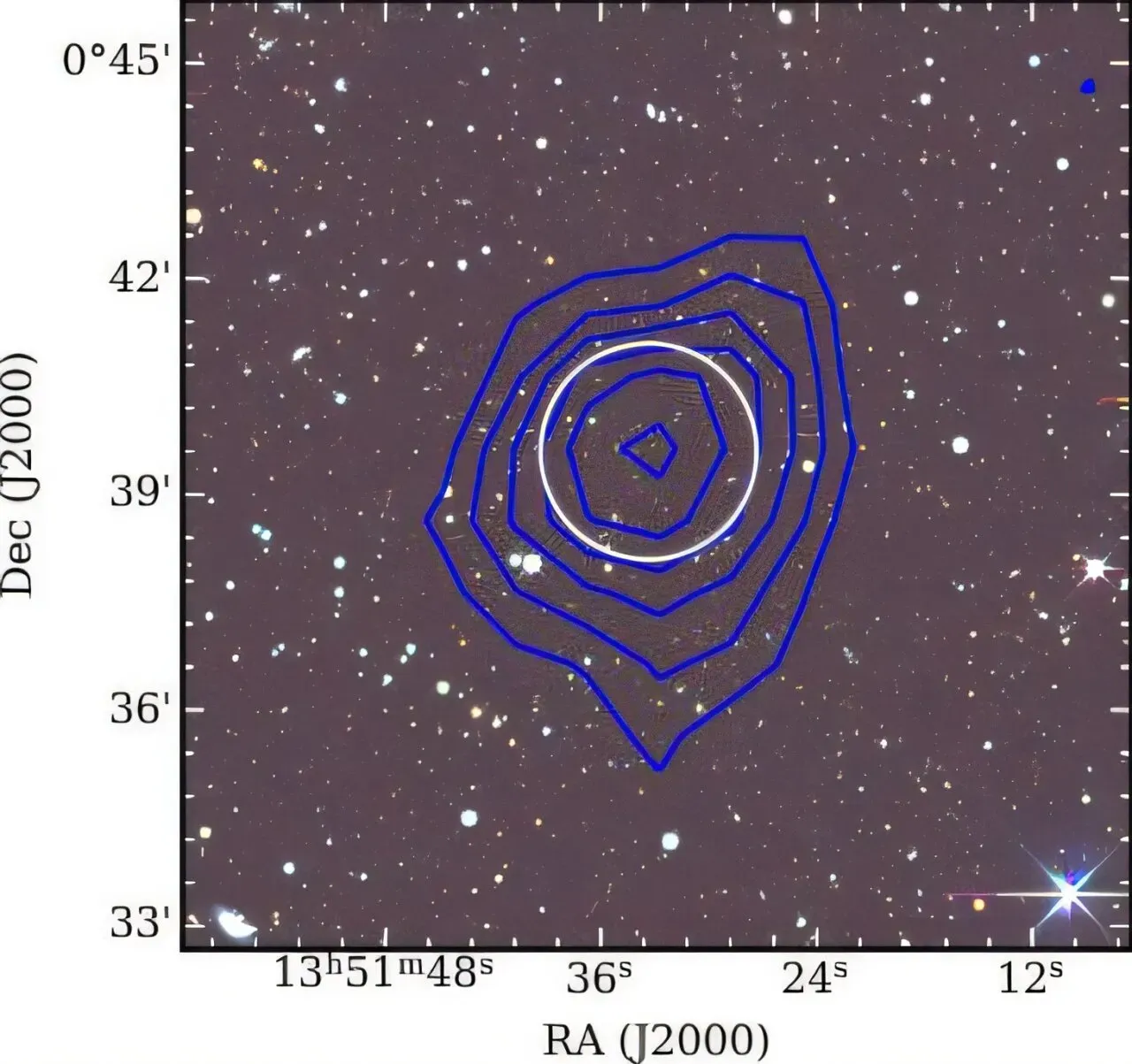
Astronomers have made a groundbreaking discovery using China's FAST radio telescope, detecting a compact cloud of hydrogen without any visible stars or galaxy surrounding it.
The newly found cloud is an astonishing 500,000 times more massive than the sun and consists almost entirely of neutral hydrogen, fueling speculation that it might be one of the strongest candidates yet for an isolated "dark galaxy.
According to the lambda cold dark matter (ΛCDM) model, structure in the universe forms through a hierarchical process: small dark matter halos form first and merge to create larger ones, ultimately giving rise to galaxies.
The model also predicts that some low-mass halos are incapable of forming stars due to various processes, including heating of gas by the ultraviolet (UV) background radiation from quasars and galaxies.
A lone neutral hydrogen cloud has been identified in a vast, starless region of space, prompting scientists to speculate that it may be a dark galaxy. To distinguish this phenomenon from faint dwarf galaxies, astronomers must carefully examine the light emitted by the neutral gas.
Researchers led by Jin-Long Xu have been studying an isolated cloud called J1351+0039, which was discovered in a blind H I survey using the Five-hundred-meter Aperture Spherical radio Telescope (FAST). The team's investigation revealed that this cloud is truly isolated, with no large galaxies within 100 kiloparsecs and a system velocity of less than 250 kilometers per second.
To gather high-quality data on J1351+0039, the researchers observed it three times between July and August 2026. Their observations ruled out several possible explanations for the cloud's existence, including tidal interactions with nearby galaxies or other massive objects. The study also revealed a total mass of approximately 130 million suns.
Further analysis of the cloud's dynamics is necessary to determine its true nature and whether it indeed represents a previously unknown type of galaxy.
The isolated cloud J1351+0039 has been found to have a mass that is largely attributed to dark matter, making it an ideal candidate for either a relic of a large halo of ionized gas (RELHIC) or an ultra-faint galaxy.
Its round shape and positive velocity suggest that it may be a dark galaxy, one that has never cooled enough to form stars. This is evident from its equilibrium temperature with the ultraviolet background, which stands at around 10,000 Kelvin.
The cloud's motion characteristics are also telling. Unlike rotationally supported disk galaxies, J1351+0039 shows weak rotation. The gas within it rotates at a relatively slow pace of about 4.2 kilometers per second, while its random motions reach speeds of approximately 11.6 kilometers per second.
These findings indicate that the cloud's structure is held up mainly by the outward pressure exerted by its randomly moving gas. This pressure-supported nature suggests that J1351+0039 may be a RELHIC that has gradually acquired angular momentum over time.
The isolation of J1351+0039 from other galaxies makes it a standout candidate for a dark galaxy.
Unlike previous examples of dark galaxies that were found in proximity to massive galaxies, J1351+0039 stands alone in the vast expanse of space.
Its complete isolation is a crucial factor in making it the most compelling and cleanest isolated RELHIC candidate discovered so far.
This discovery suggests that J1351+0039 may be a dark" galaxy that has been accumulating angular momentum over time due to internal processes.
Facts based on reporting originally published by Phys.org.
You may republish this story, in full or in part, if you credit News Central Site and link to it (licence CC BY 4.0). Photos are not included.