Groundbreaking Discovery Made in Brazilian Fossil
A team of scientists has found evidence of ancient blood in a 115 million-year-old dinosaur fossil, suggesting that remnants of red blood cells and heme are present.
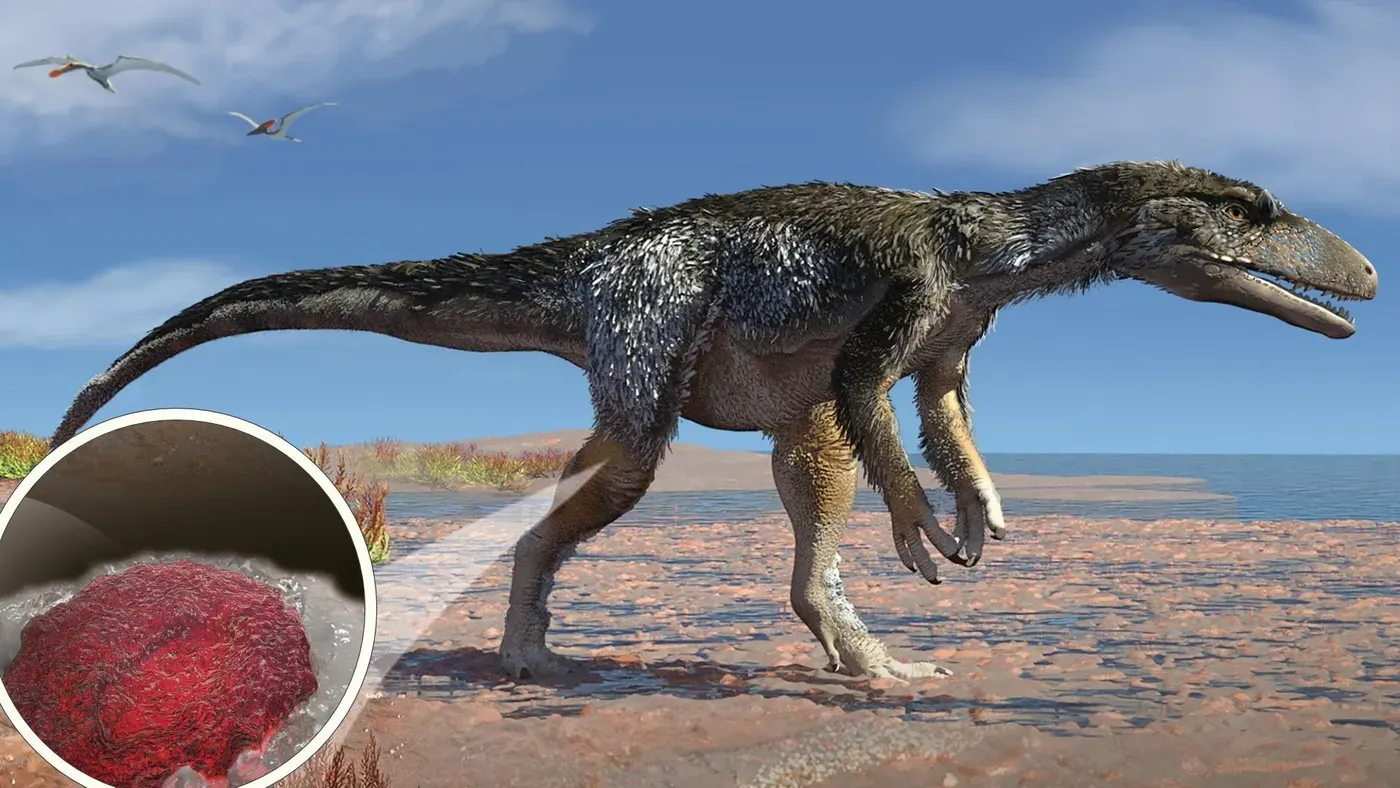
Scientists have made a groundbreaking discovery in Brazil, uncovering evidence of ancient blood in a 115 million-year-old dinosaur fossil. The findings, published in a leading scientific journal, suggest that the fossil contains remnants of red blood cells and the chemical signature of heme, a crucial component of hemoglobin.
However, not everyone is convinced by the research team's conclusions, with some experts questioning the shape of the microscopic structures found in the fossil. According to them, these structures do not resemble those typically associated with reptilian red blood cells.
The study's researchers used chemical processes to identify heme-based signatures in the dinosaur bones, a method that has previously been successful in detecting blood in fossils. The new findings come from a roughly 10-foot-long dinosaur called Aratasaurus museunacionali, whose limb bones were found to contain the microscopic structures and chemical signs of ancient blood.
The research team believes that exceptionally preserved fossils like this one can hold secrets about the original organism, going beyond traditional methods of studying bones, teeth, and shells.
The research team's initial focus was not on tracing ancient blood within fossils, but rather on understanding how much of an organism's original biology can survive fossilization over time.
To address this question, they chose to study a specific type of dinosaur: the small theropod A. museunacionali from Brazil's Early Cretaceous period.
Theropods were primarily meat-eaters and walked on two legs, with notable examples including the likes of Tyrannosaurus rex and Velociraptor.
The team conducted microscopic and chemical analysis on the limb bones of this small theropod dinosaur, revealing numerous tiny structures within vascular canals that once housed blood vessels.
These structures' shape, size, and location were consistent with those found in red blood cells.
The preservation conditions for the theropod dinosaur fossil are believed to have played a crucial role in maintaining the integrity of its internal structures.
Rapid burial by sediment in an environment with low oxygen levels and microbial mats may have hindered the normal decomposition process, allowing microscopic details like vascular structures and red blood cells to remain intact.
An illustration shows how these conditions could have protected the fossil's remains, with a layer of biofilm covering the bones after death (Image credit: Victor O. Leshyk).
The presence of hausmannite, a manganese oxide mineral, in the "red-blood-cell-like" structures further supports the idea that they are genuine remnants from 115 million years ago.
The discovery also includes preserved amino acids associated with collagen, the primary structural protein found in bone tissue.
A molecular paleontologist not involved in the study has expressed admiration for the team's rigorous approach to analyzing deep-time fossils, but some remain skeptical about the findings.
The discovery of ancient blood cells in a 115 million-year-old dinosaur fossil has sparked debate among experts about the validity of these findings.
Schweitzer, an expert on fossilized blood cells, has expressed concerns that the microstructures identified as red blood cells do not match the expected appearance of these cells in non-mammalian animals. She notes that unlike mammalian red blood cells, those found in birds and reptiles retain their nuclei during development, which typically produces a characteristic nuclear bulge.
The shape and size of the structures in question also raise questions about their identification as fossilized blood cells. According to Schweitzer, they have a concave shape with no nuclear bulge, unlike typical non-mammalian red blood cells. Additionally, these microstructures are smaller than most non-mammalian red blood cells.
The debate surrounding this discovery highlights the challenges of identifying and interpreting ancient biological molecules in fossilized remains. While some experts may be convinced by the team's rigorous approach to analyzing deep-time fossils, others remain skeptical about their findings until more evidence is presented to support them.
The researchers' approach has been met with a mix of enthusiasm and skepticism from experts in the field. Some have suggested that alternative analytical techniques, such as resonance Raman spectroscopy, could provide more conclusive evidence.
Schweitzer's team had previously employed this method to detect heme in dinosaur tissues, recovering samples from Brachylophosaurus canadensis and Tyrannosaurus rex in 2025. Despite not using the same methods, Schweitzer expressed support for the research's direction, praising the authors' use of technological innovations.
Facts based on reporting originally published by Live Science.
You may republish this story, in full or in part, if you credit News Central Site and link to it (licence CC BY 4.0). Photos are not included.