Canada Drops Plan for EU Associate Membership in New Relationship Deal
A joint declaration outlines plans for a closer relationship between Canada and the European Union without associate membership.
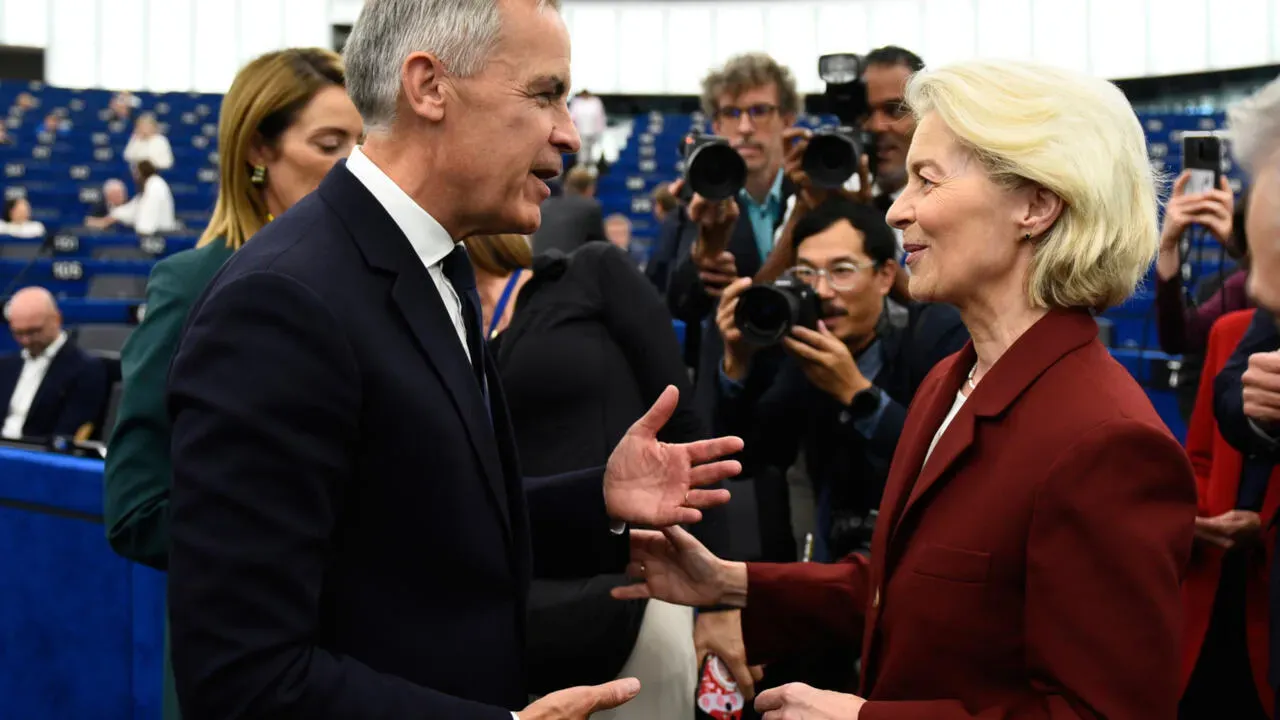
Canada and the European Union have decided to pursue a closer relationship without the option of associate membership in the EU. This decision comes ahead of a summit in Montreal hosted by Canadian Prime Minister Mark Carney, which is set to take place on Thursday.
The joint declaration seen by Reuters outlines plans for "ever closer association between Canada and the EU, but drops the contentious proposal for associate membership that was put forward by European Commission President Ursula von der Leyen six weeks ago. The idea of associate membership had been met with resistance from some EU countries, including Germany, which argued it had no legal status and needed further clarification.
The decision to abandon associate membership is part of a broader strategy by Prime Minister Carney to reduce Canada's reliance on the US. This effort is driven in part by President Donald Trump's imposition of tariffs on Canadian goods, which has highlighted the need for alternative economic partnerships.
Deeper ties with Europe are seen as key to achieving this goal, but they also risk straining relations with the US. As trade talks between Canada and the US continue, it remains to be seen how this new approach will be received by President Trump's administration.
The next steps in defining the Canada-EU relationship will be taken over the coming months, with another summit scheduled for next year. Work on this relationship is expected to continue until then, building on the foundations laid out in the joint declaration.
The EU's decision to drop plans for an associate membership status with Canada is a significant development in their bid to deepen ties between the two entities.
This move comes after previous criticism from US officials, including Trump, who described the proposal as laughable and warned that it could lead to trade restrictions if interpreted as a hostile act.
The EU's efforts to establish a closer relationship with Canada have been ongoing for some time, and this week's summit is seen as an opportunity to launch further formal negotiations on key issues such as trade and investment.
According to Mark Carney, one of the architects of the new partnership, the focus will be on making tangible improvements in people's lives through increased economic cooperation and improved connectivity between Europe, Canada, and Asia.
The Canada-EU summit has raised questions about the true intentions behind Canada's bid to strengthen ties with Europe. Former Finance Ministry adviser Julian Karaguesian describes the summit as a bit of a show, suggesting that Canada's efforts to deepen its relationship with the EU are unclear.
According to Karaguesian, increased collaboration between Canada and the EU would not necessarily address the need for Canada to diversify its relationships, given that the US accounts for nearly 70% of Canadian exports. In contrast, the EU represents only about 9% of Canada's total trade, highlighting the significant imbalance in their economic ties.
The summit statement emphasizes the importance of a rules-based international order and expresses regret over the US sanctions imposed on the Netherlands-based International Criminal Court. However, some critics argue that this rhetoric rings hollow, particularly given the current tensions between the US and Europe.
International trade lawyer Barry Appleton agrees with this assessment, describing the EU's emphasis on multilateralism as like sticking a finger into President Trump's eye. This suggests that the EU's efforts to promote international cooperation may be seen as provocative by some in the US.
The decision by Canada and the EU to abandon associate membership plans is seen as a step towards strengthening their ties, but it may also be perceived as provocative by some in the US. This perception stems from the fact that the two parties have agreed to work closely on economic security measures, which might not sit well with Washington.
Critics argue that this move could potentially anger the US, particularly given the EU's commitment to implementing similar digital regulations. The EU-style rules are viewed as a trade barrier by some in the US, and Canada's willingness to align its AI and digital policies with those of Europe may be seen as an attempt to circumvent these restrictions.
The development has been met with enthusiasm from EU officials, who describe it as a historic milestone" in the partnership between the two entities. They emphasize that all member states are on board with fostering the closest possible relationship with Canada, marking a new chapter in their collaborative efforts.
Facts based on reporting originally published by France 24 English.
You may republish this story, in full or in part, if you credit News Central Site and link to it (licence CC BY 4.0). Photos are not included.