US and Japan Agree on Joint Missile Production Facility
Details of the agreement remain scarce, with Japanese Defense Minister Shinjiro Koizumi refraining from elaborating on specifics during his announcement.
The United States and Japan have reached an agreement to set up a facility in Japan for producing medium-range air-to-air missiles. The joint production effort is part of a growing defense alliance between the two countries, which are increasingly concerned about China's expanding military presence in Asia.
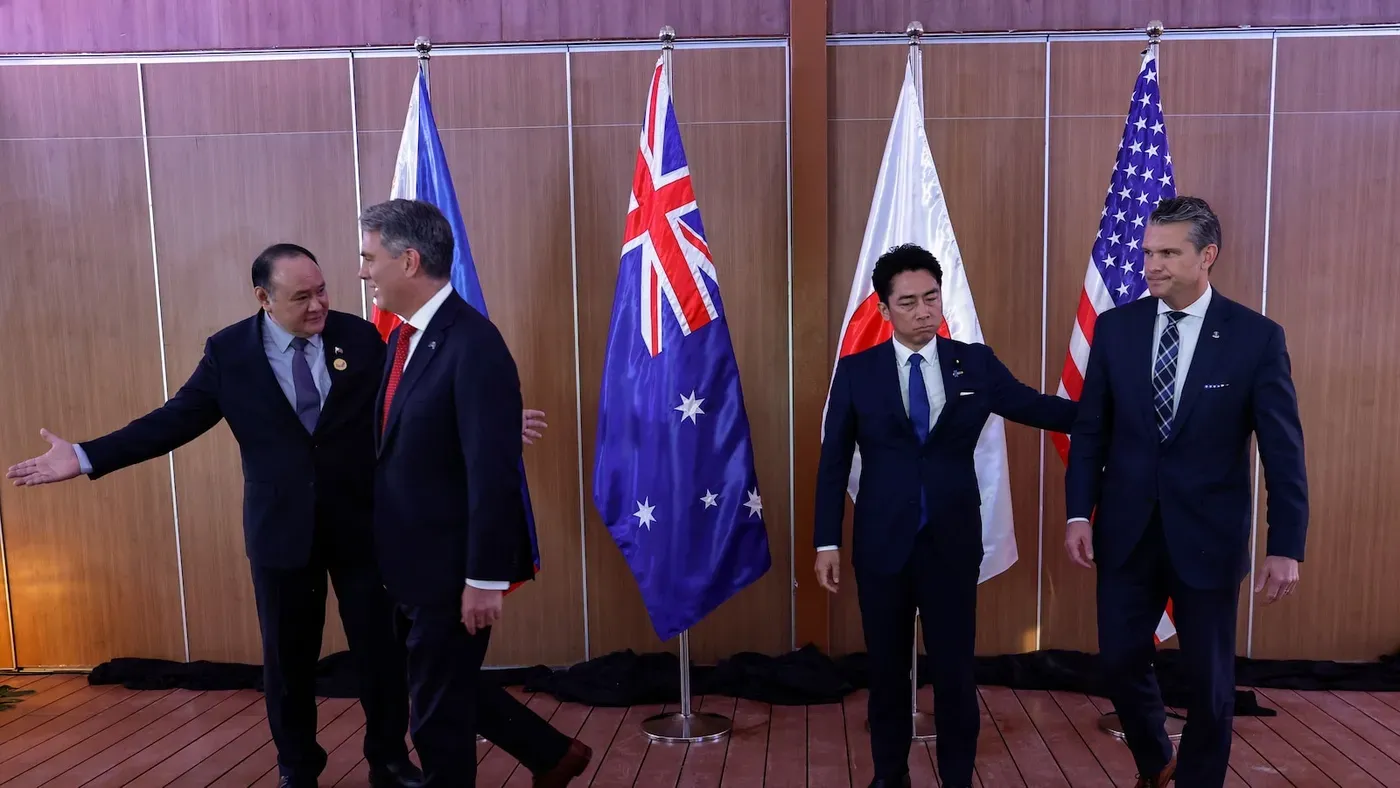
Japanese Defense Minister Shinjiro Koizumi announced the plan during a news conference in Cebu, where he met with US Defense Secretary Pete Hegseth on the sidelines of an annual regional security meeting. The gathering aims to prevent major conflicts and strengthen defense cooperation among participating nations.
The missile production facility is part of a joint initiative called "Operation Supercharge, which will provide essential components for the F-35 fighter jets used by both countries' militaries. The F-35 is one of the world's most advanced aircraft, known for its cutting-edge technology and capabilities.
Details about the agreement remain scarce, with Koizumi refraining from elaborating on the specifics during his announcement.
The agreement between the US and Japan to strengthen their alliance has taken on a new dimension. Koizumi shared his concerns about the deteriorating regional situation with Hegseth in Cebu, emphasizing the need for increased deterrence and response capabilities.
Koizumi also highlighted the importance of maintaining a free and open international order based on the rule of law during his meeting with Hegseth. This principle is crucial in preventing any attempts to alter the status quo through force or coercion. The discussions between Koizumi and Hegseth focused on strengthening their alliance, rather than targeting specific countries.
Hegseth met separately with ASEAN defense ministers, led by Philippine Defense Secretary Gilberto Teodoro Jr., to reaffirm the US commitment to regional security. Like Koizumi, Hegseth chose not to mention any specific country in expressing his concerns about aggression in the region.
The US is taking a measured approach to deterrence, according to Hegseth. He described their strategy as strong, quiet and clear," which aims to prevent unnecessary escalation or public posturing. This approach is designed to convey a clear message to both friends and adversaries.
Hegseth emphasized that the US will defend its interests and those of its allies and partners in the region. His message is intended to be clear and unambiguous, leaving no doubt about the US stance on regional security issues.
The US has reaffirmed its commitment to defending the Philippines against any military aggression, particularly in the South China Sea where China's claims have led to heightened tensions with neighboring countries.
The Philippines is a long-standing ally of Washington and is among several nations that have overlapping claims in the South China Sea, along with Vietnam, Malaysia, Brunei, Taiwan, and China itself. Beijing's assertion of control over virtually the entire waterway has sparked confrontations with coast guard and navy vessels from other countries.
Washington has made it clear that it will defend its ally if Filipino forces come under attack, including in disputed territories such as shoals and outlying waters in the South China Sea. This stance reflects the US commitment to maintaining regional stability and security.
The issue of maritime territory is also contentious between Beijing and Tokyo, with both sides accusing each other of encroaching on their respective claims in the East China Sea.
Facts based on reporting originally published by ABC News International.
You may republish this story, in full or in part, if you credit News Central Site and link to it (licence CC BY 4.0). Photos are not included.