California Foragers Gather Sea Urchin Along Sonoma Coast
A group of foragers has gathered in Sea Ranch to hunt for sea urchin along the Sonoma coast.
A group of foragers has gathered in Sea Ranch, a small town north of San Francisco, to hunt for sea urchin along California's Sonoma coast. The mission is to disturb the tide pools at low tide and search for the prized purple creatures.
The rugged coastline of Sonoma offers a unique landscape where fog-pressed hills tumble into the Pacific Ocean, creating an environment perfect for marine life. The area's remote location makes it an ideal spot for those seeking to connect with nature and try their hand at foraging.
As we arrived at Pebble Beach, the tide pools were covered in shaggy mats of kelp and bundles of seaweed. Amidst this blanket of vegetation, a colorful array of marine creatures emerged from the shadows - sea stars, anemones, crabs, and abalone made their presence known.
Our guide for the day is Nathan Maxwell Cann, a self-proclaimed 'kelp guy' with extensive knowledge of tidal foraging. He has worked in restaurants in Northern California but caught the bug to forage for seaweed and urchins a few years ago.
Nathan took us through the principles and practice of sea urchin gathering, his explanation delivered with ease and self-deprecating humor reminiscent of a former bartender. His passion for this unique pursuit is evident as he shares his expertise with our group.
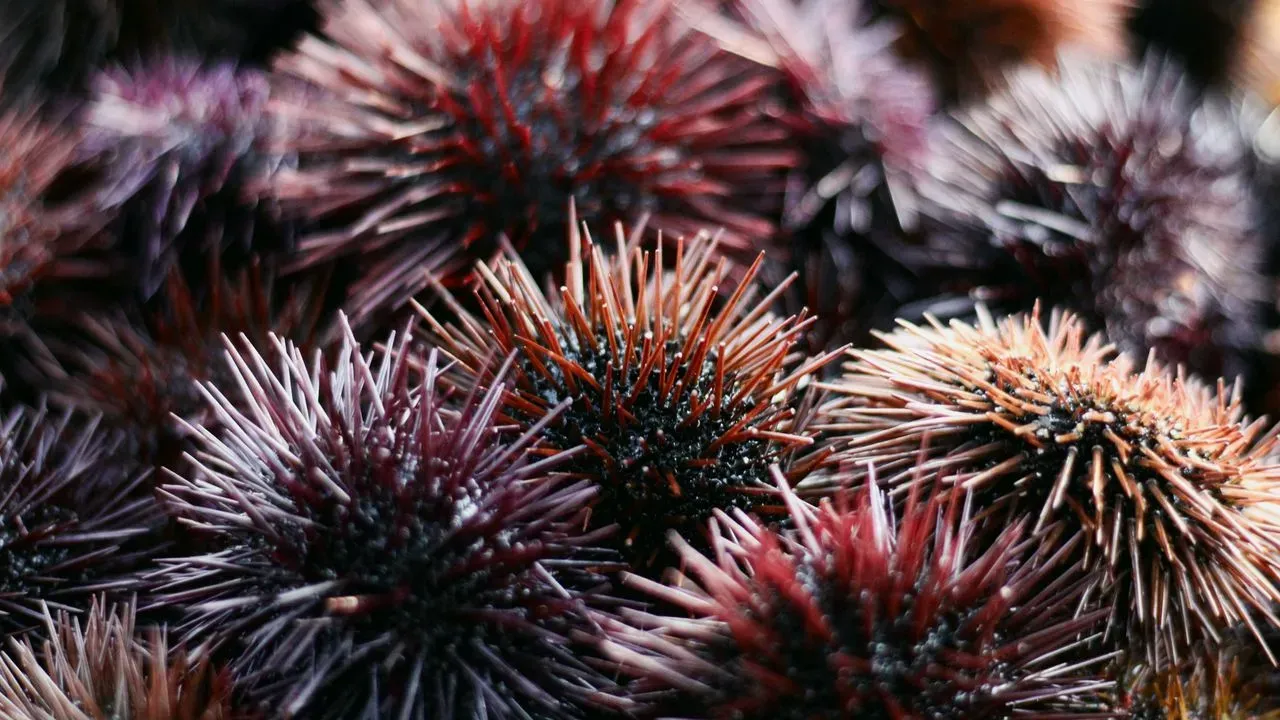
As Nathan spoke, we caught glimpses of our prey - curled-up hedgehogs, their purple spikes projecting outward from a roughly hemispherical shell known as the test. Most urchins are between the size of a golf ball and a fist in length.
Their distinctive features include a malevolent-looking mouth armed with five overlapping teeth for grinding and shearing kelp. When underwater, the flare of spines creates dark starbursts against the rock, making it difficult to spot them at first glance.
The longer you observe the tide pools, however, the more urchins become visible; what initially appear as shadows resolve into potential pickings, far outnumbering what could be taken by hand. The challenge is clear - we have a bounty of sea urchin waiting for us, but can we harvest them sustainably?
The sheer numbers of purple sea urchins along California's Sonoma Coast are staggering, and this is just one example of a much larger issue affecting coastlines around the world.
Whole areas where kelp forests once thrived are now nothing but vast expanses of urchin barrens, devoid of any other marine life. This phenomenon can be seen in several locations, including Alaska, Tasmania, New Zealand, South Africa, and many others.
The proliferation of purple sea urchins has reached alarming levels, to the point where they have become an overabundance rather than a rare delicacy. In fact, some areas are now plagued by an excess of these prickly creatures.
My own experience with sea urchins was quite different from what I see today. As a commis chef in a London restaurant, I used to clean urchins for the kitchen staff, carefully removing their spines and preparing them for serving. At that time, urchins were considered a luxury item, prized for their delicate roe.
However, my perspective on sea urchins shifted when I began researching the history of California's ocean and its impact on human life. The story of the state's marine ecosystem is complex and multifaceted, with humans and marine creatures influencing each other in intricate ways.
In recent years, the purple sea urchin has emerged as a major player in this drama, albeit not necessarily a heroic one. By devouring kelp forests at an alarming rate, they are leaving behind barren landscapes that have far-reaching consequences for the entire ecosystem.
The loss of kelp forests is particularly concerning because these underwater ecosystems support an incredible array of marine life, from tiny sea snails to large harbor seals. The balance between humans and the ocean has been disrupted, and it's now up to us to find a solution to this pressing problem.
The purple sea urchin's voracious appetite for seaweed is a major concern along California's Sonoma Coast, where unchecked grazing can lead to the destruction of kelp stipes and their eventual drifting away into the open ocean.
Historically, predators have kept urchin numbers in check, but few species possess the necessary tools to tackle these prickly creatures. Sea stars and sea otters are among the few exceptions, capable of overcoming the urchins' formidable defenses through different means.
Sea stars employ a unique digestive strategy to break down their prey, releasing digestive juices that dissolve the edible parts before ejecting the empty shells. In contrast, sea otters rely on brute force, using their powerful jaws and teeth to bash and bite their way through the urchin's protective armor.
The Sonoma Coast has been without its natural sea otter predators for over 150 years, a consequence of the devastating fur trade that decimated California's sea otter population in the early 19th century. The loss of these apex predators has allowed urchin numbers to balloon, contributing to the degradation of kelp forests and disrupting the delicate balance of marine ecosystems.
In recent years, another significant threat has emerged: a mysterious disease known as sea star wasting disease, which has decimated sea star populations along the California coast. This affliction, exacerbated by rising ocean temperatures, has left many stars lethargic and disfigured, with lesions spreading across their bodies and their arms falling off or disintegrating.
The collapse of sea star populations has created a power vacuum that urchins are now exploiting to devastating effect. As the primary predators of urchins, sea otters have been absent from this ecosystem for far too long, leaving a critical gap in the food chain that must be addressed through human intervention.
To mitigate this problem, a group of volunteers has taken on the role of "otter substitutes," tasked with manually harvesting urchins to maintain a balance between these marine creatures and their prey. This process requires a great deal of skill and attention to detail, as foragers navigate the rocky intertidal zone in search of suitable specimens.
As you immerse yourself in the activity, a sense of focus takes hold, punctuated by moments of childlike excitement as you spot the prized purple sea urchins.
Compared to other forms of foraging, collecting these creatures is surprisingly straightforward and effortless.
The enthusiastic group of ocean enthusiasts, mostly Californians from the Bay Area and beyond, quickly fill their coolers and bags with their catch, despite being novices in urchin gathering.
Their motivations are mixed, with half eager to savor the fresh seafood and the other half driven by the thrill of the hunt itself.
Once you become attuned to the distinctive color and shape of the sea urchins, they seem ubiquitous in the intertidal zone.
Picking them up from their nooks requires a gentle grasp and a slight wiggle with a pair of tongs, making it a relatively simple task.
The true challenge lies not in finding the urchins but in maintaining one's balance on the slippery kelp-covered rocks, which seem to shift beneath your feet as the ocean pulls at your ankles.
As my net bag grows heavy with spines, I find myself becoming increasingly enthralled by the teeming life of the tide pools, from the scuttling hermit crabs fleeing my shadow to the intricate patterns of anemones' tentacles.
The flavor of the sea urchin roe is nothing short of exceptional, boasting a rich, buttery taste that shifts from savory and briny to sweet. This distinctive umami flavor is directly attributed to the kelp the urchins feed on.
As we continue our foraging expedition along California's Sonoma Coast, the morning chill is starting to wear off, but the experience remains invigorating, especially at this early hour of 8:15 am.
The unique taste of the sea urchin roe is inextricably linked to its place of origin. This is a fact that chef Ryan Seal at the Sea Ranch Lodge has taken to heart, using the delicacy as the base for his sea urchin zabaglione carbonara.
Back on the shore, we've made good progress opening more urchins and savoring their meat, but despite our efforts, our bags are still overflowing with the spiny creatures. It's clear that even with our combined efforts, we're making only a small dent in the cove's urchin population.
The sheer abundance of sea urchins along this stretch of coast is a testament to their resilience and adaptability. While we may be having fun foraging for them, it's worth noting that our impact is relatively minor compared to the natural predators that inhabit this ecosystem.
In fact, from an ecological perspective, our efforts are but a drop in the bucket. To truly restore the kelp forests that these urchins feed on will require a more concerted and forceful campaign.
Several initiatives have already sprung up across California and the West Coast to address the issue of overgrazing by sea urchins. Some entrepreneurs have begun ranching operations, collecting underweight urchins from the barrens and fattening them up on sustainably harvested kelp before selling them to restaurants.
The urchins continue to ravage the kelp forests of Sea Ranch, a testament to the ongoing struggle for balance between marine ecosystems and human activities.
As we prepare to leave the parking lot and head out into the field, Cann and I take a moment to discuss the true purpose behind our urchin gathering efforts. While it may seem like we're single-handedly saving the kelp forests, that's not entirely accurate.
The experience is more about raising awareness and educating people about the importance of ocean conservation. By immersing ourselves in the natural environment and interacting with the urchins firsthand, we develop a deeper appreciation for the interconnectedness of all living things.
As we make our way through the kelp forests, it's impossible to ignore the sensation of the seaweed swaying between our toes. The experience is both grounding and humbling, serving as a poignant reminder of the delicate balance between humans and the natural world.
The foraging process itself seems almost therapeutic, with participants emerging from the car park smiling and chatting excitedly about their finds. They speak of sharing their hauls with friends and family, or using the urchin roe in creative new recipes.
As we finish our time on the coast, it's clear that the experience has left a lasting impression, one that will stay with us long after we've returned to our daily lives, reminding us of the intricate web of relationships between ourselves, the urchins, and the rest of the marine ecosystem.
Facts based on reporting originally published by Conde Nast Traveler.
You may republish this story, in full or in part, if you credit News Central Site and link to it (licence CC BY 4.0). Photos are not included.