Captain Limberth Orlando Alcocer Diaz Prepares for Fishing Expedition in Yucatán Waters
A small group of travelers joins Captain Limberth Orlando Alcocer Diaz on a fishing expedition in the turquoise waters of the Yucatán to catch octopus maya and other seafood delicacies.
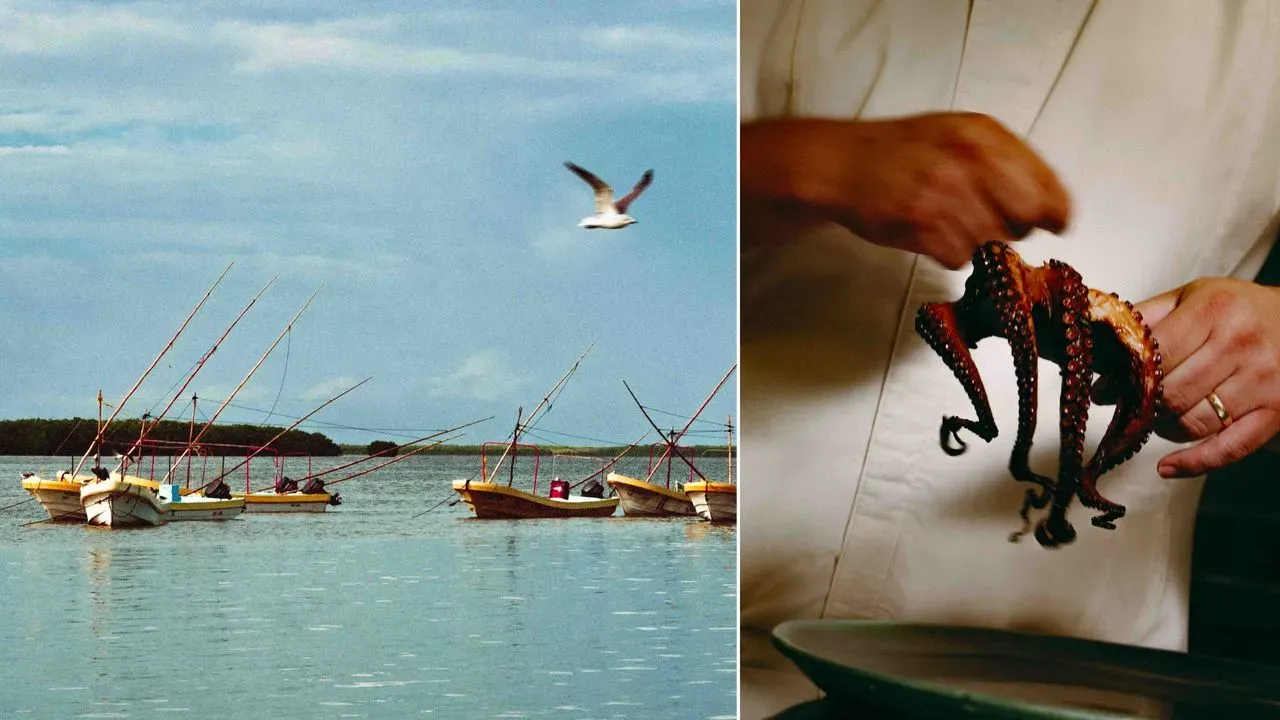
The turquoise waters of the Yucatán are abuzz today, their warm temperature a perfect match for the vibrant culture that thrives in this region. A small skiff, known as an alijo, is gently swaying on the waves as Captain Limberth Orlando Alcocer Diaz prepares to cast his lines into the water.
Captain Alcocer Diaz has been fishing these waters since he was eight years old, following in the footsteps of his parents who also made their living from the sea. The waters provide a bounty of fresh seafood, including mero fish and succulent shrimp that are prized for their flavor. These delicacies are highly sought after by locals and visitors alike.
We're just 20 minutes away from the charming town of Rio Lagartos, where life moves at a leisurely pace. Our captain expertly navigates the waters, his years of experience evident in every move he makes. The Yahilin, our trusty vessel, glides smoothly through the waves as we head out to catch a glimpse of the region's prized octopus maya.
Chef Cesar A. Landeo has joined us on this journey, and his enthusiasm for the day's catch is palpable. He explains that the octopus maya, while smaller than its Mediterranean counterpart, makes up for it in flavor and presentation. This delicate creature is a staple of local cuisine and highly prized by chefs like Landeo.
A bucket of bait crabs sits between us, their wiggling bodies adding to the excitement of our adventure. Chef Karla Encisco, an expert in hospitality and seafood preparation, shares her knowledge on how to cook octopus using only seawater released by the animal for steaming. This dry-pot method is a testament to the region's innovative approach to sustainable fishing.
As we set out into the open waters, it becomes clear that our journey is not just about catching fish but also about understanding the complex issues surrounding seafood consumption. The Yucatán has earned a reputation for its responsible approach to octopus fishing, and we're here to learn more about what makes this region so unique.
The sun beats down on us as we continue our search for the elusive octopus maya. Captain Alcocer Diaz's patience is being put to the test, but he remains undeterred, repeatedly checking his lines in a quest to land the perfect catch.
The traditional fishing method used by Captain Alcocer Diaz and his fellow fishermen is a testament to their understanding of the delicate balance between humans and marine life.
This artisanal technique relies on two long pieces of bamboo, known as "jimbas, a few cords, and a live crab or lobster as bait. It's an approach that has been employed commercially for over five decades, despite its roots in ancient Maya fishing practices that date back hundreds of years.
The petite octopus maya is the prized catch of these fishermen, recognizable by its distinctive false eyes that sit below its real ones. This coral-red creature lives a precarious existence, typically lasting only about a year before meeting a tragic end.
Once female octopuses have laid their eggs in a cave, they become devoted guardians, abandoning all thought of food until the eggs hatch. At this point, the mothers literally drop dead, famished and withered, leaving nothing for scavengers to feed on.
The males fare no better, mating several times before expiring after a summer of procreation. This brief, intense period is why octopus fishing is strictly regulated here, allowed only from August 1 to December 15.
During this time, fishermen like Captain Alcocer Diaz use the jimba method to target the males at their most active and vulnerable stage. By attaching a crab or lobster's torso to a line and letting it dangle from the bamboo, they create a makeshift feeding ground for the males.
The males willingly wrap themselves around the shellfish, just as they would in the wild, and when fishermen feel that telltale weight on their lines, it just feels different, Captain Alcocer Diaz explains, they reel them in.
As the sun beats down on the water, Captain Alcocer Diaz's patience is being tested, but he remains focused on landing the perfect catch. The wait may be long, but the reward will be worth it if his lines yield a prized octopus maya.
Alcocer Diaz's respect for the octopuses he catches is evident in his method of quickly dispatching them with a spike between the eyes, a technique that has gained popularity under the Japanese process of ikejime.
This swift and humane approach stands out in contrast to other fishing methods, where animals are often left to struggle on deck before being killed.
The octopuses' intelligence is also a factor in Alcocer Diaz's actions, as he acknowledges their capacity for escape if not handled promptly.
Their ability to think and react has even led some diners to turn down perfectly grilled pulpo, opting instead to spare the animal's life.
The documentary My Octopus Friend has had a similar effect on Encisco, who is tasked with preparing these eight-armed creatures, but still can't bear to watch it.
Alcocer Diaz's wife also raised concerns about his involvement in octopus fishing, highlighting the emotional toll that comes with handling such intelligent and capable animals.
For Alcocer Diaz, however, the cycle of life is a natural and necessary part of feeding his family, and he approaches every aspect of his work with this understanding in mind.
He considers even the smallest details, from gassing up his boat to choosing which seafood to fish based on the weather or season.
Pesca Con Futuro, an organization connecting chefs with sustainable fishing collectives throughout Mexico, was founded by Citlali Gomez Lepe eight years ago. As a biologist, she recognized that consumer demand plays a significant role in shaping the way food is produced.
Gomez Lepe's initiative helps restaurants and hotels source seafood from various regions of Mexico, including the Gulf of Mexico, Baja California, and Michoacan. Over 60 fisheries are currently involved with Pesca Con Futuro, providing a wide range of products to consumers.
By promoting artisanal and sustainably sourced seafood, Gomez Lepe aims to create a market signal that encourages fishers to adopt best sustainability practices. As she explains, when consumers show a preference for these products, the market transmits this message along the value chain, ultimately benefiting the fishers who operate with sustainability in mind.
Many prominent Mexican chefs have joined forces with Pesca Con Futuro, including Gabriela Camara and Javier Plasencia. These culinary ambassadors help spread awareness about sustainable seafood options and promote the organization's mission among their peers.
Enciso, a chef working on the Riviera Maya, has partnered with Pesca Con Futuro to source high-quality seafood for her clients' hotels. She believes that chefs have a significant influence on what ends up on restaurant tables, which is why she got involved with the organization in the first place.
The sheer number of tourists visiting the Riviera Maya presents both a challenge and an opportunity for sustainability. Enciso remains optimistic about the impact that consumers can have when making informed choices about their seafood options.
As we spend the day at sea with Alcocer Diaz, it becomes clear that even small decisions require careful consideration. From refueling his boat to choosing which seafood to fish based on the weather or season, every detail is meticulously planned and executed.
The Yucatán's prized octopus fishermen face a multitude of challenges in their pursuit of sustainable seafood. Weather conditions can be unpredictable, making it difficult for them to catch their quarry. On this particular day, an approaching storm muddies the waters and reduces visibility, hindering the octopuses' ability to find bait.
The consequences of this weather are evident as Alcocer Diaz's boat returns with a meager haul. Despite their best efforts, the only octopus they manage to catch is destined for the dinner plate. This is not an uncommon occurrence in the Yucatán, where fishermen must contend with unpredictable weather patterns and fluctuating sea conditions.
Inland, a meal of pulpo rojo offers a respite from the day's challenges. This local specialty features battered and fried octopus served with lime juice, onions, and sliced jalapeños. The dish is a testament to the region's culinary expertise and its reliance on fresh seafood.
However, dining on sustainable seafood in the Yucatán remains a privilege rather than a given. Local fishermen face numerous hurdles as they strive to balance their livelihoods with environmental concerns. One major issue is the demand for sea cucumbers, which are exported to China but cannot be sustainably harvested at current levels.
The region's artisanal fishermen also grapple with competition from those who employ short-sighted methods to maximize profits. This can have devastating consequences, including the use of chemicals to flush out octopuses and the subsequent damage to marine ecosystems. Limberth speaks of his own experiences with divers from neighboring states who fish during seasonal bans.
The impact of climate change is another pressing concern for Yucatán's fishermen. As water temperatures rise, octopuses retreat deeper into the ocean, making them increasingly difficult to catch. This shift in behavior highlights the need for sustainable fishing practices and more effective management of marine resources.
Despite these challenges, Limberth remains committed to his craft and the well-being of the region's ecosystems. He is acutely aware of the importance of preserving the delicate balance between human activity and the natural world.
As I reflect on our day at sea with Alcocer Diaz, I begin to grasp why many of our conversations kept circling back to the concept of círculo de la vida" - the delicate balance between human existence and the natural world.
The fishermen's respect for the octopus's vulnerabilities is evident in their fishing methods, which prioritize sustainability over short-term gains. However, they must continue to fish to sustain their families, making it a complex issue to navigate.
One of the most striking aspects of our experience was the consideration given to the octopus's lifecycle. The fishermen are acutely aware that high water temperatures can be detrimental to the species, with temperatures above 80 degrees proving fatal for the octopus maya.
As I grapple with my own moral dilemma about consuming octopus, I am struck by the complexity of the issue. On one hand, I feel guilty about a recent meal featuring creamy octopus eggs, unaware at the time of their value and rarity.
The experience has left me with a newfound appreciation for the considered approach taken by Alcocer Diaz and his fellow fishermen, who strive to balance their need to fish with the importance of preserving the delicate ecosystem.
Facts based on reporting originally published by Conde Nast Traveler.
You may republish this story, in full or in part, if you credit News Central Site and link to it (licence CC BY 4.0). Photos are not included.