Unique Stone Tool Technique Uncovered in Southwest China
Archaeologists have discovered evidence of a technique that allowed for repeated sharpening and reuse of stone tools in southwest China.
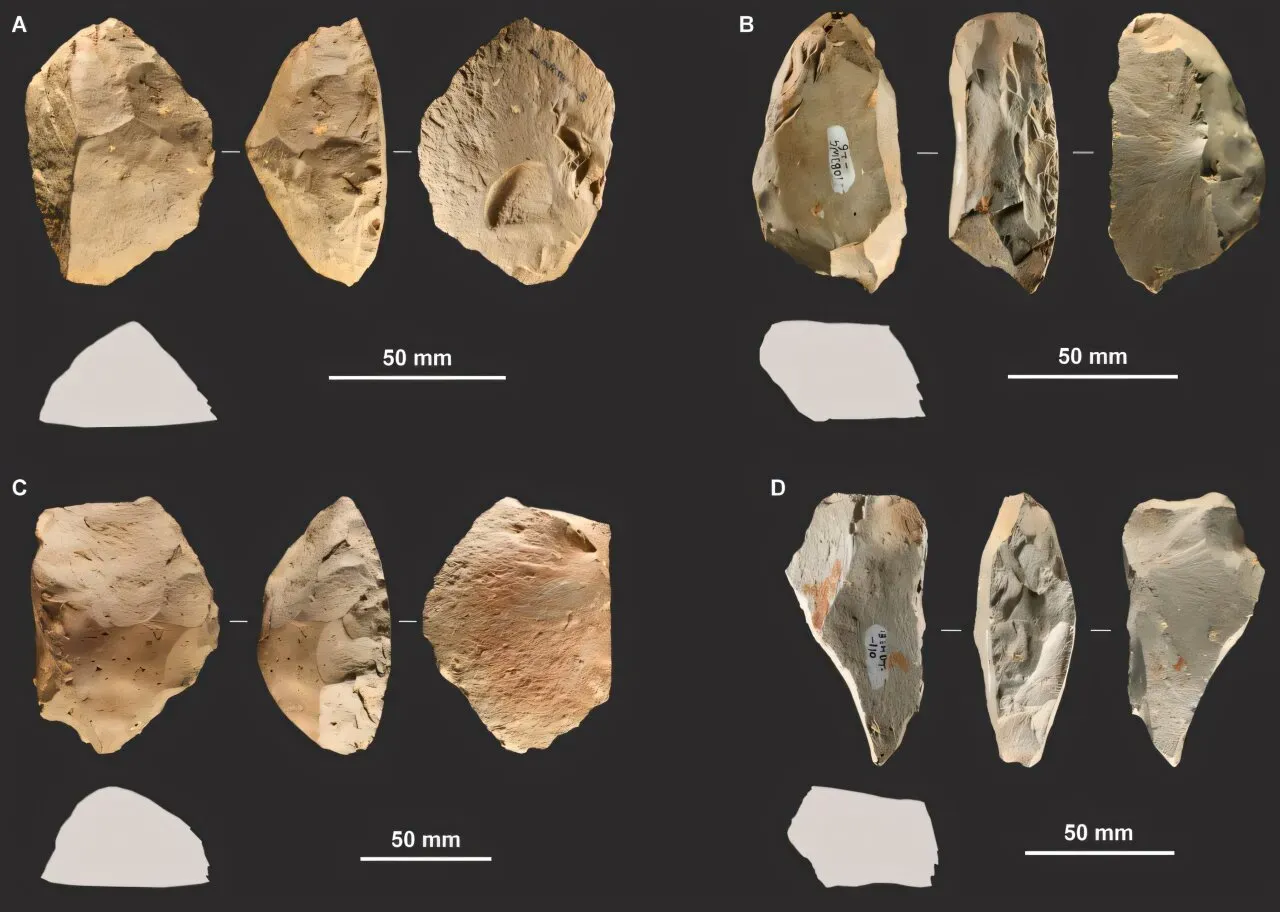
A unique approach to toolmaking has been uncovered in southwest China, where archaeologists have discovered evidence of a technique that allowed for repeated sharpening and reuse of stone tools.
The findings suggest that a technology previously identified at Longtan on the southeastern margin of the Tibetan Plateau extended across the surrounding region. This raises questions about whether knowledge was shared between distant populations or if similar production methods developed independently. The toolmaking system in question is known as Quina, which has been associated with Neanderthals in Europe.
Pei-Yuan Xiao and his team from the Chinese Academy of Sciences have published their findings in a recent issue of Palaeogeography, Palaeoclimatology, Palaeoecology. Their research provides tangible examples of ancient people extending the useful life of their most valued tools through innovative techniques.
Quina toolmaking involves combining the production of thick, asymmetric flakes with repeated edge maintenance and reuse. The chosen rock is shaped to create a honed working edge opposite a substantial rounded back, leaving a reserve of stone for later sharpening. This allows flakes removed during maintenance to be used as cutting edges on their own.
The use of Quina toolmaking across 27 locations in southwest China indicates that this technology was widespread and effective in the region. The findings are significant because they suggest that similar approaches to tool production may have been developed independently by distant populations, rather than through knowledge sharing.
The surface collections in Huangping and Binchuan basins yielded a significant number of ancient stone tools, including 166 scrapers and 58 resharpening flakes that have yet to be dated.
These finds share striking similarities with the Quina scrapers excavated from Longtan, with many retaining thick backs and overlapping generations of scars from repeated edge maintenance.
Detached flakes from the surface collections preserved evidence of earlier sharpening, while some larger pieces showed signs of being used as both tools and sources of new flakes. This dual purpose is a testament to the resourcefulness of ancient toolmakers.
Comparative analysis revealed that the scrapers from Huangping and Binchuan basins exhibited similar features to Longtan's Quina scrapers, including thickness, edge angles, and other characteristics. In contrast, non-Quina scrapers from the same site showed distinct differences.
The researchers observed a clear preference for trachyte, a type of volcanic rock, which accounted for approximately 96% of the surface-collected scrapers. Trachyte was chosen over sandstone, despite being less abundant in the area.
The sampled trachyte cobbles were larger and had a finer-grained structure than sandstone cobbles, suggesting more predictable fracturing properties that would be beneficial for tools intended to withstand repeated reworking.
The researchers' hypothesis suggests that people who migrated seasonally in search of resources required tools that were both stable and maintainable.
Moving away from riverbeds where rocks were sourced meant that stone tools had to be reliable and durable, as they carried them with them across rugged terrain.
Similar demands could have driven similar inventions among populations without direct contact, much like the European Quina sites which also faced scattered resources and seasonal prey availability.
However, this explanation remains a hypothesis until further evidence emerges, as modern ecology provides the basis for understanding animal resource distribution in the study area.
More excavations are needed to determine whether Longtan represents a recurring pattern of working stone, and to establish its history, with potential implications for shared knowledge or independent invention.
Excavations at Longtan site in southwest China have revealed a pattern of stone tool reuse and resharpening that spans thousands of years. The tools, found in a region known as the Quina Landscape, demonstrate a regional technological system with its own distinct characteristics.
The discovery suggests that ancient humans in this area developed their own unique approach to working with stone, rather than independently inventing new techniques. Further excavations are necessary to confirm whether Longtan represents a recurring pattern and to shed light on the history of these tools.
Facts based on reporting originally published by Phys.org.
You may republish this story, in full or in part, if you credit News Central Site and link to it (licence CC BY 4.0). Photos are not included.