Researchers Develop Microrobots for Targeted Blood Clot Treatment
The microrobot technology has shown promise in initial tests on pigs, dissolving blood clots around 10 times faster than medication alone.
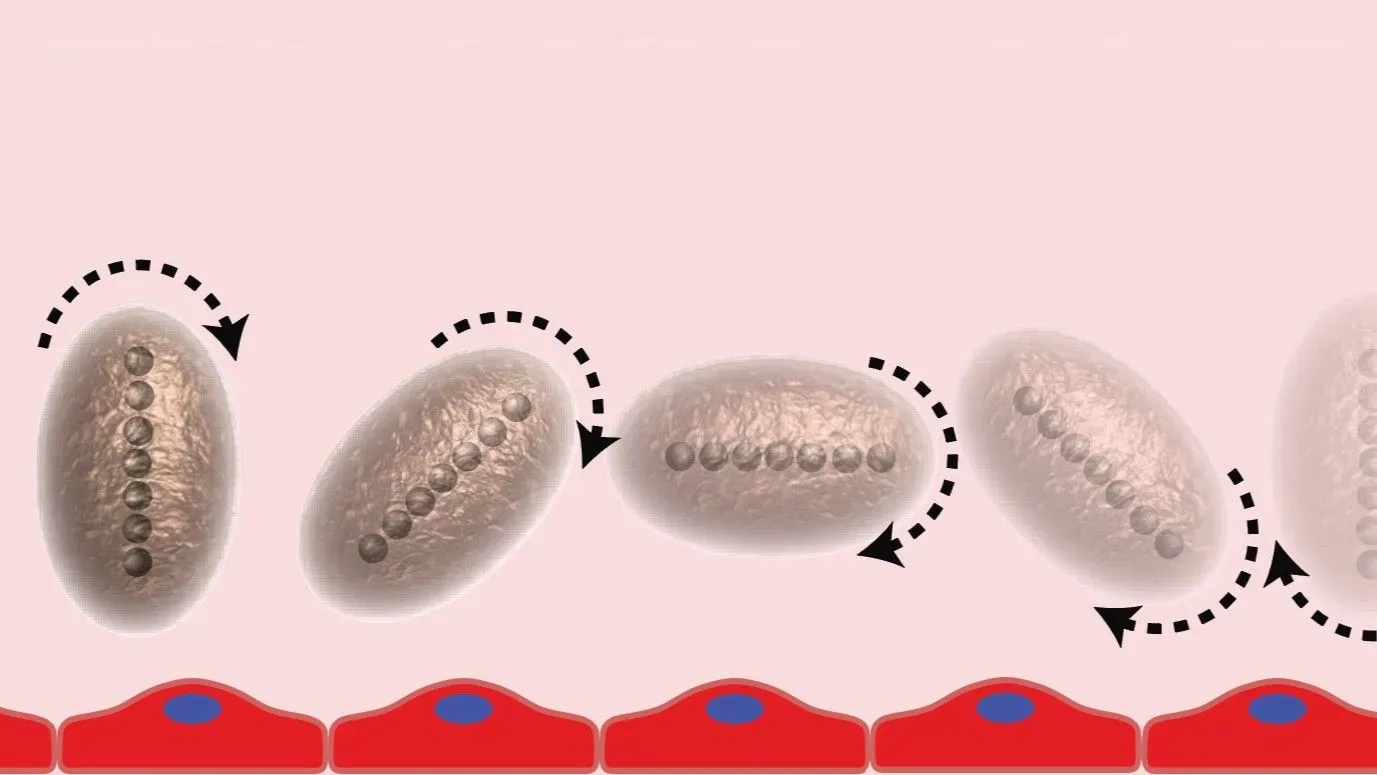
Researchers have been experimenting with tiny robots that can be controlled by magnets and navigated through blood vessels to target hard-to-reach blood clots. These microrobots are designed to sweep medications towards the clots, potentially increasing the effectiveness of treatments.
Initial tests on pigs showed promising results: the microbots were able to dissolve blood clots around 10 times faster than medication alone could manage. However, further testing is needed before the technology can be considered for use in humans. The research team at ETH Zürich is currently working to refine the safety and efficacy of the microrobots.
The idea behind these tiny robots was inspired by nature's own magnetic navigators, certain bacteria that use magnetic backbones to navigate the Earth's magnetic field, according to lead researcher Simone Schürle. "The whole construct is inspired by nature," she explained. We were struck by the physics and properties of these bacteria when exposed to rotating magnetic fields.
ETH Zürich announced its research findings in a statement on November 9, but it has not yet been published in a peer-reviewed study. The team's work aims to develop a treatment that can effectively target blood clots without causing unnecessary damage to surrounding tissues or organs.
The challenge of delivering clot-dissolving medications to the site of blockage lies in navigating the final few millimeters.
Fluid flow is severely impeded when it encounters resistance in a branched system, causing it to seek alternative routes where passage is easier, according to Schürle's explanation.
Microbots can serve as a solution by redirecting interrupted blood flow and carrying essential drugs directly to their target location.
The microbots' design allows them to be controlled externally with magnets, sending them rotating and tumbling through blood vessels.
The researchers next tested the microbots in a more realistic setting by using live animals. They placed clots in the kidneys of several pigs to simulate the conditions found in humans. This experiment was crucial in determining whether the microbots could effectively dissolve blood clots in a living organism.
The results showed that when the microbots were paired with a standard thrombolytic drug, they were able to restore blood flow to a significantly larger area than if only the medication was used. This is a promising finding, as it suggests that the microbots may be able to help save lives by quickly dissolving clots.
The team's use of live animals allowed them to assess the safety and efficacy of their device in a more realistic way. While the experiment provided valuable insights, it also highlighted the need for further testing before the microbots can be used in human patients. The researchers acknowledged that there are still several hurdles to overcome before the device is ready for clinical trials.
The next step will be to conduct safety studies on larger mammals, which will provide more information about how the microbots break down in the body and whether they cause any adverse effects. These findings will be crucial in determining whether the device can be safely trialed in human patients.
The next step in testing these tiny robots involves injecting them into the body alongside thrombolytic medicine, which dissolves blood clots. The idea is that once inside the body, the microbots would be controlled using targeted electromagnets to ensure a seamless integration with existing clinical procedures for treating clots.
The researchers are optimistic about the potential of this technology, and Schürle has already applied for a patent for the production process, which uses droplet-based microfluidics to create each individual particle. This method is both cost-effective and efficient, making it an attractive option for large-scale production.
The development of these tiny robots holds promise not only for treating clots but also for other medical applications, and their potential impact will be closely monitored as this research continues.
Facts based on reporting originally published by Live Science.
You may republish this story, in full or in part, if you credit News Central Site and link to it (licence CC BY 4.0). Photos are not included.