Artificial Intelligence Sparks Concerns Over Graduate Job Market
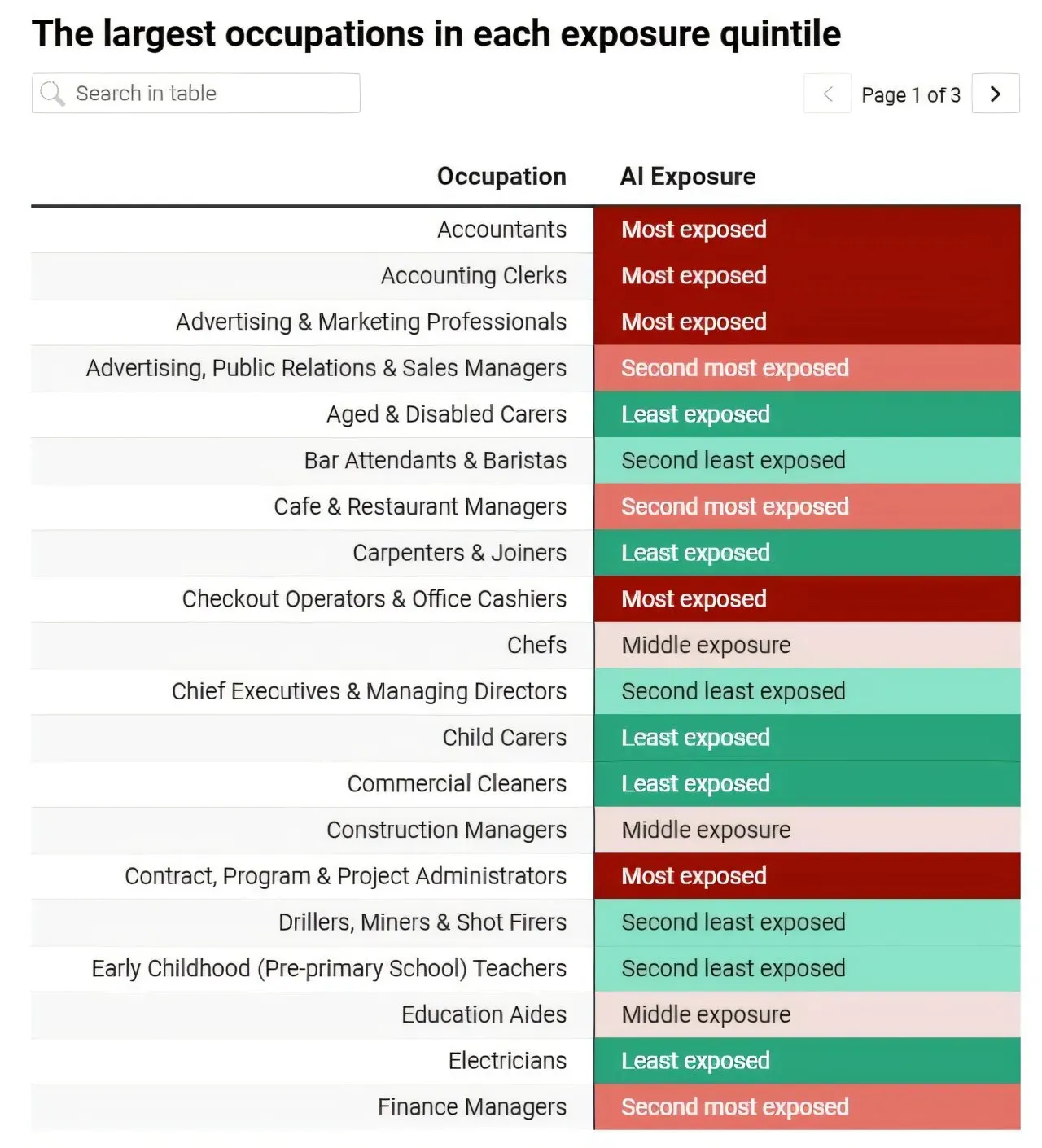
A federal government report highlights the jobs most vulnerable to automation due to their reliance on cognitive tasks.
Concerns are growing about the impact of artificial intelligence (AI) on the graduate job market worldwide. The rise of AI software companies such as OpenAI and Google DeepMind has led to a focus on developing AI systems that can match or surpass human performance in various intellectual tasks.
These developments have sparked worries among graduates and universities, who fear that AI may reduce job opportunities for new entrants into the workforce. A recent federal government report sheds light on this issue, highlighting which jobs are most vulnerable to automation due to their reliance on cognitive tasks.
The report reveals that jobs involving high levels of mental work, such as accounting and data entry, have a significant risk of being automated by AI systems. In contrast, roles requiring physical labor or manual skills, like those in the trades or healthcare, are less likely to be affected by AI automation.
According to the government's findings, many current jobs will not be replaced by AI but instead undergo changes as technology takes on certain tasks. The report suggests that AI could augment existing job roles, rather than simply eliminating them.
The Australian job market appears to have been relatively untouched by AI so far, with no significant impact observed in the number of entry-level positions available for college graduates, despite international concerns about a potential decline in these opportunities.
The Reserve Bank of Australia has recently noted a concerning trend in the Australian job market, suggesting that younger workers in industries heavily exposed to artificial intelligence are struggling to find employment.
In some sectors, such as law firms, entry-level positions have been drastically reduced as low-level tasks are increasingly being automated by AI. This shift is not limited to law firms alone, with consulting firms also cutting back on graduate roles in recent years, although they attribute this decision to factors other than AI.
The aviation industry is another sector undergoing significant changes, with Qantas announcing plans to outsource 850 jobs to India while investing heavily in artificial intelligence technology. This move highlights the growing reliance on automation and AI in various industries.
Researchers have been studying the impact of AI on human reasoning skills, comparing them to those of AI language models through a series of tests. These assessments involve complex math puzzles that require individuals to identify incorrect answers, such as determining the cost of a hat given its total cost with a scarf is €220 and it costs €210 more than the hat.
The results of these studies are crucial in understanding how graduates can adapt to an AI-driven job market, where critical thinking and reasoning skills will be increasingly valued.
The trend of AI performance is shifting as newer models surpass their predecessors in reasoning tasks. This upward trajectory suggests that AI could eventually outperform humans across a broader range of cognitive abilities. A notable example of this progress lies in geometry, where an OpenAI model recently solved a long-standing problem dating back to 1946.
My own research into the capabilities of AI systems has yielded similar findings. In a study examining AI's performance on university exams in criminal law, I observed significant improvements between 2023 and 2025. Specifically, AI's average exam scores rose from 52.5% in 2023 to 76.3% in 2025.
A closer look at the data reveals that the most striking gain was in critical thinking capabilities. Unlike its predecessors, the 2025 AI models consistently outperformed an average university student on these tests. This achievement challenges the assumption that AI's limitations will persist indefinitely.
The implications of this trend are far-reaching and multifaceted. If a capable AI could be paired with reliable robots, it may soon pose a threat to professionals like electricians and plumbers. The automation of tasks is already underway in various industries, as evidenced by the growing presence of robotaxis, delivery robots, and autonomous excavators.
These developments underscore the need for universities to adapt their curricula and training programs to prepare students for an AI-driven job market. By acknowledging and addressing these changes, institutions can help graduates develop the critical thinking and reasoning skills that will be increasingly valuable in a world where AI is becoming increasingly prevalent.
The impact of automation on vocational jobs is still a topic of debate. While robots are becoming increasingly skilled at performing complex physical tasks, it's unclear when they will be able to fully replace tradespeople.
However, this doesn't necessarily mean that white-collar workers will be immune to the effects of AI. As machines become more prevalent in various industries, it's likely that certain roles will require a combination of human and artificial intelligence.
Research suggests that collaboration with AI is not a straightforward process. It requires a level of judgment and critical thinking to get useful results from working alongside machines.
Studies have shown that even healthcare professionals can struggle when using AI systems for decision-making. In one pilot study, nurses accepted half of the incorrect recommendations provided by an AI system, while another study found that users often left out important details when consulting chatbots, leading to mixed and misleading suggestions.
Universities must prepare students to work alongside AI systems effectively. This means teaching them how to collaborate with these technologies, direct their output, and question any incorrect results that may arise.
To stay relevant in the job market, students will need to possess both traditional disciplinary knowledge and skills, as well as the ability to work seamlessly with AI. Simply replacing one with the other is not a viable solution for universities seeking to equip graduates with the necessary tools for success.
A technology designed to streamline tasks could paradoxically require individuals to invest more effort in staying up-to-date with its capabilities. This presents a challenge for those navigating the changing landscape of the graduate job market.
As a result, universities must adapt their curricula and teaching methods to accommodate this shift, ensuring that students are well-equipped to thrive in an environment where AI is increasingly prevalent.
Facts based on reporting originally published by Phys.org.
You may republish this story, in full or in part, if you credit News Central Site and link to it (licence CC BY 4.0). Photos are not included.