Neolithic Revolution in Denmark Revealed Through Well-Preserved Skeleton
A remarkably well-preserved skeleton from Mesolithic Denmark has been radiocarbon dated and analyzed for isotopes, revealing that the individual lived through the introduction of agriculture.
Archaeologists have made an extraordinary discovery in Denmark that provides a unique glimpse into one of humanity's most significant technological revolutions - the Neolithic revolution.
A remarkably well-preserved skeleton from Mesolithic Denmark has been radiocarbon dated and analyzed for isotopes, revealing that the individual lived through the introduction of agriculture. The findings offer a firsthand account of how people adapted to this fundamental shift in their way of life.
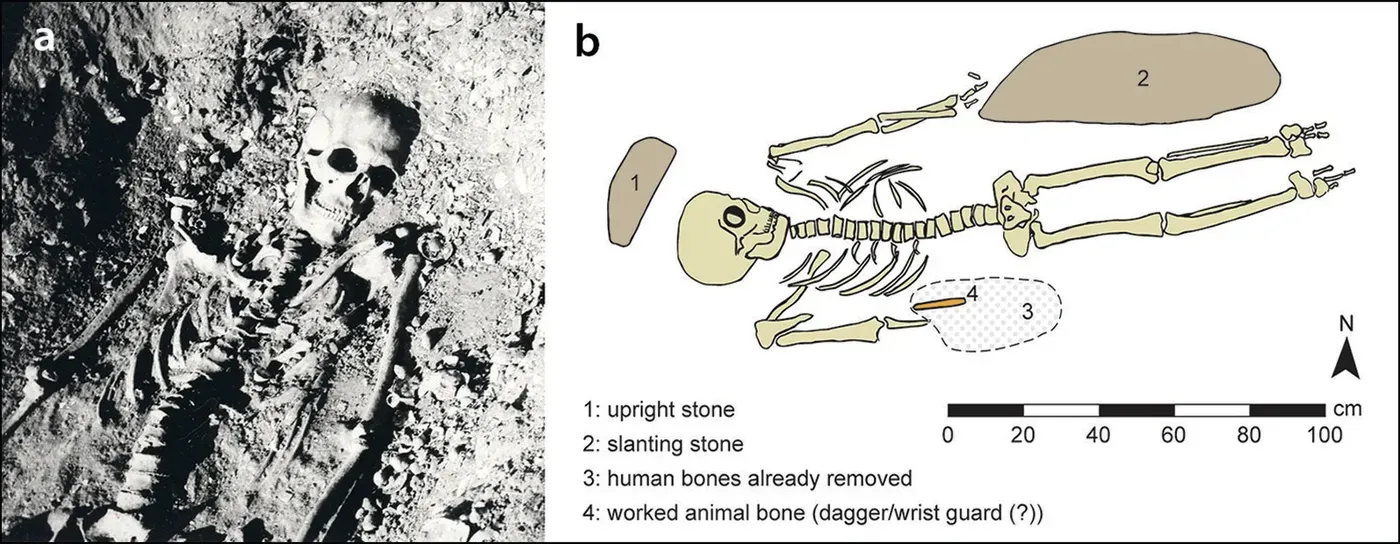
The skeleton was discovered on the island of Sejerø, where it is believed that a biologically male individual died approximately 6,000 years ago. This person had been living as an indigenous forager, relying on fishing, hunting marine mammals, and gathering shellfish for sustenance.
For centuries, these foragers thrived on the island, but their way of life was about to come to an abrupt end with the arrival of Neolithic farmers from the south. Dr. Anders Fischer, lead author of a recent study published in Antiquity, notes that "foragers seemed to have disappeared abruptly from the archaeological record just as the first farmers arrived."
The research team analyzed Rødhals Man's life by examining his radiocarbon dates, ancient DNA, and isotope analysis results. These findings reveal how his lifestyle changed over time, offering a unique perspective on the impact of Neolithic farmers' arrival on foragers like him.
Co-author Dr. John Meadows from the Leibniz Center for Archaeology posed some thought-provoking questions about the risks and opportunities that came with interacting with these newcomers. However, the data suggests that Rødhals Man's interactions with farmers were a given rather than a choice.
The isotopes show that he ate significantly more terrestrial foods in his teenage years and adulthood, indicating a shift towards consuming more land-based resources as he grew older. This is an interesting contrast to his childhood diet, which relied heavily on marine resources.
His burial also shares similarities with the burials of Early Neolithic farmers rather than those of Late Mesolithic hunter-gatherers. This suggests that Rødhals Man's way of life was influenced by his interactions with the incoming farmers.
Rødhals Man's story offers a direct window into the lives of foragers during this pivotal period in human history, when the introduction of farming dramatically altered the course of human development.
The discovery of Rødhals Man offers a poignant reminder that individual experiences are often lost to history, leaving behind only fragmented records of significant events.
Fischer notes that despite being just one person's story, it provides valuable insights into the lives of those who lived during this pivotal period in human development. The combination of ancient DNA analysis and multi-isotope ecology has shed light on Rødhals Man's choices and fate, allowing researchers to better understand his place within the broader context of the Neolithic revolution.
Rødhals Man is an extraordinary find, representing a complete skeleton from someone who witnessed firsthand the transition from foraging to farming. This individual did not abandon his ancestral way of life entirely, but instead incorporated some aspects of farmer culture into his daily routine.
The study's findings have significant implications for our understanding of human history and development.
Facts based on reporting originally published by Phys.org.
You may republish this story, in full or in part, if you credit News Central Site and link to it (licence CC BY 4.0). Photos are not included.