Tsunami experts study lab experiments and real-world scenarios to understand volcanic eruptions' impact on sea waves
Researchers have conducted laboratory experiments to better grasp how volcanic rocks and ash interact with seawater to generate massive waves.
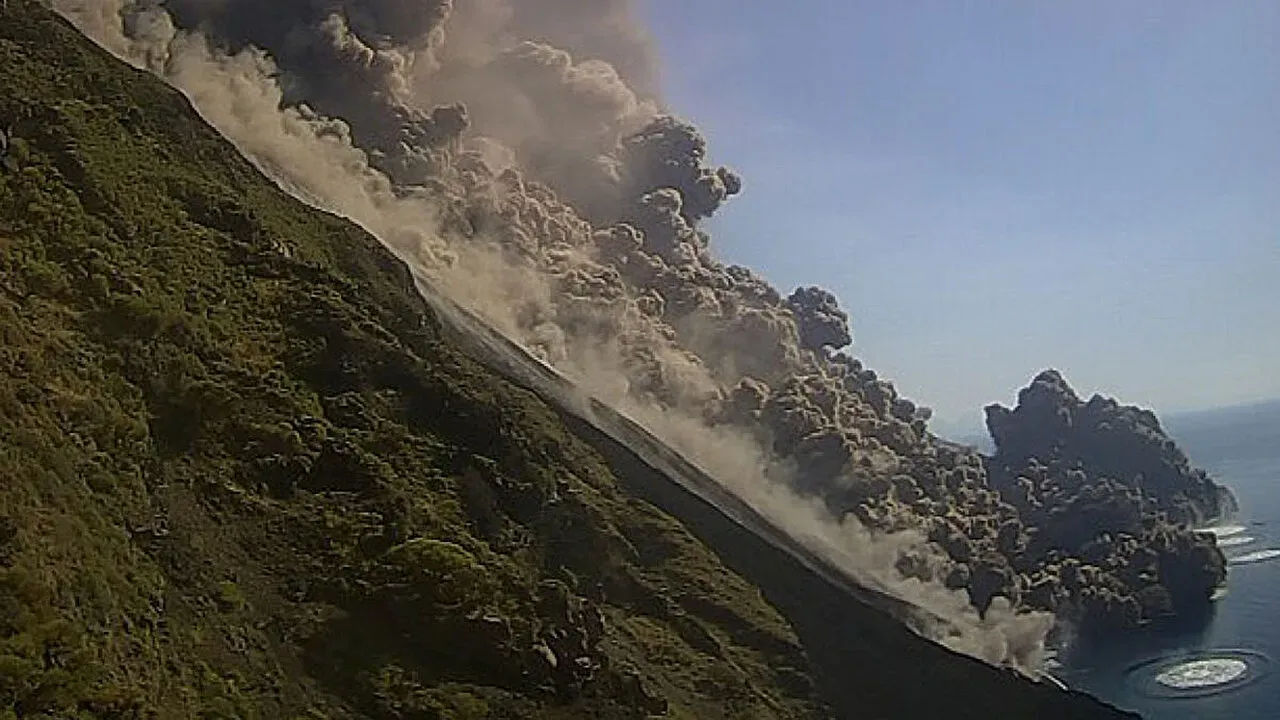
Tsunami experts have long struggled to predict when a volcanic eruption will trigger a devastating tsunami, but new research is shedding light on this complex and poorly understood phenomenon. The main challenge lies in understanding how volcanic rocks and ash interact with seawater to generate massive waves.
In an effort to better grasp the dynamics at play, researchers have turned to laboratory experiments, which provide valuable insights into the processes involved. However, it remains unclear whether these models accurately replicate real-world scenarios, making predictions a daunting task. To address this uncertainty, scientists have sought to compare lab results with actual observations from volcanic eruptions.
The Italian island of Stromboli has emerged as an ideal location for studying tsunamis triggered by volcanic activity. The volcano's constant eruptions and frequent entry into the sea create an environment conducive to monitoring these events. A unique monitoring system, comprising land-based cameras and offshore wave gauges, provides valuable data on the formation and impact of tsunamis.
The researchers' decision to focus on Stromboli was driven by its distinctive characteristics, which make it an ideal "laboratory in the field." By comparing lab results with real-world observations from this volcano, scientists aim to gain a deeper understanding of the complex interactions between volcanic materials and seawater. This knowledge could ultimately improve predictions and save lives in the event of a tsunami triggered by a volcanic eruption.
The researchers conducted laboratory experiments to better understand how volcanic eruptions trigger tsunamis. They focused on three recent eruptions at Stromboli volcano that generated tsunamis between 2019 and 2021. The team compared observations from the field with results from both new and existing lab experiments.
In the laboratory, a large tank filled with water was used to replicate the conditions of a volcanic eruption. A mass of polystyrene beads, representing pyroclastic flows, was released down a slope into the water. Despite being buoyant, these lightweight beads can still generate significant waves when sent tumbling into the water.
The experiments revealed that lab simulations cannot be directly scaled up to predict real-world events, with most models based on such experiments overestimating tsunami sizes in the field. However, the new research helped bridge this gap by reproducing key features observed at Stromboli, including a distinctive three-wave pattern.
The team's findings suggest that lab experiments can capture the energy transfer from pyroclastic flows to resulting wave trains, although some limitations remain. This knowledge could ultimately improve predictions and save lives in the event of a tsunami triggered by a volcanic eruption.
The researchers' findings offer a crucial step forward in assessing volcanic tsunami hazards.
By comparing lab experiments to real-world observations, the team was able to gain valuable insights into the dynamics of such events. This knowledge will be instrumental in refining predictions and mitigating the impact of tsunamis triggered by volcanic eruptions. The study's results have significant implications for disaster preparedness and response efforts.
The research has provided a critical foundation for improving our understanding of the complex processes involved in volcanic tsunami generation.
Facts based on reporting originally published by Phys.org.
You may republish this story, in full or in part, if you credit News Central Site and link to it (licence CC BY 4.0). Photos are not included.