Quantum Computers Face Challenge in Nondestructive Reading of Qubits
A new study proposes using Andreev qubits to achieve nondestructive reading of quantum information without altering its content.
Quantum computers face a significant challenge in reading information from their fundamental units, known as qubits, without altering it. Unlike classical bits, which can be repeatedly read without changing their content, direct measurement of quantum systems typically causes them to collapse before their state can be determined.
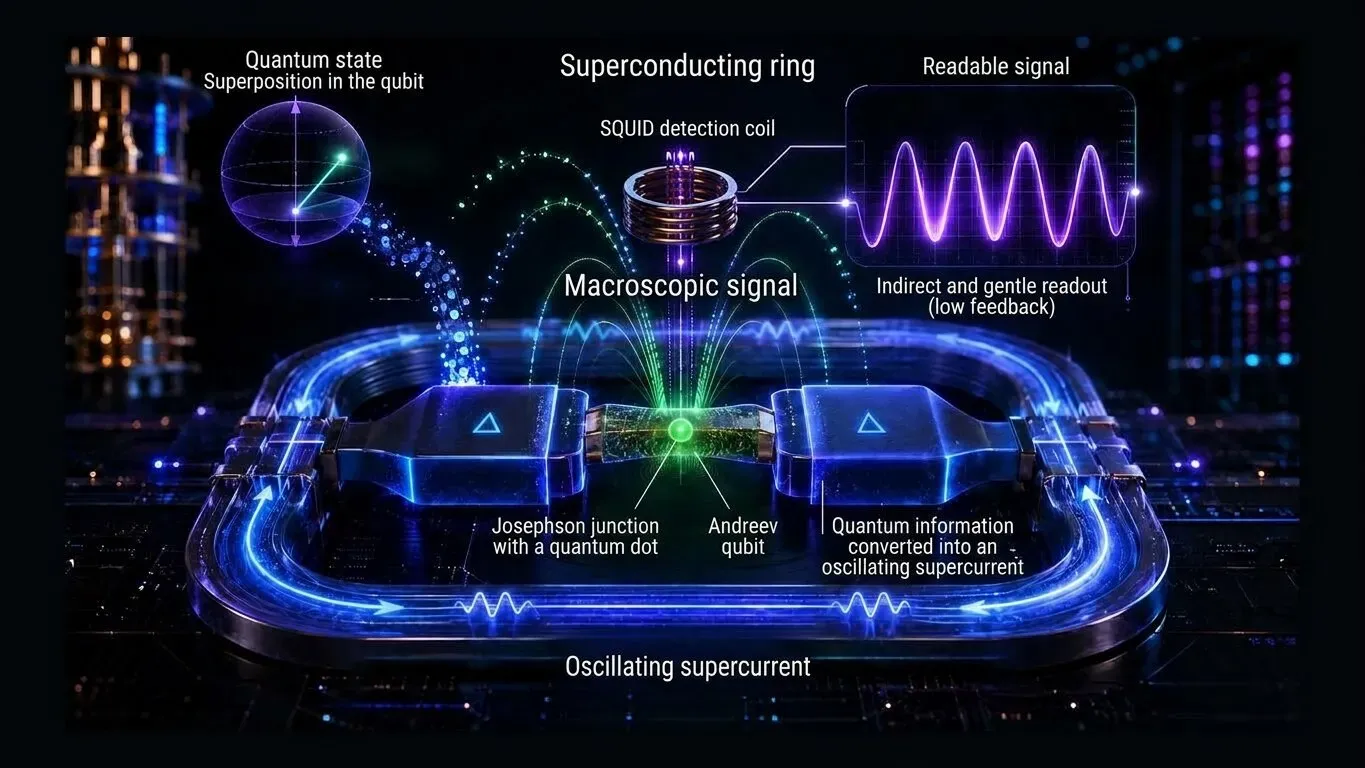
Researchers have been exploring ways to overcome this problem, and a new study proposes using the unique properties of an "Andreev qubit to achieve nondestructive reading. This type of qubit generates an oscillating electric supercurrent through its own quantum dynamics, which could serve as a macroscopic indicator of its state.
The study, led by José Carlos Egues from the University of São Paulo and Yugui Yao from the Beijing Institute of Technology, suggests that this method eliminates the need for ancillas, auxiliary qubits used in current techniques for nondestructive quantum readout. This development has significant implications for the development of more efficient and reliable quantum computers.
Qubits are the basic units of information in quantum computing, capable of existing in various superpositions of 0 and 1 states. However, this property also makes them vulnerable to interaction with their environment and measurement processes, which can alter or destroy the information they contain.
Researchers have been working on developing methods to read qubit information without causing it to collapse, but these efforts often require auxiliary qubits that add complexity to the system. The new study proposes a more straightforward approach using the supercurrent generated by Andreev qubits.
The use of Andreev qubits in quantum computing has been explored for its potential to create a macroscopic indicator of the qubit's state, enabling its reconstruction without causing it to collapse. This property could be leveraged to develop more efficient and reliable quantum computers that can harness the power of quantum information processing.
The conventional approach to measuring quantum information often results in its destruction. When a qubit is measured directly, it tends to collapse into one of the states associated with the measurement quantity. This means that the superposition of 0 and 1 is lost, along with the information it contained.
To overcome this limitation, researchers have developed quantum nondemolition measurements or QND protocols. These methods involve transferring the qubit's information to an auxiliary system called an ancilla. The term ancilla comes from Latin, where it means slave" or "servant. In this context, the ancilla serves as a proxy for the original qubit.
While QND protocols are effective, they require significant experimental overhead. This includes preparing the ancillas, coupling them to the qubit, transferring the information, and performing successive measurements. In systems with multiple qubits, this process can be time-consuming and cumbersome.
A new approach seeks to obtain quantum information directly from a signal produced by the qubit under study itself. This strategy eliminates the need for an auxiliary system and associated infrastructure.
The qubit in question is known as an Andreev qubit." It is based on a phenomenon discovered by Soviet physicist Alexander Andreev, who described a process characteristic of interfaces between normal and superconducting materials in 1964. These states are created at the nanoscale region separating two superconducting materials.
In this specific system, the quantum dot is formed within an indium arsenide nanowire connected to superconducting materials on both sides. This environment gives rise to the Andreev qubit's characteristic states.
The researchers' approach has the potential to simplify and streamline the measurement process for quantum information. By harnessing the properties of the Andreev qubit, they aim to develop more efficient and reliable methods for reading quantum information without destroying it.
The researchers have identified a key property of their system that enables the reading of quantum information without destroying it: the circulation of a supercurrent. This electric current flows without resistance and is an essential component in the team's proposal for reading qubit states.
When the qubit is in a superposition of its basic 0 and 1 states, the supercurrent exhibits an oscillating component over time due to quantum interference between these states. This oscillation carries valuable information about the qubit's state, making it possible to extract this data without disrupting the system.
The researchers have also developed a way to geometrically represent any qubit state using the Bloch sphere. Each point on the surface of this sphere corresponds to a specific superposition of 0 and 1 states, defined by two angles: one indicating the proportion of each state in the superposition and the other representing their phase relationship.
By harnessing this geometric representation, the team has discovered that the information about the qubit's state is encoded within the supercurrent itself. Specifically, the constant component of the current and the amplitude of its oscillation reveal the proportions of 0 and 1 states in the superposition, while the timing of the oscillation's onset discloses their phase relationship.
The researchers have shown that by measuring how the current varies over time, it is possible to reconstruct the initial state of the qubit. This breakthrough has significant implications for the development of more efficient and reliable methods for reading quantum information without destroying it.
The team's findings demonstrate a novel approach to extracting data from qubits, which could lead to major advances in the field of quantum computing and beyond.
The supercurrent phenomenon in this system defies conventional understanding of how electric voltage is required to cause the current to oscillate over time. Typically, an external voltage is necessary to trigger the AC Josephson effect, but in this case, the current can fluctuate without any applied voltage.
This self-sustaining oscillation is a direct result of the qubit's state evolving over time. The researchers have cleverly harnessed this microscopic quantum dynamics to create a macroscopic manifestation - the supercurrent that flows through the circuit.
The Andreev qubit is an integral part of the closed superconducting circuit, where the supercurrent circulates and produces a varying magnetic field. A SQUID, an extremely sensitive device for detecting weak magnetic fields, is strategically placed near the circuit to monitor these changes.
As the supercurrent flows through the circuit, it generates a dynamic magnetic field that fluctuates in sync with the current's behavior. The SQUID detects these variations and uses them to infer how the current is behaving, effectively providing information about the qubit's state without directly measuring it.
The researchers have likened this process to two compasses interacting - one representing the qubit and the other the SQUID. The magnetic field produced by the supercurrent serves as a signal that the SQUID 'senses', allowing for the reconstruction of the qubit's state with minimal disturbance.
In quantum physics, measuring an object inevitably alters its behavior due to the interaction between the measuring instrument and the system being measured. This phenomenon has puzzled physicists for decades, but it is now acknowledged as an intrinsic property of material reality.
However, this proposed device does have feedback, which could potentially influence the qubit's state. But simulations conducted by the researchers suggest that this effect can be minimized to negligible levels, making it irrelevant in practical applications.
The ability to read the qubit's state without directly measuring it is a significant breakthrough in quantum computing and beyond. This novel approach to extracting data from qubits could lead to major advances in the field and has far-reaching implications for various areas of research.
The researchers behind the novel approach have made it clear that their method doesn't solve the fundamental problem of quantum measurement. However, it can minimize its destructive impact and eliminate the need for auxiliary qubits, which are typically used in nondestructive quantum measurement protocols.
One significant advantage of this new approach is that it allows measurements to be performed successively without needing to reset the qubit to its initial state after each reading. This enables the tracking of the system's dynamics over time, providing valuable insights into its behavior.
To test the robustness of their method in real-world scenarios, the researchers ran simulations incorporating noise and feedback caused by a small detection coil. The results showed that the approach can achieve high accuracy even with imperfections present.
The simulations yielded impressive accuracy rates: 99.52%, 99.81%, and 99.85% for different numbers of measurements considered. These figures fall within the standard thresholds used in quantum error correction schemes, demonstrating the potential of this novel method.
While the study is entirely theoretical, the researchers argue that it's based on realistic parameters taken from existing systems. They emphasize that the device doesn't rely on nonexistent components or future technological advancements but rather proposes a new geometry and setup.
This distinct approach differs from other theoretical proposals that depend on breakthroughs in material or device fabrication. The detection of extremely small currents and magnetic fields by SQUIDs, for example, is already an established technology.
The proposal combines two significant results: the prediction of an oscillating supercurrent generated by a qubit's own coherent evolution without external voltage, and the use of this current as a signature to reconstruct the qubit's state with minimal perturbation.
The proposal suggests that a supercurrent generated by a qubit's own coherent evolution could be used to read quantum information without destroying it. This method would eliminate the need for ancillas and successive resets, potentially simplifying the architecture for reading Andreev qubits.
If confirmed through experimentation, this approach could also leverage a unique feature of these systems: accessing microscopic quantum information through a macroscopic electric current produced by the qubit itself. This could provide a promising new way to read quantum information in Andreev qubits without compromising its integrity.
Facts based on reporting originally published by Phys.org.
You may republish this story, in full or in part, if you credit News Central Site and link to it (licence CC BY 4.0). Photos are not included.