Prehistoric human life revealed at Saudi lakeside site
A recently discovered lakeside site in southern Saudi Arabia has yielded a wealth of information about prehistoric human life in the region.
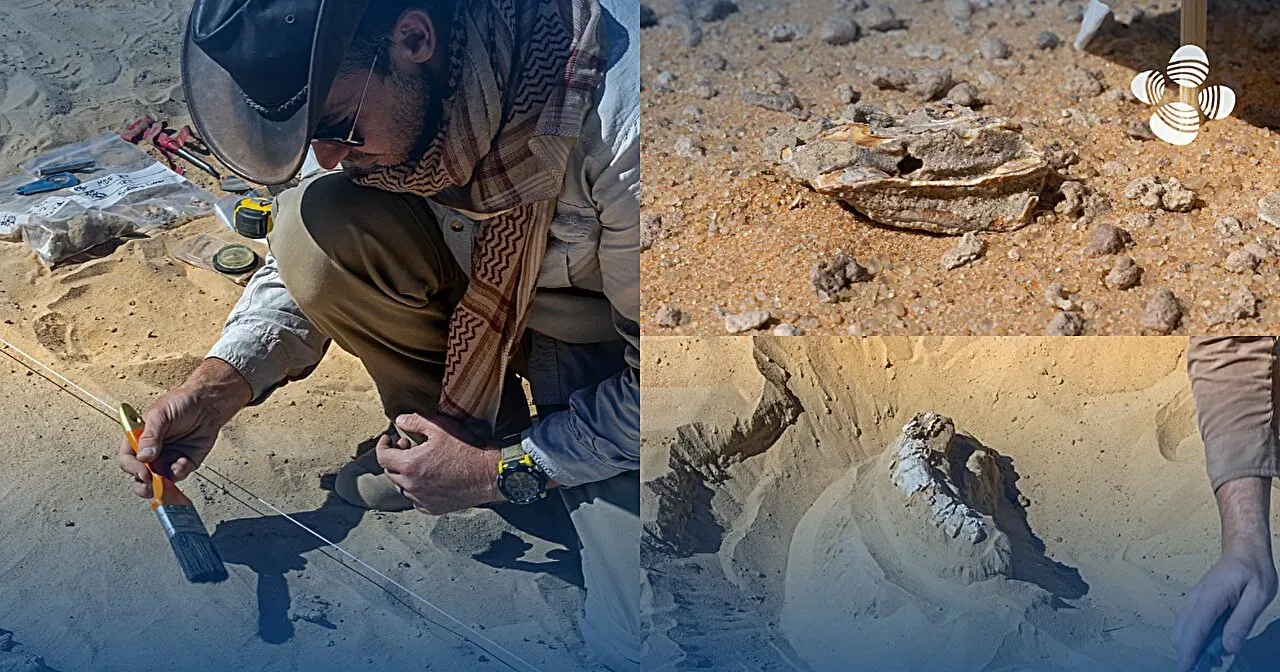
A recently discovered lakeside site in southern Saudi Arabia has yielded a wealth of information about prehistoric human life in the region. The ancient lake, which dates back around 125,000 years, was once home to a thriving ecosystem and a diverse range of plant and animal species.
Researchers from King Abdullah University of Science and Technology have been working alongside colleagues from Griffith University and other international institutions to unravel the secrets of the site, known as Uruq al-Julaybah. By combining insights from geology, archaeology, botany, and micropaleontology, the team has gained a detailed understanding of how early humans lived in this part of Arabia.
A key factor in the region's history is its climate, which was once much wetter and greener than it is today. The researchers have found evidence of a relatively stable freshwater lake surrounded by vegetation and open grasslands, providing a unique window into the past.
To reconstruct the ancient landscape, the team used satellite terrain modeling to create a detailed map of the 340-square-kilometer area surrounding the lake. This work was complemented by systematic grid surveys to collect fossils and stone tools from the site.
The researchers also employed advanced dating methods, including two different techniques applied to sand and fossil teeth, to determine the age of the finds. Additionally, they used 3D-refitting techniques to analyze the structure of stone tools and microscopic and chemical residue analysis to examine tool surfaces for signs of wear.
Further evidence of early human presence was uncovered through the discovery of rare plant material and megafauna remains at the site.
The fossil record at the site is remarkably diverse, with over 500 specimens of plants and animals documented across more than 130 locations. This bounty includes a range of invertebrates, as well as larger animal remains such as hippos, long-horned buffaloes, camels, Arabian oryx, gazelles, and ostriches.
Researchers have collected an impressive number of stone tools from the main study area, with over 5,511 specimens larger than 2 cm in size. The majority of these tools were crafted from flint, a material that was extensively used for this purpose. Analysis has revealed that many of these tools employ Levallois techniques, a method of stone tool production that is both complex and sophisticated.
The presence of plant residues on the stone tools provides valuable insights into the daily lives of the people who occupied the site. These residues include not only edible plants but also those with toxic properties, suggesting that the inhabitants were capable of processing and utilizing a wide range of plant materials for various purposes.
Some of the most significant findings from the site relate to the potential use of toxic plant compounds in hunting technology. This is an intriguing discovery, as it suggests that early humans in this region may have employed innovative methods to enhance their hunting prowess. Additionally, evidence of palm-related vegetation has been uncovered, which adds to our understanding of the local flora and fauna.
The uniqueness of this site lies in its ability to provide a comprehensive picture of daily life for the people who inhabited Green Arabia. The presence of animal remains, stone tools, and plant material, all found together in a single context, offers a rare glimpse into the lives of early humans. This combination of elements has allowed researchers to reconstruct with remarkable detail how these individuals lived, hunted, and interacted with their environment.
The shores of ancient Lake Mundafan were a hub of activity 125,000 years ago, attracting a diverse array of freshwater resources, animals, plants, and raw materials.
This convergence of elements enabled early humans to engage in various activities such as crafting stone tools, preparing hunting equipment, processing animal and plant resources, and working with fibers. The presence of these resources suggests that the lake's shores were an ideal location for human settlement during this period.
Professor Frans van Buchem expresses his enthusiasm for the collaborative effort that has made this reconstruction possible, highlighting the unique value of bringing together specialists from diverse fields to create a comprehensive picture of life in the distant past. The expertise of these researchers has allowed them to shed light on aspects of ancient human behavior and environmental interactions.
Dr. Faisal Al-Jibreen describes the discovery as an important archaeological find that provides valuable insights into the early prehistory of southern Saudi Arabia, particularly with regard to the relationship between humans, animals, and their environment during this period.
The significance of this site lies in its ability to offer a detailed and nuanced view of how people lived in a landscape vastly different from modern-day Arabia. The combination of animal remains, stone tools, and plant material within a single, dated context makes this discovery truly remarkable.
The discovery is significant because it provides a unique window into the lives of early humans living in Saudi Arabia 125,000 years ago. The site's location near a lake suggests that these individuals were able to thrive in a relatively stable and wet environment.
This finding highlights the importance of building heritage science capabilities in Saudi Arabia, allowing researchers to uncover even the smallest traces of human activity from the past. Professor Laurence Hapiot notes that this capability will enable them to turn such discoveries into compelling stories.
Facts based on reporting originally published by Phys.org.
You may republish this story, in full or in part, if you credit News Central Site and link to it (licence CC BY 4.0). Photos are not included.