Collaboration between University of Connecticut's Neag School of Education and Metamorphix aims to support student success
Researchers at the University of Connecticut are partnering with Metamorphix to improve student outcomes through a connected set of tools that track and manage supports.
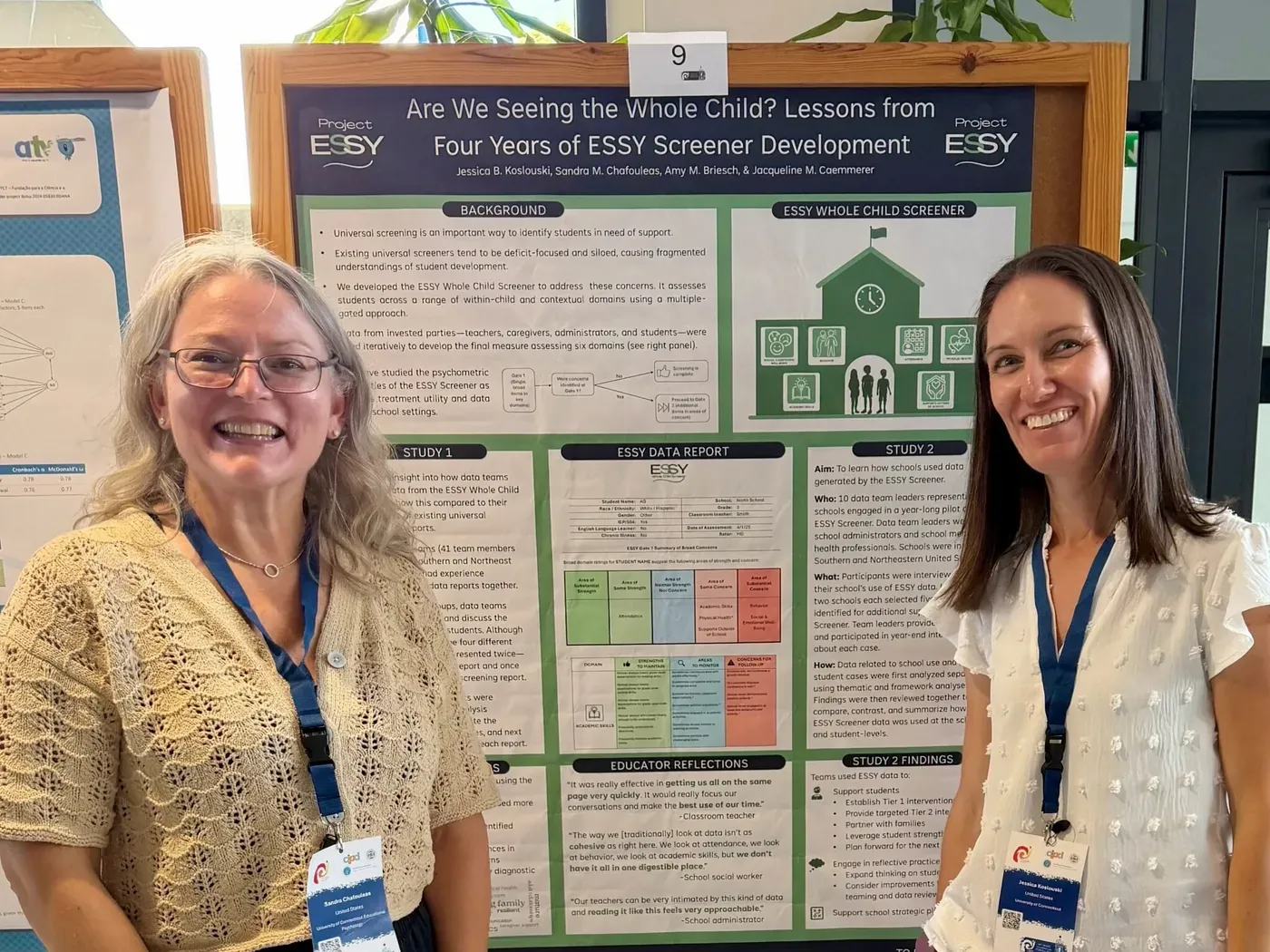
Researchers at the University of Connecticut's Neag School of Education are collaborating with a company that provides schools with innovative solutions to support student success.
The partnership involves Metamorphix, which offers a connected set of tools that turn every student signal into timely and measurable data to track and manage supports. This collaboration was facilitated by the university's Technology Commercialization Services (TCS), which has licensed the ESSY Whole Child Screener to Metamorphix.
The company will incorporate the screening program into its Cascades platform, a multi-tiered system of support that focuses on the whole child. By integrating this tool, schools can better identify students who need extra support and provide them with timely interventions to help them thrive.
This initiative is led by Sandra Chafouleas, a renowned expert in school psychology and one of the developers of the ESSY Whole Child Screener.
The development of the ESSY Whole Child Screener involved a team effort led by Sandra Chafouleas, who is also one of its developers. The screener was created through funding from the U.S. Department of Education's Institute of Education Sciences. Joining Chafouleas on this project were Amy Briesch, M.A. '05, Ph.D. '09, a professor at Northeastern University, and two other faculty members from the same institution: Jackie Caemmerer and Jessica Koslouski.
The goal of Project ESSY was to design a comprehensive tool that would enable schools to identify students' strengths as well as challenges. This approach is based on the idea that traditional assessment methods often overlook underlying issues affecting students' behavior or performance.
When dealing with troubled students, educators might typically focus on behavioral interventions such as creating incentive systems. However, this may not address the root causes of their problems. For instance, a student experiencing morning hunger due to food insecurity would benefit more from access to school meals than from an incentive plan.
To ensure that the ESSY Screener was feasible and effective in real-world settings, its developers sought feedback from various stakeholders including school administrators, teachers, parents, students, and advisory boards. They gathered multiple rounds of input before conducting a large pilot test to validate the screener's performance.
The results of this pilot test were published in the journal School Mental Health, providing valuable insights into how schools used the ESSY Screener to inform their decision-making processes.
School leaders who used the ESSY Screener reported that it gave them a more comprehensive understanding of their students' needs.
This tool was seen as particularly valuable because it aligned with their existing philosophies on child development, which emphasize the importance of considering multiple factors when assessing a student's well-being.
The developers of the ESSY Screener subsequently sought out an educational technology company to partner with in order to make the screener more widely available.
They chose Metamorphix, whose platform called Cascades was already being used by many schools to review data and connect students with suitable interventions.
Metamorphix was looking for a new screening tool that would complement its existing whole-child focus.
The partnership between the University of Connecticut and Metamorphix is moving forward quickly, thanks to the collaboration between the two entities.
This partnership was crucial in putting together a complete system, says Chafouleas. The university had been missing a way to get its screener to schools efficiently and in a usable format, which the Metamorphix Cascades platform could provide by incorporating the screener.
The combination of forces between the university and Metamorphix enables them to help schools assess students' needs to develop appropriate interventions through multi-tiered systems of support. The user-friendly Cascades platform can incorporate feedback on how to present data, making it a valuable tool for educators.
Naren Balasubramaniam, co-founder and CEO of Metamorphix, is also enthusiastic about the agreement. We are proud to partner with the University of Connecticut to advance our mission, he says. The goal is to pair ESSY's whole child screener with Cascades to give educators a more complete picture of each student's needs and context.
The ESSY Whole Child Screener is a tool designed to assess students' social-emotional learning and mental health needs. This assessment is part of an ongoing effort to pair it with the Cascades system, which tracks student data over time. By combining these tools, educators hope to get a more comprehensive understanding of each student's strengths and challenges.
The goal is to provide a holistic view of students' needs, allowing educators to tailor their support to individual circumstances.
Facts based on reporting originally published by Phys.org.
You may republish this story, in full or in part, if you credit News Central Site and link to it (licence CC BY 4.0). Photos are not included.