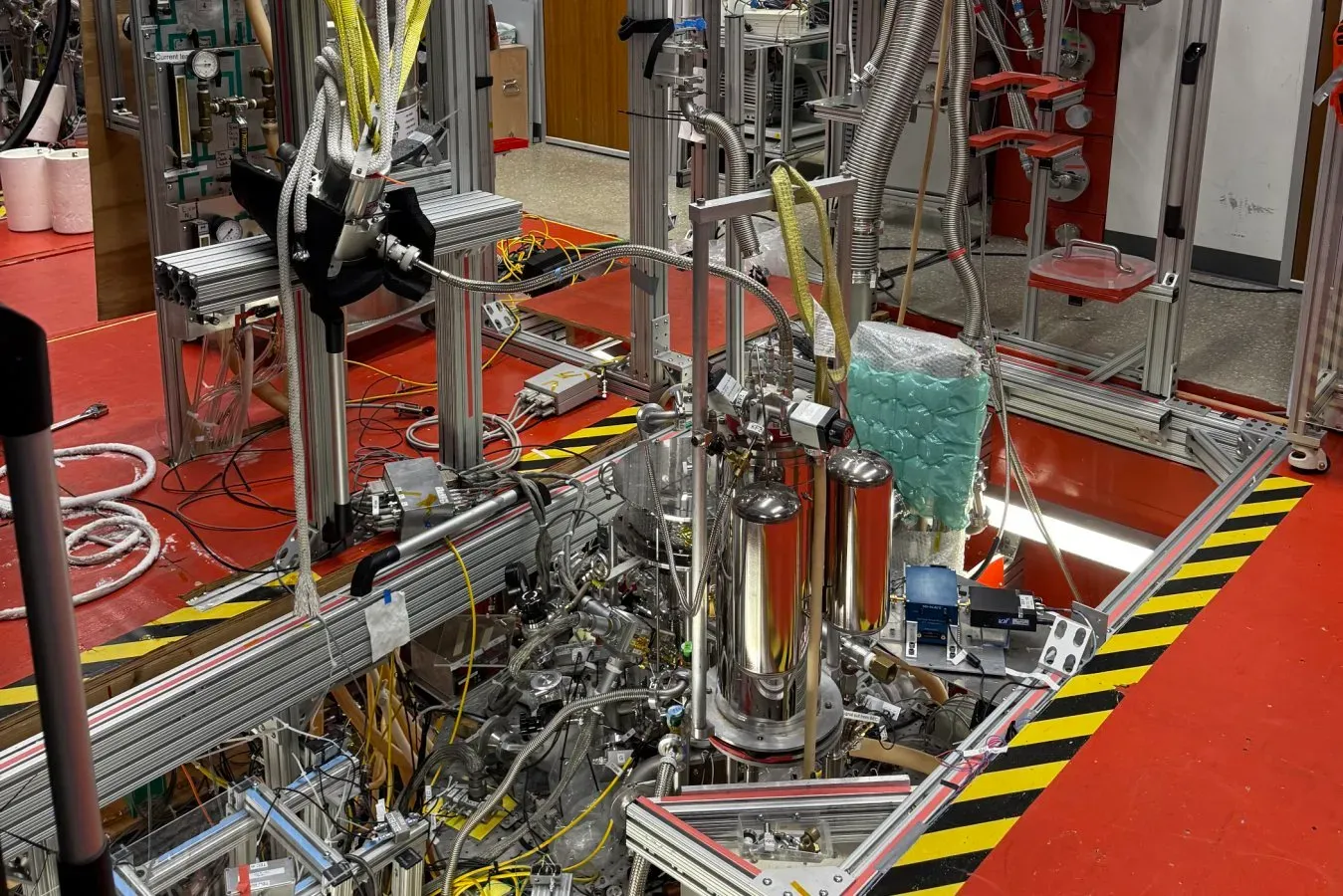
Physicists Propose New Method for Testing Standard Model Prediction
A team of physicists has developed a method to test a fundamental prediction of the Standard Model by trapping a single positron in a quantum cyclotron.
Physicists have proposed a new way to test a fundamental prediction of the Standard Model, which describes the behavior of subatomic particles. The key prediction is that the magnetic moment of the positron, the antimatter counterpart of the electron, should be exactly equal and opposite to the electron's.
A team led by Gerald Gabrielse at Northwestern University in Illinois has developed a method to trap a single positron in a "quantum cyclotron, which could potentially test this assumption. This device would allow researchers to study the behavior of individual particles with unprecedented precision.
The prediction is based on CPT symmetry, a principle that suggests that if we swap every particle for its antiparticle and flip the universe into its mirror image, while also running time backward, the laws of physics would remain unchanged.
The positron's magnetic moment is another crucial aspect of the Standard Model that requires precise measurement. Researchers have made significant strides in determining this value for electrons, but the same accuracy has not been achieved for positrons due to the challenges associated with isolating and cooling them.
To overcome these obstacles, scientists have employed creative methods to capture and slow down positrons. One approach involves using a radioactive sodium source that releases positrons at high speeds, which are then decelerated before being confined within a trap.
In their research, Gabrielse's team adopted this method by pairing a single positron with an electron to form positronium, an electrically neutral atom. This process allows the positron to be isolated and then torn apart from its electron partner inside the trap, leaving it free to be measured.
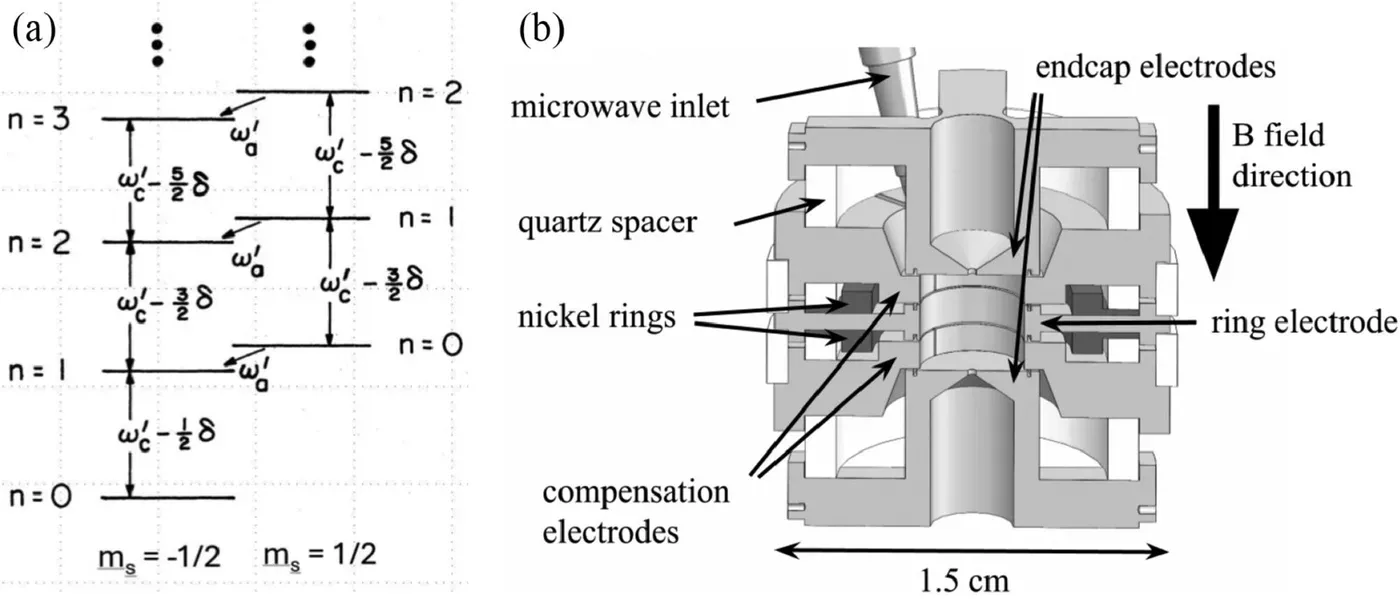
The positrons were then stored in a Penning trap, which utilizes both magnetic and electric fields to contain the particle in a circular motion, much like miniature cyclotrons used in particle accelerators. This setup enabled researchers to examine the positron's behavior under precise conditions.
By cooling the trap to just above absolute zero, scientists were able to minimize thermal fluctuations and allow the positron to settle into its lowest-energy state, making it possible to measure its magnetic moment with greater accuracy.
The positron's energy was now divided into distinct steps, allowing researchers to manipulate its state with precision. By using microwaves and carefully controlled spin flips, scientists could nudge the positron up or down a single step at a time.
This precise control enabled researchers to monitor the positron's motion within the trap by detecting tiny shifts in its back-and-forth movement. This allowed them to simultaneously track the positron's spin without disturbing either its motion or magnetic properties.
The positron can be stored for several months once it is captured, paving the way for future experiments that could measure its magnetic moment with unprecedented accuracy. These measurements have the potential to rival existing electron measurements by a factor of 30 or more.
This demonstration of a one-positron quantum cyclotron" also paves the way for stringent tests of CPT symmetry and a powerful new tool for probing the predictions of the Standard Model.
This innovative design of a one-positron quantum cyclotron enables researchers to study particles with unprecedented precision, allowing for more accurate testing of fundamental theories in physics.
The demonstration of this device also opens up new possibilities for probing the predictions of the Standard Model, which could potentially reveal subtle deviations from expected behavior. This breakthrough has significant implications for our understanding of the universe and may lead to groundbreaking discoveries in the field of particle physics.
Facts based on reporting originally published by Phys.org.
You may republish this story, in full or in part, if you credit News Central Site and link to it (licence CC BY 4.0). Photos are not included.