The Sun's Massive Explosions of Energy Released as Solar Flares
Solar flares occur when massive explosions of energy are released from the sun's surface, often accompanied by coronal mass ejections that can interact with Earth.
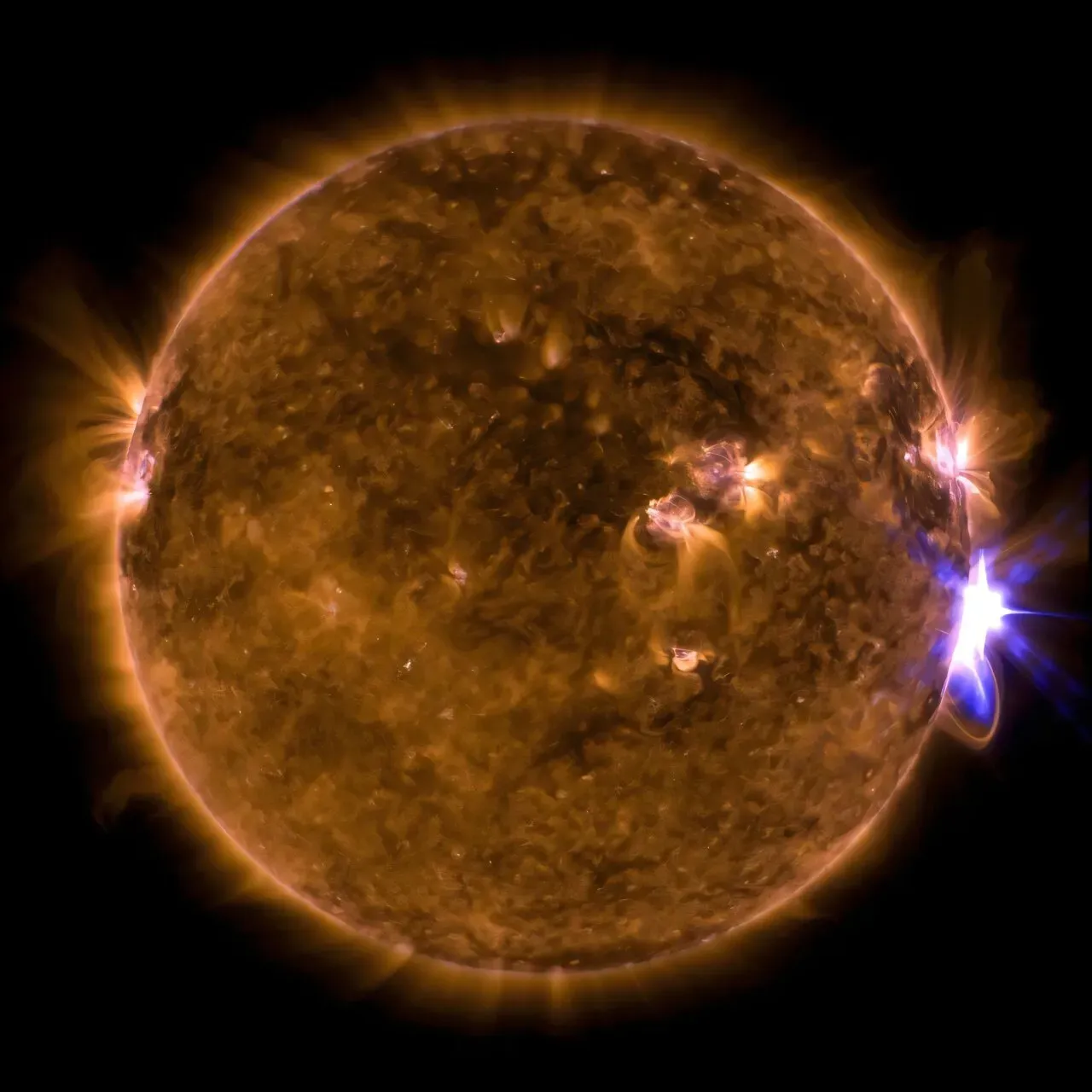
The sun's behavior has a profound impact on our daily lives, and its flaring is particularly noteworthy. This phenomenon occurs when massive explosions of energy are released from the sun's surface, often accompanied by coronal mass ejections that can interact with Earth.
These solar flares can be mesmerizing to behold, as they create spectacular auroras in the polar skies when their CMEs strike our planet. However, they also have a more significant impact on our lives than just being visually stunning. Their effects can be far-reaching and potentially hazardous.
To better understand these events, astrophysicists have developed a classification system based on X-ray brightness. Solar flares are grouped into categories from A to X, with each letter representing a tenfold increase in energy output. This system allows researchers to analyze the severity of solar flares and their potential consequences for our planet.
The sheer scale of these explosions is awe-inspiring, releasing an enormous amount of energy equivalent to millions or even billions of hydrogen bombs detonating simultaneously. By comparison, supervolcano eruptions on Earth are relatively mild and even the asteroid that wiped out the dinosaurs pales in significance against the power of a solar flare.
Solar flares have been observed to release massive amounts of energy into space, dwarfing other known natural phenomena in terms of their scale and intensity. This unique characteristic makes them an area of ongoing research for scientists seeking to understand the workings of our star and its impact on our world.
The sun's powerful magnetic fields are constantly in motion, twisted and rotated by its internal dynamics. This twisting and rotating can lead to a phenomenon known as reconnection, where the magnetic fields finally snap due to their inability to withstand the stress.
When reconnection occurs, some of the sun's energy is released from its magnetic restraints and emitted as a solar flare. These flares can have significant effects on our daily lives, causing radio blackouts when they strike the ionosphere and disrupting aviation and maritime communications.
Solar flares can also introduce inaccuracies in GPS systems by altering the altitude of satellites and create malfunctions in electronics on spacecraft. Furthermore, their accompanying coronal mass ejections (CMEs) can disrupt our power grids, highlighting the importance of understanding these solar events.
Research is ongoing to better comprehend the mechanisms behind solar flares, including the process of magnetic reconnection that triggers them. A recent study published in The Astrophysical Journal aims to shed light on this complex phenomenon and its relationship to flare ribbon substructure.
The authors of this research focused on flare ribbons, which are essentially the "footprints" left behind by a solar flare as it interacts with the sun's chromosphere. These ribbons are made up of plasma and high-energy particles that slam back into the sun during reconnection, following magnetic field lines and lighting up brightly when they collide with the chromosphere.
Recent research on solar flares has led to a better understanding of their internal dynamics. Flare ribbon substructure is now seen as a key indicator of the fragmentation process within the reconnecting current sheet in the corona.
To quantify the evolution of flare ribbons and their substructure, scientists have been studying small details where these ribbons deposit energy into the chromosphere. This close examination has provided valuable insights into processes occurring far above the Earth's atmosphere.
A model was developed to analyze the behavior of flare ribbons and tested against simulated observations. The model's accuracy was then confirmed by applying it to real data from a solar flare observed in 2015.
The study revealed that when flares release energy, the process is not uniform but rather fragmented. Instead of one major energetic event, the flare ribbon breaks apart into smaller fragments, depositing its energy in bursts.
This finding has significant implications for understanding the internal dynamics of solar flares and their impact on the surrounding environment.
The researchers used a novel tool adapted from another field to analyze the patterns below the flare ribbon boundaries and found that their complexity increased with reconnection rate.
This finding was made possible by applying a quantitative observational test of simulations that had suggested this behavior for years but lacked confirmation through observations. The team's work demonstrates the importance of collaboration between scientists from different fields, as well as the value of persistence and creativity in graduate research.
The patterns observed below the flare ribbon boundaries are thought to provide clues to difficult-to-observe processes occurring above, specifically in the energy conversion region of solar flares. By studying these irregularities, researchers can gain a better understanding of what is happening in this region.
The study's conclusion highlights the potential for using spatial complexity as an observational proxy for current-sheet fragmentation in the corona.
The study's findings are significant because they provide a new perspective on how solar flares release their energy. The researchers analyzed flare ribbons and found that their spatial complexity can be used as an observational proxy for current-sheet fragmentation in the corona.
This discovery is crucial for improving our understanding of magnetic reconnection dynamics, which play a key role in solar flaring. By linking flare ribbon morphology to reconnection dynamics, the study provides valuable insights into the underlying processes driving these powerful events.
The study's conclusion highlights the potential for using spatial complexity as an observational proxy for current-sheet fragmentation in the corona. This breakthrough will contribute to the development of more accurate models of solar flares and their impact on space weather.
Facts based on reporting originally published by Phys.org.
You may republish this story, in full or in part, if you credit News Central Site and link to it (licence CC BY 4.0). Photos are not included.