Spatial Genomics Tool Maps Long-Range DNA Interactions in 3D Tissues
A new spatial genomics tool has been developed that maps long-range DNA interactions while preserving cells' locations within tissues. This innovative technology allows researchers to study...
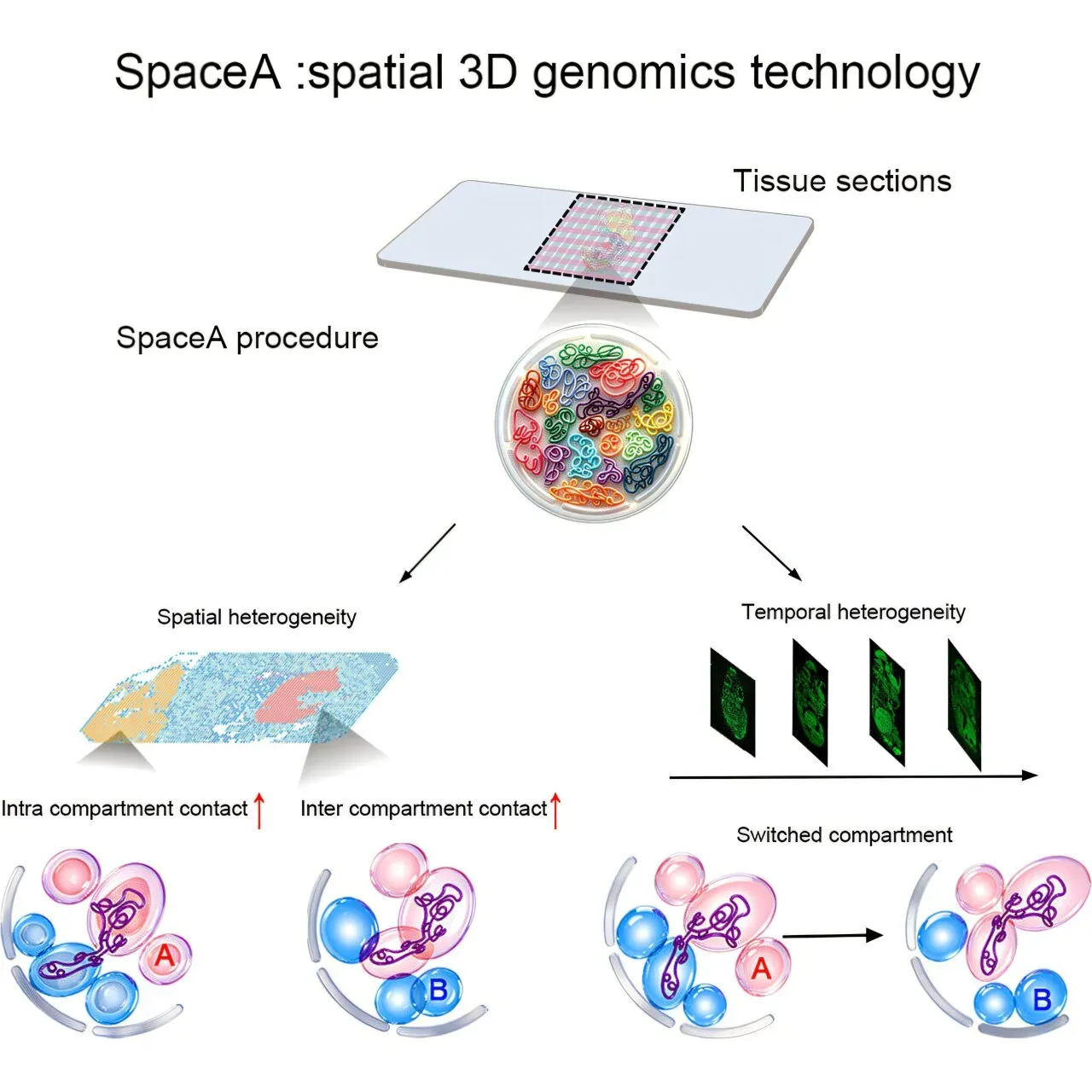
A new spatial genomics tool has been developed that maps long-range DNA interactions while preserving cells' locations within tissues. This innovative technology allows researchers to study how complex three-dimensional structures are regulated and change over time. The research team behind the tool, led by professor Li Xiang from the Institute of Genetics and Developmental Biology in China, has made significant progress in understanding the intricate organization of DNA.
The tool, called SpaceA, combines two approaches to investigate higher-order chromatin architecture while preserving spatial context. It uses microfluidic spatial barcoding to assign molecular identifiers to different locations within a tissue section. This enables researchers to determine where specific chromatin interactions occur, providing valuable information about long-range DNA connections.
SpaceA also employs a SPRITE-like ligation-free contact detection strategy that detects interactions between chromatin regions without physically joining DNA fragments. This approach allows for the identification of complex relationships between different parts of the genome. By combining these two methods, SpaceA offers a powerful tool for researchers to study the intricate organization of DNA.
The development of SpaceA represents an important step forward in understanding how cells interact with their environment and how genetic information is organized within tissues. The team's research has significant implications for fields such as cancer biology, developmental biology, and regenerative medicine, where a deeper understanding of chromatin architecture could lead to new insights and therapeutic strategies.
The tool is designed to help researchers better understand the complex three-dimensional organization of DNA in cells. This knowledge can be used to identify patterns and relationships that are not visible through traditional methods. By studying long-range DNA interactions, scientists can gain a more complete understanding of how genetic information is organized within tissues.
SpaceA's ability to map chromatin interactions while preserving spatial context makes it an ideal tool for researchers who need to study the intricate organization of DNA in real-time. The technology has far-reaching implications for various fields and could lead to significant breakthroughs in our understanding of cellular biology.
The study published in Developmental Cell highlights a significant limitation of current single-cell 3D genomics technologies: their inability to preserve the spatial positions of cells within tissues.
These methods are unable to capture how genome architecture regulates gene expression in its native cellular environment, making it challenging to understand the complex relationships between chromatin conformation and gene function.
To overcome this challenge, researchers developed a novel tool called SpaceA, which allows for the mapping of long-range DNA interactions while preserving cells' locations within tissues. This breakthrough technology has been applied to nine mouse embryo sections spanning four developmental stages.
Using SpaceA, the researchers analyzed the changes in chromatin conformation during embryonic development and discovered significant transitions in A/B compartments between E12.5 and E13.5, coinciding with profound transcriptomic changes.
Microscopy revealed that liver cell nuclei exhibit a distinct heterochromatin adhesion pattern, providing further evidence of this chromatin structure's presence.
This pattern stands in contrast to the classical model, where gene expression is promoted through A/B compartment switching or intracompartmental interactions. Instead, a global decline in gene expression accompanies the heterochromatin adhesion observed in liver cell nuclei.
The discovery highlights significant deviations from traditional models of chromatin structure and gene regulation during embryonic development, underscoring the complexity of long-range DNA interactions within tissues.
Facts based on reporting originally published by Phys.org.
You may republish this story, in full or in part, if you credit News Central Site and link to it (licence CC BY 4.0). Photos are not included.