Launch Scheduled for Unmanned Mission to Mars' Moons
The Martian Moons eXploration (MMX) probe will travel to Mars and its moons, Phobos and Deimos, in a mission that could revolutionize our understanding of the solar system and life on Earth.
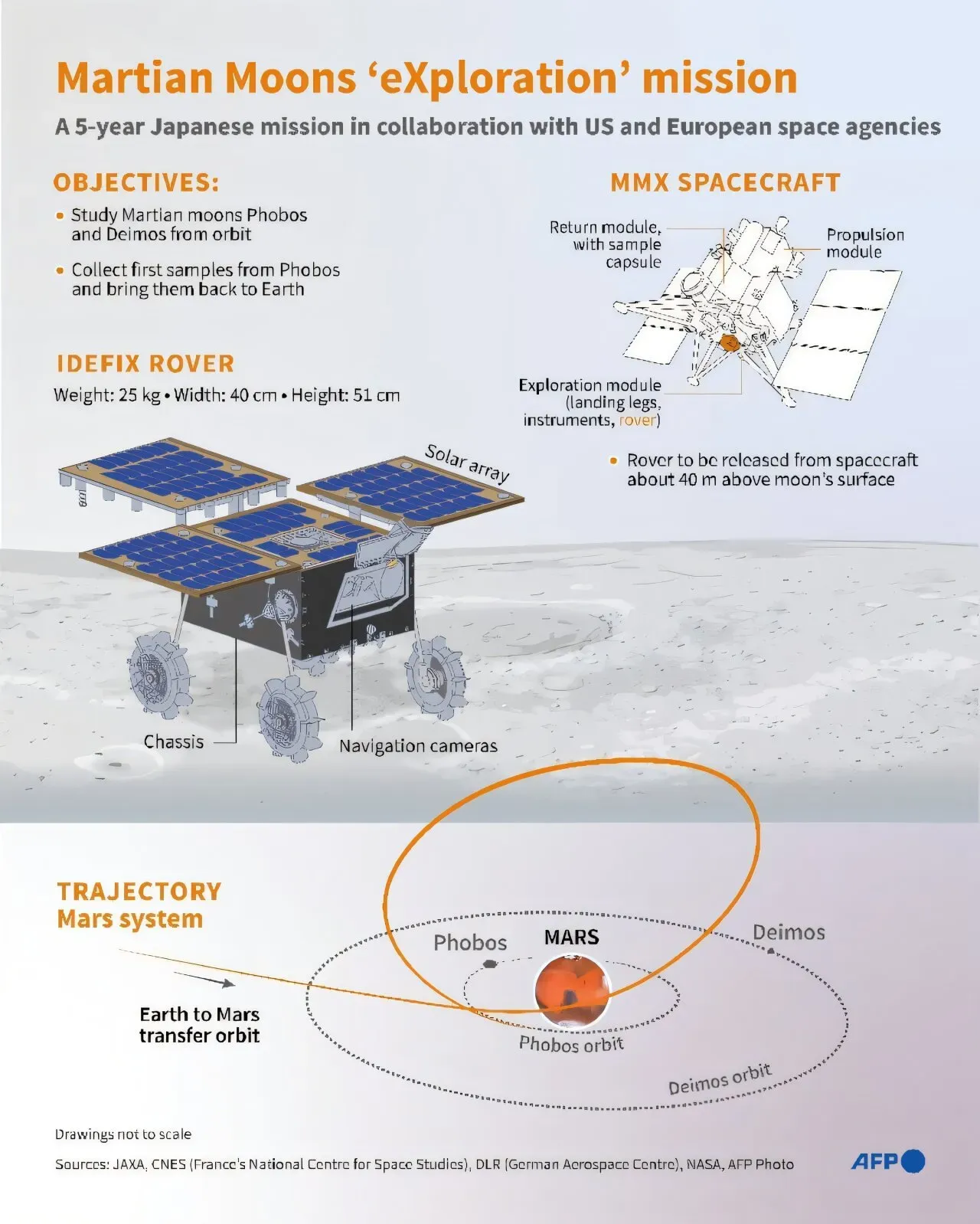
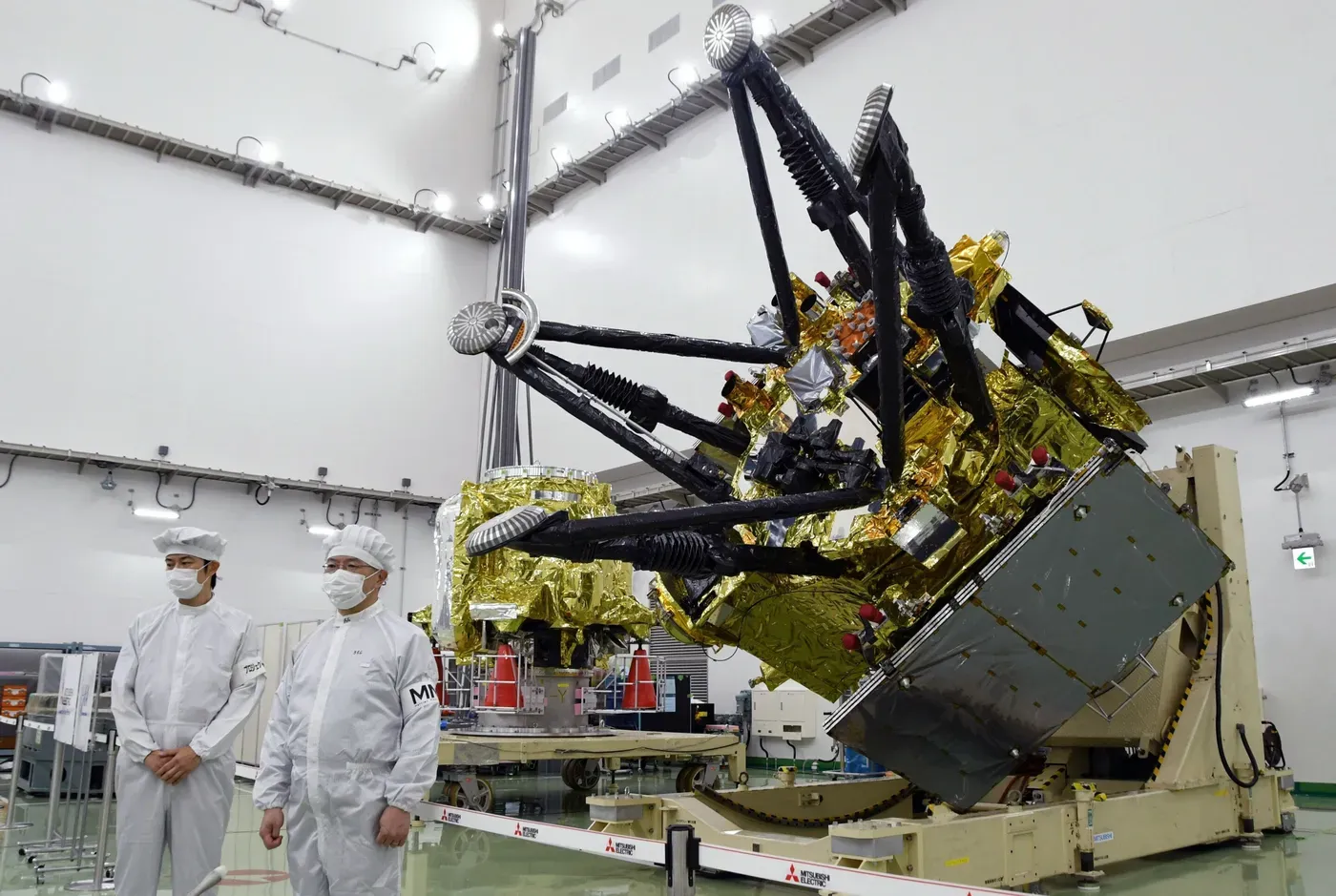
Japanese scientists are gearing up to embark on an unprecedented journey to Mars' moons in a mission that could revolutionize our understanding of the solar system and life on Earth. The unmanned Martian Moons eXploration (MMX) probe is the culmination of a collaborative effort between Japanese, American, and European space agencies as well as numerous universities and tech companies.
The MMX spacecraft will be launched aboard the flagship H3 rocket from the Tanegashima Space Center, with liftoff scheduled for 4:41 a.m. on Tuesday, according to the Japan Aerospace Exploration Agency (JAXA). Project manager Makoto Arita expressed his excitement about being part of this historic mission, stating that it is "incredibly exciting to be involved.
The MMX spacecraft will travel through space and arrive near Mars in August next year, where it will enter orbit around one of the planet's moons, Phobos. The spacecraft will then land on Phobos' surface and collect at least 10 grams of material from the Martian moon over a period of three years.
The mission to retrieve samples from Phobos is crucial for understanding the origins of the solar system and potentially shedding light on the existence of life beyond Earth. The MMX probe's findings will also lay the groundwork for future human exploration of Mars, making this mission a significant milestone in space research.
The MMX probe's sampling mission to Phobos is marking a significant milestone in space exploration as it becomes the first round trip to the Martian system.
JAXA scientists are also looking into the possibility of utilizing Phobos as a natural space station for future crewed missions to Mars, by establishing the requirements for a round trip to the Red Planet.
In addition to studying Phobos, the mission will observe Deimos, the other Martian moon, from afar. Although it won't land on Deimos, this observation will provide valuable insights into the Martian system's dynamics.
JAXA researchers are seeking to understand how Mars and its moons formed through this mission. The formation of these celestial bodies is crucial in understanding the origin of our solar system.
The giant impact hypothesis suggests that Phobos and Deimos were formed after a massive collision with Mars, while the capture theory proposes they are captured asteroids.
The weak gravitational pull of Phobos is a significant challenge for any spacecraft attempting to land on the Martian moon. According to JAXA scientists, developing landing legs capable of handling this environment was particularly difficult. The mission's designers had to find ways to ensure that the craft could safely touch down and collect samples.
Japan has a history of successfully retrieving samples from space. In 2020, the Hayabusa-2 spacecraft returned over five grams of rock and dust collected from an asteroid hundreds of millions of kilometers away. This achievement demonstrates Japan's expertise in navigating the complexities of space exploration and sample collection.
The upcoming mission to Phobos will require even more precision and skill due to the need for the spacecraft to escape Mars' strong gravitational pull before returning to Earth. Kawakatsu noted that this would necessitate traveling extremely close to the planet, which is a significant challenge in itself.
Japan's experience with landing on the Moon has also been valuable in preparing for the Phobos mission. The Smart Lander for Investigating the Moon (SLIM), nicknamed the Moon Sniper, successfully transmitted data after tipping over during its 2024 lunar touchdown. Although it did not survive the harsh conditions of a lunar night, the SLIM's performance provided essential insights for future missions.
The collaboration between JAXA and other international partners such as France's CNES, Germany's DLR, NASA, and the European Space Agency has been instrumental in making this historic mission possible. Over 20 universities and tech companies are also contributing to the project, further underscoring its global scope and significance.
The Martian moon Phobos is set to be explored like never before as Japan prepares to launch a historic round-trip mission to the celestial body.
Phobos orbits approximately 6,000 kilometers above the Martian surface, making it an attractive target for scientists seeking to uncover its secrets. According to experts, navigating this region of space poses significant challenges due to the intense gravitational forces at play. Going deep into what we call the 'gravity well' is difficult," noted Kawakatsu.
The mission comes as NASA's Perseverance rover continues to collect samples on Mars since 2021. However, a previous attempt by NASA to return rock samples from the Martian surface was canceled in January following a vote by Congress. Meanwhile, China has announced plans to launch its Tianwen-3 spacecraft around 2028 with the goal of returning Mars samples to Earth as early as 2031.
The Japanese mission aims to collect sand and rocks from Phobos, which may offer a wider variety of samples than those found on Mars itself. Scientists believe that Phobos could have formed through a collision between a celestial body and Mars, making it an intriguing target for research.
Facts based on reporting originally published by Phys.org.
You may republish this story, in full or in part, if you credit News Central Site and link to it (licence CC BY 4.0). Photos are not included.