Groundbreaking Discovery Made Using ORCA Telescope in Mediterranean Sea
Physicists have made a groundbreaking discovery using a state-of-the-art telescope submerged in the Mediterranean Sea off the coast of France.
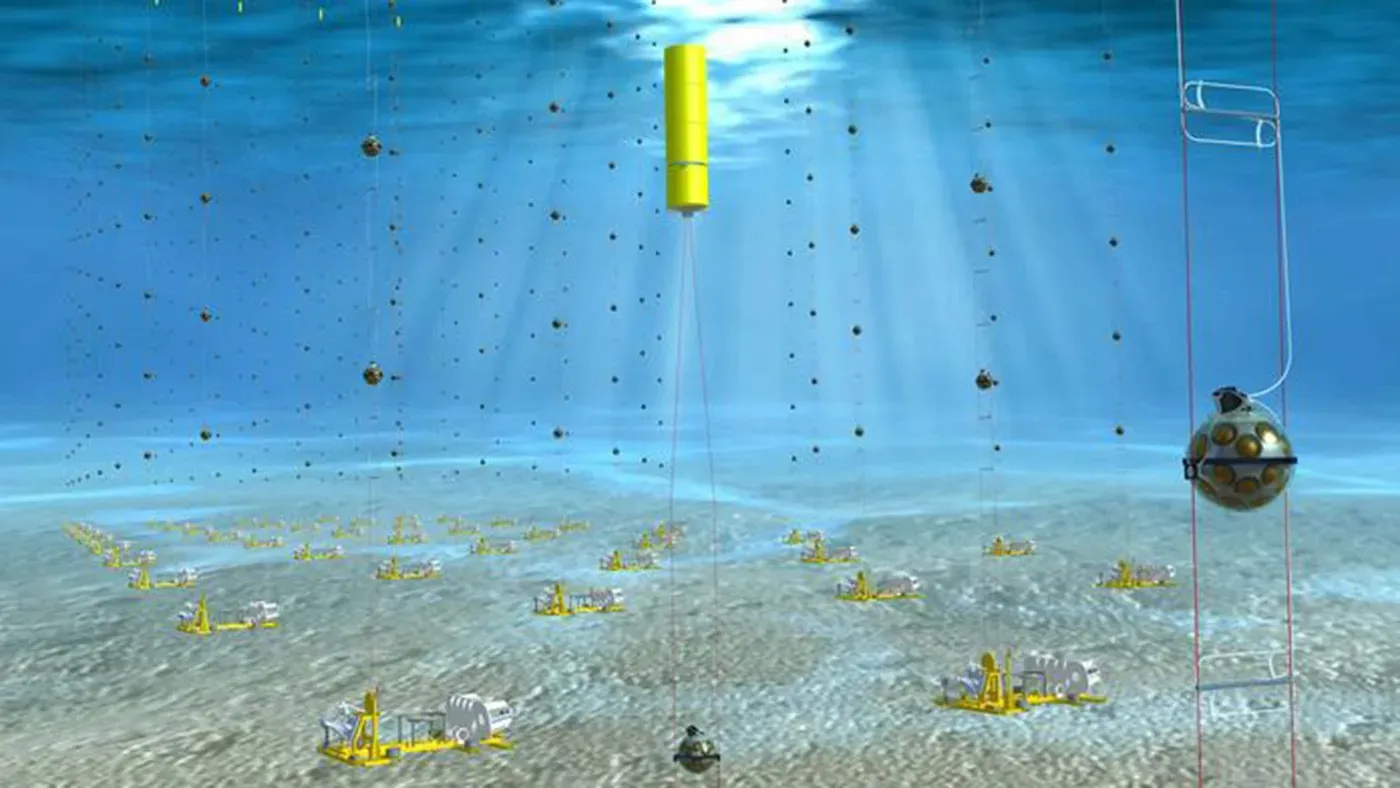
Physicists have made a groundbreaking discovery using a state-of-the-art telescope submerged in the Mediterranean Sea off the coast of France. The telescope, known as Oscillation Research with Cosmics in the Abyss (ORCA), has been detecting elusive particles called neutrinos at a depth of over 1.5 miles beneath the waves.
The ORCA detector is designed to study these tiny particles, which are notoriously difficult to detect due to their ability to pass through solid objects almost undisturbed. By analyzing data from the first detection units, researchers aimed to test one of Einstein's core principles: that the laws of nature remain unchanged regardless of an object's direction or speed.
The team found no evidence to contradict this fundamental concept, known as Lorentz invariance. Despite being a fraction of its planned size, the ORCA detector set limits on this principle that rival those of larger and more long-running experiments.
The findings, published in the Journal of Cosmology and Astroparticle Physics, offer significant insights into our understanding of space-time and the universe as a whole.
Physicists have long sought to merge two fundamental theories of our universe: general relativity and the Standard Model of particle physics. These theories describe the universe on vastly different scales, yet they share a common assumption known as Lorentz invariance.
However, when pushed to extreme settings, such as the moments immediately following the Big Bang, these theories fail to align with each other. This disparity has driven researchers for decades to develop a unified theory of quantum gravity that reconciles the two frameworks.
Some proposed candidates, including string theory and loop quantum gravity, suggest that space-time may have an underlying "grain" at its most fundamental levels. This idea implies that Lorentz invariance, a cornerstone assumption of our understanding of the universe, might be compromised.
The minute scale of any such violation necessitates the use of a probe capable of traversing vast distances with minimal interaction with its surroundings.
The researchers focused on detecting neutrinos created when cosmic rays collided with the Earth's atmosphere elsewhere on the globe. These high-energy particles traveled up through the planet before reaching the detector. By targeting neutrinos generated in this way, the team was able to minimize the impact of local sources of background radiation that could interfere with their measurements.
The detection units were anchored to the seabed and consisted of 18 glass spheres packed with 31 light sensors each. When a neutrino collided with a particle in the water, it produced a faint flash of blue light that the sensors could detect. The numerous sensors within each sphere helped the team pinpoint the direction from which the light originated.
The researchers employed a technique to filter out unwanted particles and isolate the neutrinos. Earth itself served as a natural filter, allowing only upward-traveling particles to reach the detector. By selecting only these particles, the team was able to exclude the vast majority of other particles from the atmosphere that would have overwhelmed the signal.
To further refine their measurements, the researchers selected particles that had traveled significant distances through the Earth's interior. Some of the tested neutrinos even crossed the entire 7,900-mile width of the planet before reaching the detector.
The researchers used a unique approach to test Einstein's theory of relativity, which states that the laws of physics are the same everywhere in the universe. The setup was different from that of IceCube, another neutrino detector buried in Antarctic ice, where light is scattered and absorbed differently due to the presence of ice.
This difference in behavior affects how scientists reconstruct a neutrino's energy and path. The team used 5,828 neutrinos collected over about 17 months between 2020 and 2021, which provided valuable data for their analysis. By studying these particles, they were able to test the limits of Lorentz invariance.
The researchers found that the oscillations of the neutrinos matched standard physics predictions, indicating that any potential Lorentz violation must be weaker than the limits set by this study. This finding has significant implications for theoretical models, as it rules out certain models that predict stronger violations of Lorentz invariance.
According to Dr. Hennig, if a model predicts a Lorentz invariance violation stronger than the new limits, the data would rule it out as incorrect. The team also set direct limits on a type of violation that distinguishes between muon and tau neutrinos, which is an important area of study in particle physics.
The results from this detector are notable for their competitiveness with other large-scale experiments, such as Japan's Super-Kamiokande, which used 12 years of data to achieve similar limits. Dr. Hennig expressed surprise at the team's ability to achieve comparable results with only six detection units, highlighting the efficiency and effectiveness of their setup.
The team behind the experiment is planning for a significant expansion of its underwater detection units, aiming to have 44 operational by now and eventually increasing that number to 108 by 2030.
To further test the validity of Einstein's theory, the researchers plan to analyze neutrinos from distant cosmic sources, which are thought to be ideal candidates for detecting any potential Lorentz-violating effects due to their high energy levels. The team also intends to repeat its search using another detector located off the coast of Sicily, called ARCA, which is designed specifically to capture these high-energy particles.
Facts based on reporting originally published by Live Science.
You may republish this story, in full or in part, if you credit News Central Site and link to it (licence CC BY 4.0). Photos are not included.