New water heater design aims to eliminate Legionella bacteria
Researchers at the National Institute of Standards and Technology have developed an innovative design that seeks to utilize heat exchangers in a new way, commonly found in air conditioners, heat pumps, furnaces, and refrigerators.
A new approach to water heater design has been developed by researchers at the National Institute of Standards and Technology, aimed at eliminating harmful bacteria like Legionella pneumophila in household water tanks. The current challenge is that standard water heaters often struggle to reach high enough temperatures to kill these bacteria, which can cause Legionnaires' disease.
Legionella bacteria thrive in warm environments, making it difficult for standard water heaters to eradicate them completely. While these bacteria may be vulnerable at higher temperatures, achieving such heat with existing water heaters would also pose a risk of scalding to human skin when faucets are turned on.
Researchers at the National Institute of Standards and Technology have developed an innovative design that seeks to utilize heat exchangers in a new way. This technology is commonly found in air conditioners, heat pumps, furnaces, and refrigerators. To learn more about this approach, I spoke with David Yashar, a mechanical engineer who played a key role in its development.
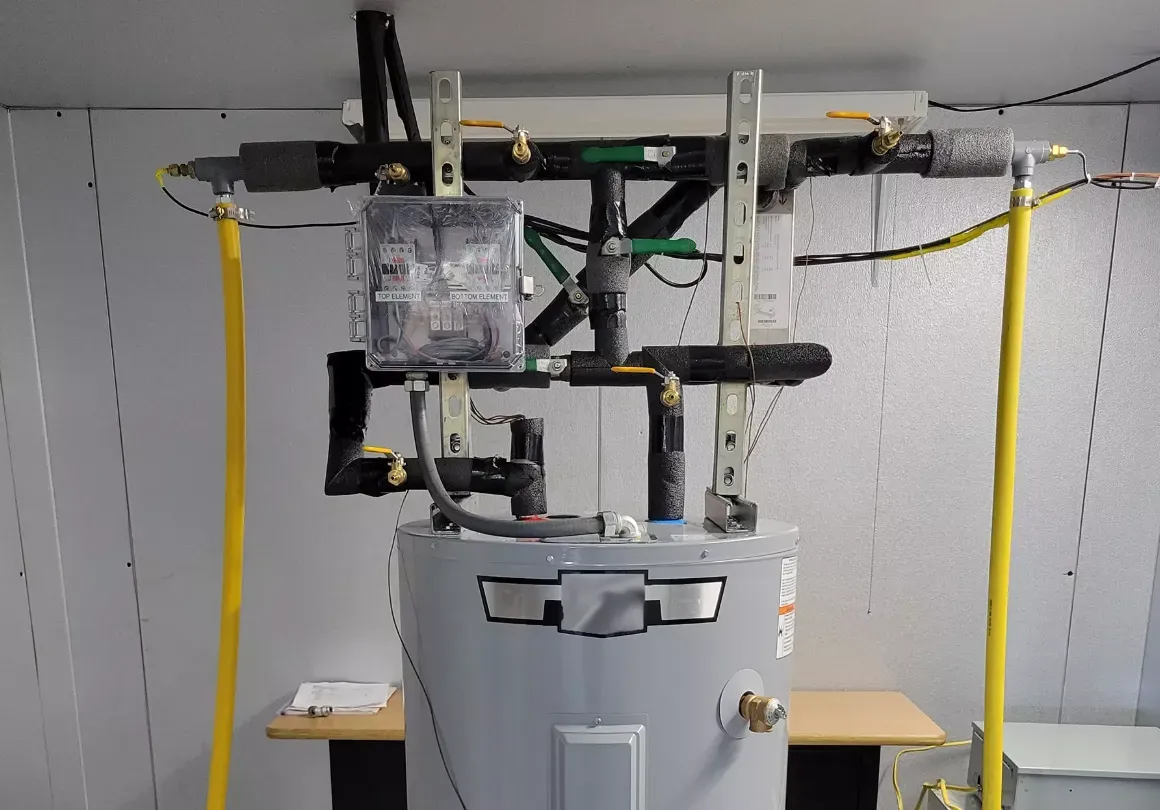
Yashar's team had to find a solution that would allow tank temperatures of around 160 degrees Fahrenheit to be both safe for humans and practical in everyday use. They achieved this by incorporating an unmixed heat exchanger into the design. This component allows cold water entering the system to cool hot water leaving the tank, without mixing the two.
The new design utilizes a separate section for the heat exchanger, which contains both the water inlet and outlet. This separation is crucial in preventing the hot and cold waters from mixing, thereby maintaining safe temperatures while still achieving the high heat needed to kill Legionella bacteria.
The new water heater design utilizes an innovative principle where incoming cold water receives a heating boost from the hot-water outlet while being cooled to safe levels for human consumption.
This process enables the tank to maintain high temperatures necessary to prevent the growth of pathogens behind illnesses such as Legionnaires' disease, which has a fatality rate of around 10%, according to the Centers for Disease Control and Prevention.
As I examined the design further, I noticed similarities between the unmixed heat exchanger and those used in heating, ventilation and air conditioning systems. In fact, air conditioners employ a heat exchanger to pull heat from indoor air and push it outside without drawing in external air.
The use of an unmixed heat exchanger is not unique to water heaters; similar technology can be found in refrigerators and heat pumps. For instance, heat pumps may utilize a heat exchanger for defrosting ice buildup when operating in heating mode.
When discussing the similarities with Yashar, he explained that his background in HVAC&R led him to draw inspiration from existing technologies. He noted that it is common to use unmixed heat exchangers to manipulate temperature conditions and achieve specific outcomes.
Yashar's idea for the unmixed heat exchanger was sparked by learning about Legionella and traditional mitigation strategies. By using this design, he found a simple and cost-effective way to raise water temperatures while also cooling them back down to safe levels.
The innovative design of Yashar's heat exchanger has not only improved energy efficiency but also found a simple and cost-effective way to raise water temperatures while cooling them back down to safe levels. This breakthrough is a testament to the value of repurposing existing technology.
While the concept has been proven using a 60-gallon tank, it remains uncertain when this technology will become available for consumer use. Manufacturers must first license the design and adapt it into products suitable for homes, a process that could take several years or be completed quickly.
Retrofitting existing water heaters in people's homes is possible but would require significant modifications to the tank's hardware and controls. According to Yashar, while the concept was initially designed with retrofitting in mind, the steps involved may not be straightforward for existing applications.
The success of a retrofit depends on proper insulation, which is essential for minimizing standby losses when the system is not in use. Without adequate insulation, any efficiency gains from the heat exchanger would be negated by heat loss during standby mode.
Extra insulation is necessary to ensure that the tank temperature does not exceed what the existing system was designed for, thereby preventing significant energy waste. This highlights the importance of considering practical implementation when developing innovative technologies like Yashar's heat exchanger design.
Developing a product based on Yashar's heat exchanger design seems more feasible than retrofitting existing water heaters. This approach would allow manufacturers to incorporate the innovative technology from the outset and balance its benefits with practical considerations like energy efficiency.
Implementing such a system could involve designing new appliances or modifying existing ones, taking into account factors like cost-effectiveness for consumers.
Facts based on reporting originally published by CNET.
You may republish this story, in full or in part, if you credit News Central Site and link to it (licence CC BY 4.0). Photos are not included.