Colombia Tops Global Climate Health Report for Integrating Health into National Plan
Colombia has been recognized by the Global Climate and Health Alliance for its efforts to consider the impact of climate change on public health in its policies.
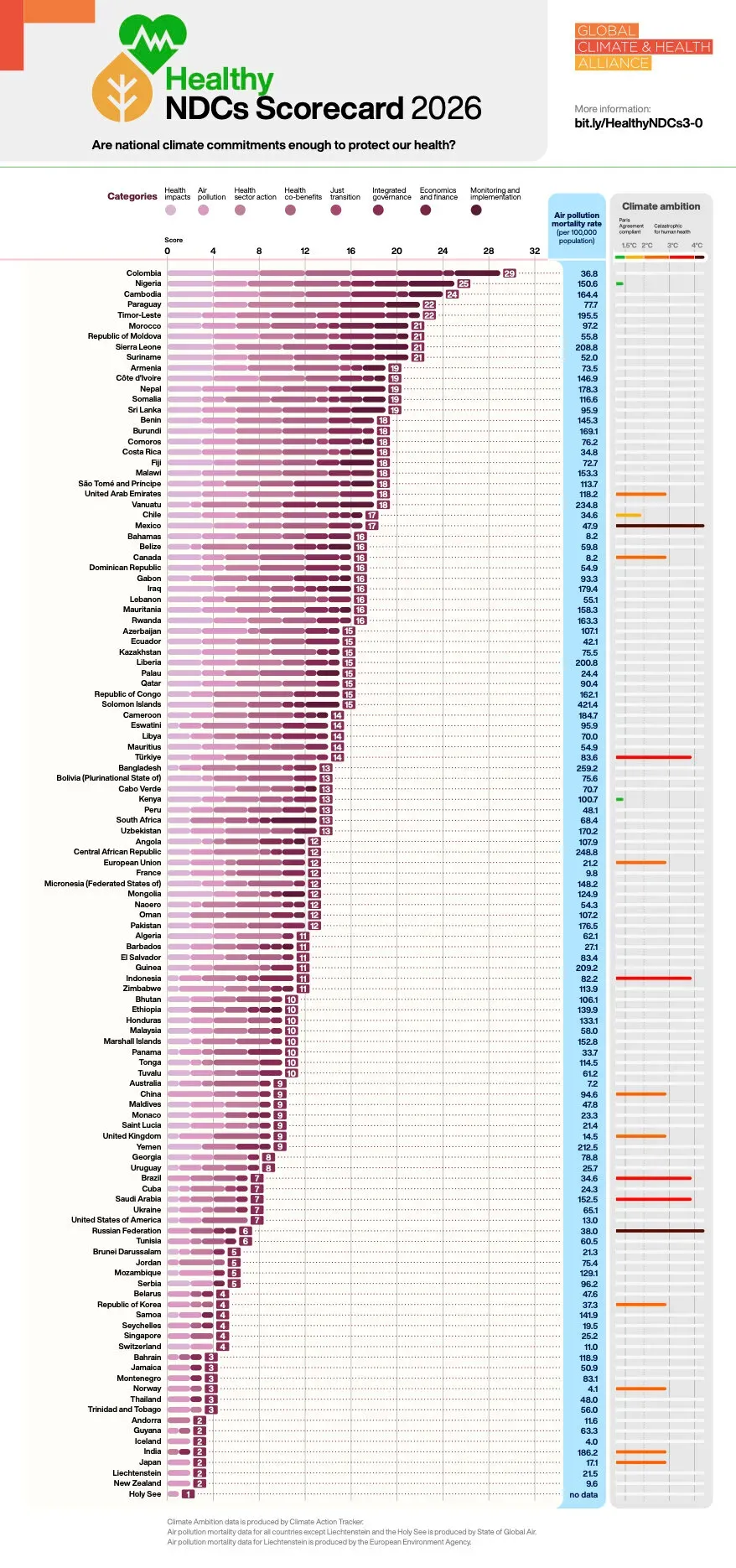
The latest report from the Global Climate and Health Alliance has given Colombia top marks for integrating health into its national climate plan, a move that is being closely followed by Nigeria and Cambodia.
These countries stand out among their peers as they have made significant efforts to consider the impact of climate change on public health in their policies. In contrast, some major emitters such as Japan, New Zealand, and India are failing to adequately address the health implications of climate change in their national plans.
The report highlights that many governments are missing opportunities to tackle air pollution and protect public health at the same time as addressing climate change. Only a handful of countries, including Cambodia, Chile, Colombia, Costa Rica, and Paraguay, have set targets to reduce black carbon emissions, which is a major contributor to global heating and air pollution.
Black carbon is particularly hazardous as it contributes to severe health problems. The report emphasizes that reducing its emissions can bring significant benefits for both human health and the environment.
The study's lead researcher, Dr. Nova Tebbe, notes that the Healthy NDC Scorecard provides a valuable tool for evaluating how governments are considering health in their climate planning.
The scorecard assesses whether countries' climate commitments match their ambitions to reduce emissions and protect public health. It also compares intended actions with actual air pollution mortality.
Dr. Tebbe stresses that the human impact of climate change is becoming increasingly apparent, and it is imperative for governments to take action now to integrate health into their policies.
Rapid reductions in short-lived climate pollutants such as black carbon can have multiple benefits, including slowing global heating, improving public health, and saving costs. However, more ambitious efforts are needed to dramatically reduce CO2 emissions to prevent long-term damage to human health.
Climate change is having a devastating impact on human health worldwide, with severe weather events and air pollution causing widespread harm.
The situation is particularly dire in regions affected by El Niño conditions, where extreme weather patterns are intensifying the effects of climate change. In recent months, Nepal has experienced deadly floods that have claimed hundreds of lives, while millions of children in Eastern and Southern Africa face the risk of hunger due to drought and food shortages.
In addition to these events, heat-related mortality has been on the rise in Europe and the United States, with widespread wildfires also raging across Canada. These disasters highlight the urgent need for governments to take immediate action to protect public health from climate change.
Air quality is a critical aspect of effective climate action, and policymakers must recognize that addressing air pollution is essential to preventing long-term damage to human health. By integrating health and air quality considerations into climate policies, governments can maximize economic benefits, build public support, and protect populations from the impacts of climate change.
The NDC Scorecard provides a valuable tool for policymakers to assess their countries' progress on climate action and identify areas where more effort is needed. This scorecard highlights strengths and gaps in climate plans, showcases good practices from around the world, and enables countries to compare their performance with others.
By using the NDC Scorecard, governments can take a more comprehensive approach to addressing climate change, one that prioritizes public health and well-being alongside economic and environmental goals.
The latest analysis of national climate commitments reveals stark differences in how governments recognize the links between climate change and public health. The NDC Scorecard assesses the plans submitted by countries to the United Nations Framework Convention on Climate Change, highlighting those that prioritize both economic and environmental goals alongside human well-being.
Colombia stands out as a top performer, earning 29 out of 32 possible points for its comprehensive approach to addressing climate change. This is closely followed by Nigeria and Cambodia, which also demonstrate a strong commitment to protecting their citizens from the impacts of climate change. Other low- and middle-income countries are also among the top scorers on the NDC Scorecard.
In contrast, some high-emitting nations fall short in recognizing the links between climate change and human health. Japan, India, and New Zealand are notable examples, achieving just two points each on the scorecard. This indicates a lack of consideration for the potential health impacts of their climate policies, which could leave citizens vulnerable to the effects of pollution and other environmental hazards.
The emissions reduction targets set by these countries also raise concerns about their alignment with the Paris Agreement. Japan and India's goals have been assessed as being inconsistent with the agreement, posing significant risks to public health. India, in particular, carries a high burden of air pollution-related mortality but fails to address this issue in its NDCs.
Other high-emitting nations that fail to commit to their fair share of emissions reductions include the Republic of Korea, Russia, Brazil, and Australia, China, and the U.K., which all score less than 10 points on the scorecard. These countries are not prioritizing public health alongside economic and environmental goals in their climate plans.
While some high-emitting nations do receive higher scores for their attention to health, this is often not matched by ambitious emissions reduction targets. Indonesia, the EU, South Africa, Türkiye, Canada, and the UAE all fall into this category, with scores ranging from 11 to 19 points on the scorecard. However, these countries' climate plans may still risk worsening health impacts over time due to inadequate commitments.
Notably, the EU is an exception among high-emitting nations in prioritizing public health alongside economic and environmental goals. Its NDC outlines a specific target for air pollution reduction, including a plan to fully phase out hydrofluorocarbons by 2050. This commitment demonstrates a more comprehensive approach to addressing climate change.
The stark differences between countries' approaches to climate policy highlight the need for governments to prioritize public health alongside economic and environmental goals. By using the NDC Scorecard, policymakers can identify areas where their commitments fall short and take steps to strengthen their policies and protect citizens from the impacts of climate change.
Air pollution is a significant contributor to global heating, driving temperatures up faster than carbon dioxide. In addition to their greenhouse gas emissions, countries are also failing to address other major "superpollutants such as black carbon, nitrous oxide and ozone, which have severe impacts on human health.
These pollutants not only accelerate climate change but also cause harm through air pollution, leading to a range of health problems for individuals. The lack of attention paid to these superpollutants is particularly concerning given their rapid contribution to global heating.
The United States was analyzed in the study despite its current withdrawal from the Paris Agreement. Its National Determined Contribution (NDC) received a relatively low score for its health impacts, with national climate policies deemed highly insufficient" or "critically insufficient" to meet the agreement's targets.
Countries that prioritize health and take ambitious action to reduce emissions are reaping significant benefits. Nigeria is one such example, demonstrating high levels of climate ambition while also implementing plans to address air pollution.
The Republic of Moldova has made a notable commitment to addressing air pollution by developing a National Short-Lived Climate Pollutants Plan. Similarly, Nigeria and Paraguay have already implemented such plans, highlighting the importance of considering health co-benefits.
Air quality funding remains woefully inadequate despite its critical role in protecting human health. The latest State of Global Air Quality Funding report reveals that outdoor air quality funding accounts for less than 1% of development funding, despite the fact that air pollution impacts are estimated to cost countries 5% of their GDP.
Data on air pollution mortality underscores the urgent need for increased finance and action to address this critical issue. Countries like Nigeria and Nepal have made efforts to address air pollutants but continue to face exceptionally high rates of air pollution-related deaths.
By neglecting to prioritize health alongside emissions reductions, governments risk overwhelming their healthcare systems with the compounding impacts of climate change and air pollution.
The Global Climate and Health Alliance emphasizes that countries in the Global South have received top scores on a health-focused climate scorecard, highlighting the stark reality that these nations cannot afford to separate climate change from public health concerns.
These developing countries rely heavily on external funding for the implementation of their Nationally Determined Contributions (NDCs), with a significant proportion of this finance expected to come from developed countries in line with Article 9.1 of the Paris Agreement.
The Alliance's policy lead, Jess Beagley, notes that high-emitting countries have a responsibility not only to reduce their own emissions but also to provide urgent funding for the reduction of short-lived climate pollutants, which pose an immediate threat to human health.
COP31 will offer a crucial opportunity for governments to elevate national priorities and secure global commitment on critical issues such as climate finance. Beagley highlights that a proposed agenda item on a climate finance work program could focus on developed countries' obligations under the Paris Agreement to provide developing nations with climate funding.
Without sufficient financing, the burden on healthcare systems will be overwhelming, exacerbating the compounding impacts of climate change and air pollution. The Alliance stresses that this issue cannot be ignored, particularly given the current state of global health.
The scorecard evaluation methodology involves a qualitative coding and point-based system across eight key categories, comparing the inclusion of health in NDCs to available data on emissions reduction ambition and air pollution mortality.
As COP31 marks the start of the second global stocktake, Beagley emphasizes that governments must translate national advances into effective global policies. This includes avoiding backsliding on previously agreed calls for a just transition away from fossil fuels, which is essential for public health.
Colombia has earned top marks for its efforts to protect public health from climate change, according to a recent scorecard.
The country has demonstrated a strong commitment to reducing greenhouse gas emissions and transitioning to cleaner energy sources, setting an example for other nations to follow. In contrast, high-emitting countries have been criticized for doing too little to address the issue, with some even backtracking on previous agreements to phase out fossil fuels.
Facts based on reporting originally published by Phys.org.
You may republish this story, in full or in part, if you credit News Central Site and link to it (licence CC BY 4.0). Photos are not included.