Seagull Nebula Captured in Unprecedented Detail by Vera C. Rubin Observatory's New Telescope
Astronomers have captured a stunning image of the Seagull Nebula using the Vera C. Rubin Observatory's new telescope and experimental 144-megapixel camera, showing its distinctive pink plumage and blue feathers in unprecedented detail.
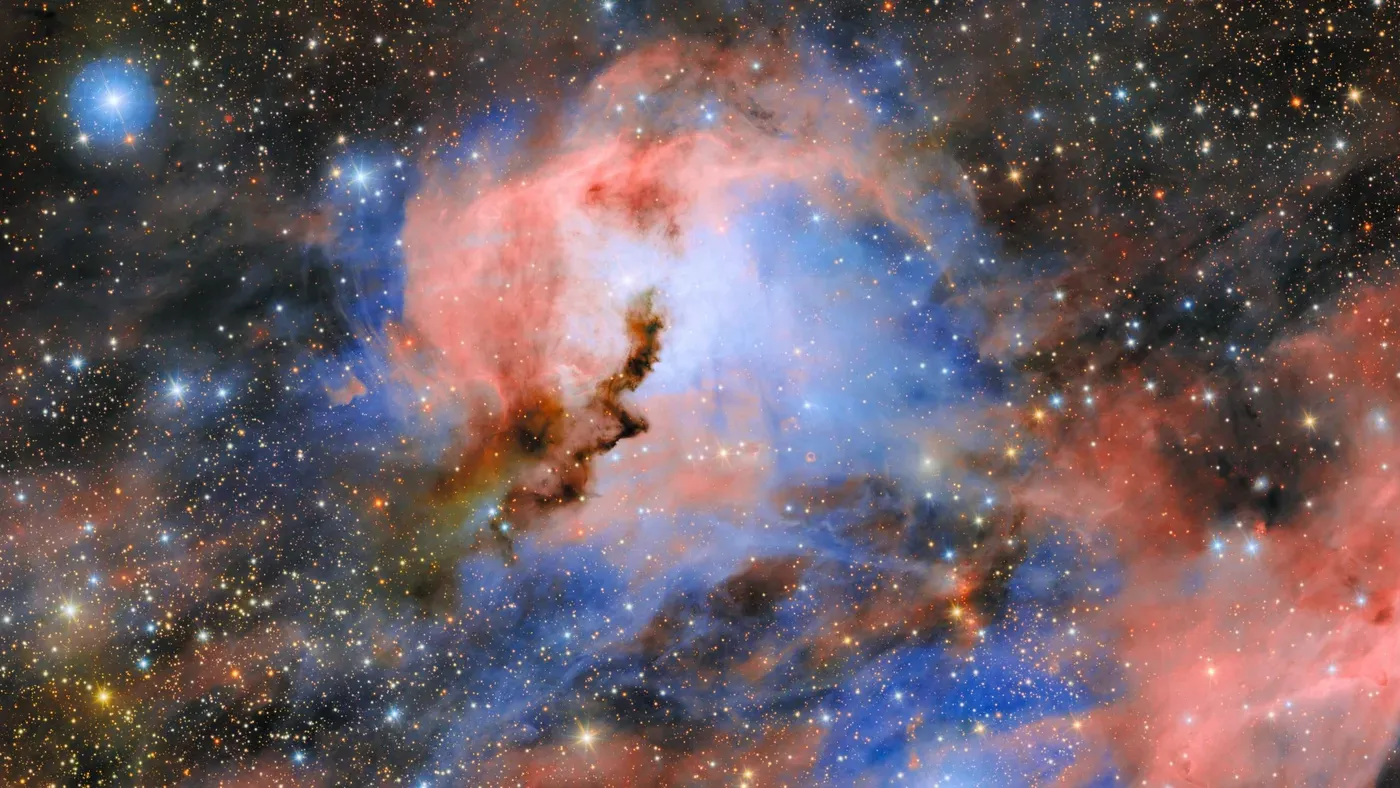
Astronomers have captured a stunning image of the Seagull Nebula using the Vera C. Rubin Observatory's new telescope and experimental 144-megapixel camera. The test image shows the nebula in unprecedented detail, featuring its distinctive pink plumage and blue feathers.
The Seagull Nebula is a massive interstellar gas cloud located approximately 3,700 light-years from Earth, situated between the constellations Monoceros and Canis Major. It is comprised of three enormous clouds of ionized gas, with Sharpless 2-292 being the central feature in Rubin's image.
The "head of the Seagull Nebula, Sharpless 2-292, displays vibrant pink hues due to the presence of hydrogen gas that glows intensely as it interacts with ionizing radiation emanating from young stars within its core. In contrast, the nebula's blue feathers are clouds of dust reflecting light from nearby blue stars.
The Vera C. Rubin Observatory's new telescope and camera system have proven capable of capturing high-resolution images of distant celestial objects. This achievement marks a significant milestone for the observatory's future astronomical endeavors.
The test image of the Seagull Nebula serves as a precursor to the observatory's forthcoming surveys, which will provide valuable insights into the properties and behaviors of various celestial entities in our universe.
The Vera C. Rubin Observatory's Commissioning Camera captured a remarkable test image of the Seagull Nebula, showcasing its capabilities in capturing deep-space photos.
This image is just one of over 16,000 exposures taken between October 24 and December 11, 2024, as part of the observatory's early testing phase. The National Science Foundation, which co-manages Rubin along with the U.S. Department of Energy, played a key role in this process.
The Commissioning Camera's test image is notable for its exceptional clarity, but what's even more significant is that Rubin has since upgraded to a camera with significantly improved capabilities. The new Legacy Survey of Space and Time Camera boasts an impressive field of view, allowing it to capture vast expanses of the night sky in incredible detail.
This camera is mounted on the Simonyi Survey Telescope and takes 3,200-megapixel images every 30 seconds, scanning the entire southern sky multiple times each night. According to Tony Tyson, Rubin's chief scientist, this will enable the observatory to create a comprehensive time-lapse movie of the universe over the next decade.
As the Legacy Survey of Space and Time officially begins, the Vera C. Rubin Observatory is poised to spend the next 10 years capturing millions of cosmic wonders, including exploding supernovas, newfound comets, and exoplanets. The wealth of data collected will provide valuable insights into the properties and behaviors of various celestial entities in our universe.
The Vera C. Rubin Observatory has captured a long-awaited test image featuring a celestial object that resembles a seagull in flight. This unique sighting is part of a series of images taken by the observatory's Dark Energy Camera (DECam) as it undergoes testing and calibration.
The DECam has been designed to capture vast amounts of data on the night sky, including images of distant galaxies, stars, and other celestial entities. By analyzing these images, scientists hope to gain valuable insights into the properties and behaviors of various objects in our universe. The wealth of data collected will provide a rich source for astronomers to study.
The successful test image featuring the seagull" object marks an important milestone in the observatory's development. As testing continues, scientists will be able to refine their understanding of the cosmos and unlock new secrets about the workings of the universe.
Facts based on reporting originally published by Live Science.
You may republish this story, in full or in part, if you credit News Central Site and link to it (licence CC BY 4.0). Photos are not included.