Global CO₂ Storage Hits Record High
A new report reveals that 43.6 million metric tons of carbon dioxide were stored in 2024 alone, marking a new annual record.
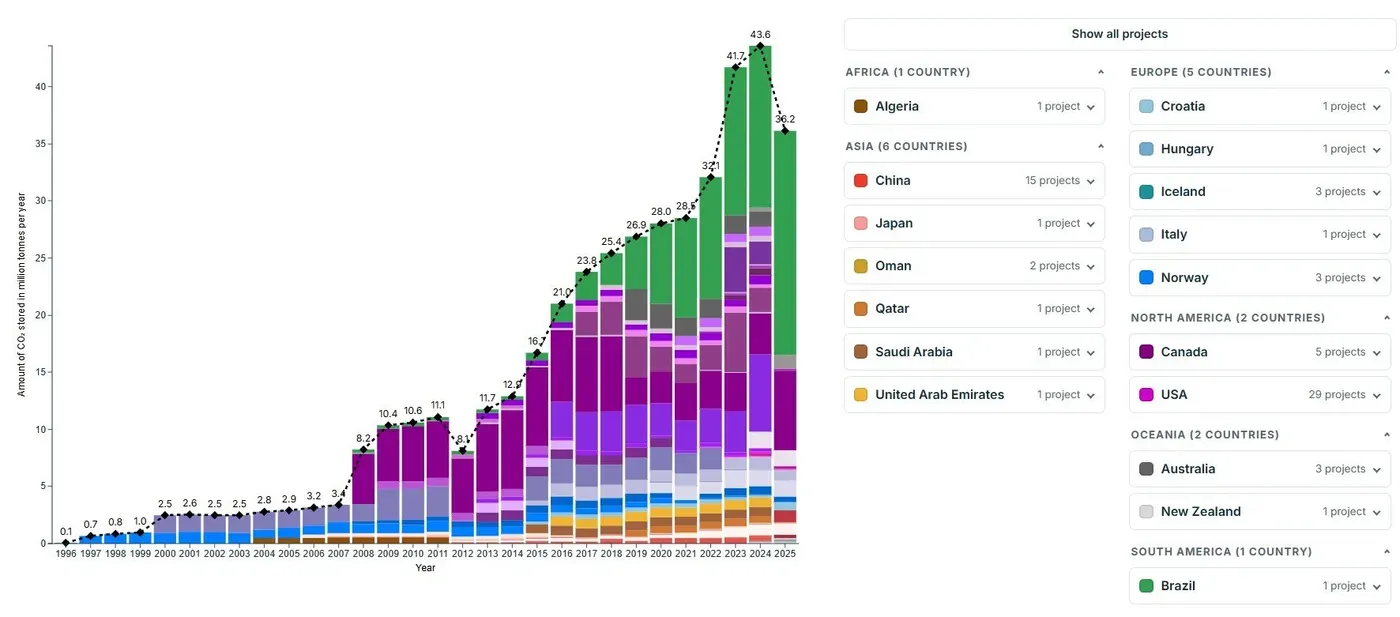
Global underground CO₂ storage has reached an all-time high, according to a newly published report. The data reveals that 43.6 million metric tons of carbon dioxide were stored in 2024 alone, marking a new annual record.
This achievement is part of a larger trend, with the total amount of CO₂ sequestered over the past three decades reaching an impressive 421.7 million metric tons. The report highlights the growing importance of geological carbon dioxide storage as a mitigation technology.
The 2026 Annual Report from The London Register of Subsurface CO₂ Storage is a comprehensive tracking system that monitors annual rates of CO₂ stored by operational projects worldwide. This year's edition expands the Register to include 70 projects across 17 countries on six continents, providing a more complete picture of global efforts.
According to Professor Samuel Krevor, director of the Register from Imperial College London, "Our latest report shows that geological CO₂ storage has become a global enterprise." He notes that annual reported storage has more than doubled between 2016 and 2024, demonstrating the growing scale of this technology.
The consistency of these operations is also notable, with new countries and projects continuing to join the Register. This suggests that geological storage is indeed being demonstrated as a large-scale mitigation technology, capable of making a significant impact on reducing carbon emissions.
The London Register of Subsurface CO₂ Storage has been tracking geological storage, a process where captured CO₂ is injected into rocks deep underground for safekeeping. This method allows greenhouse gases to be stored for potentially thousands of years.
According to the Register's findings, reported annual storage rose significantly from 21.0 million metric tons in 2016 to a record 43.6 million metric tons in 2024. The latter marks the most recent complete reporting year and represents a substantial increase over previous years.
The largest contributors to this growth are projects located in the U.S., with 23 reporting a combined 20.2 million metric tons of storage. This is followed by Brazil's Petrobras Santos Basin Pre-Salt Oil Field, which remains the single largest project globally, accounting for approximately one-third of the global total at 14.2 million metric tons.
China has also seen an increase in reported storage, reaching 1.7 million metric tons in 2024. This growth is largely attributed to two major projects: the Shengli Oilfield and the newly included Daqing Aonan Oilfield. Australia's storage figures have also risen, with the addition of the Moomba project contributing to its total of 1.7 million metric tons.
New Zealand and Italy made their debut on the Register in 2024, joining a growing list of countries participating in large-scale geological CO₂ storage efforts. In Europe, the Northern Lights project in Norway began injection in August 2025, marking another significant milestone in this field.
These developments suggest that international collaboration and knowledge-sharing are key drivers of progress in geological CO₂ storage. As more projects come online and new participants join the Register, it will be interesting to see how these trends continue to shape the global landscape of carbon capture and storage efforts.
The Register's annual report has revealed significant revisions to previously published figures on geological CO₂ storage. The changes are primarily due to new data from the North Burbank Unit, which has been reinterpreted to account for recycled CO₂, and a correction of double counting between company-level and project-level reporting.
As a result of these revisions, cumulative geological CO₂ storage through 2023 has decreased by 2.7% from 351.4 million metric tons to 342.0 million metric tons. Similarly, the annual figure for 2023 has been revised downward from 45.2 million metric tons to 41.7 million metric tons.
Dr. Xiaowei Gao, executive director of the Register, emphasized the importance of transparency in geological CO₂ storage reporting. "These revisions reflect the latest evidence," he said, adding that the report explicitly highlights areas where accounting for reported storage remains uncertain.
This increased transparency is crucial if policymakers and investors are to have confidence in the effectiveness of geological CO₂ storage efforts. By acknowledging potential uncertainties, the Register aims to provide a more accurate picture of global carbon capture and storage trends.
At present, 29 projects across 12 countries have submitted data on 2025 storage levels, with an aggregate total of 36.2 million metric tons. However, the authors caution that this figure is incomplete and should not be taken as a representative of the full-year global total.
Brazil's Petrobras Santos Basin project is off to a strong start in 2025, having already reported an impressive increase in CO2 storage from last year. The project has stored 19.6 million metric tons of CO2 this year, up from the 14.2 million metric tons recorded in 2024.
Meanwhile, other countries are also making significant strides in underground CO2 storage. In China, seven projects have collectively reported storing 2.6 million metric tons of CO2, while six projects in the United States have stored 8.9 million metric tons.
However, some U.S. projects that reported data for 2024 are still missing corresponding records for 2025. This includes several large projects such as the Denver Unit/Wasson San Andres Field, Hobbs Field, Seminole San Andres Unit and Shute Creek.
The reporting of CO2 storage in the United States is subject to rigorous accounting guidelines set by the Environmental Protection Agency. However, it appears that not all projects have a clear basis for their accounting methods, which could lead to inconsistencies in reported values.
A significant portion of the stored CO2, 82.3% of the total, falls under the category of Geological Storage with Oil Recovery. This method aims to extend the life of existing oil fields by injecting CO2 into them. However, around a third of this stored CO2 is simply recorded as 'injected' without accounting for potential losses or reinjections.
The increasing importance of geological CO2 storage has been highlighted by the need to scale up to 1 billion metric tons of CO2 storage per year by 2050 to meet the 1.5°C target pledged by the Paris Agreement.
However, current records show that around a third of injected CO2 is not accounted for due to potential losses or reinjections, which can make it difficult to accurately track and verify the effectiveness of the technology.
Accurate tracking and verification of CO2 storage are crucial as the technology grows to meet climate targets, and efforts should be made to improve transparency and accountability in the reporting of CO2 injection and storage.
Facts based on reporting originally published by Phys.org.
You may republish this story, in full or in part, if you credit News Central Site and link to it (licence CC BY 4.0). Photos are not included.