Scientists Recreate Solar Flares in Lab Setting Using Lasers and Plastic
Researchers at the China Institute of Atomic Energy, led by Wei Sun, have successfully simulated conditions on the sun's corona to study tiny solar flares known as nanoflares.
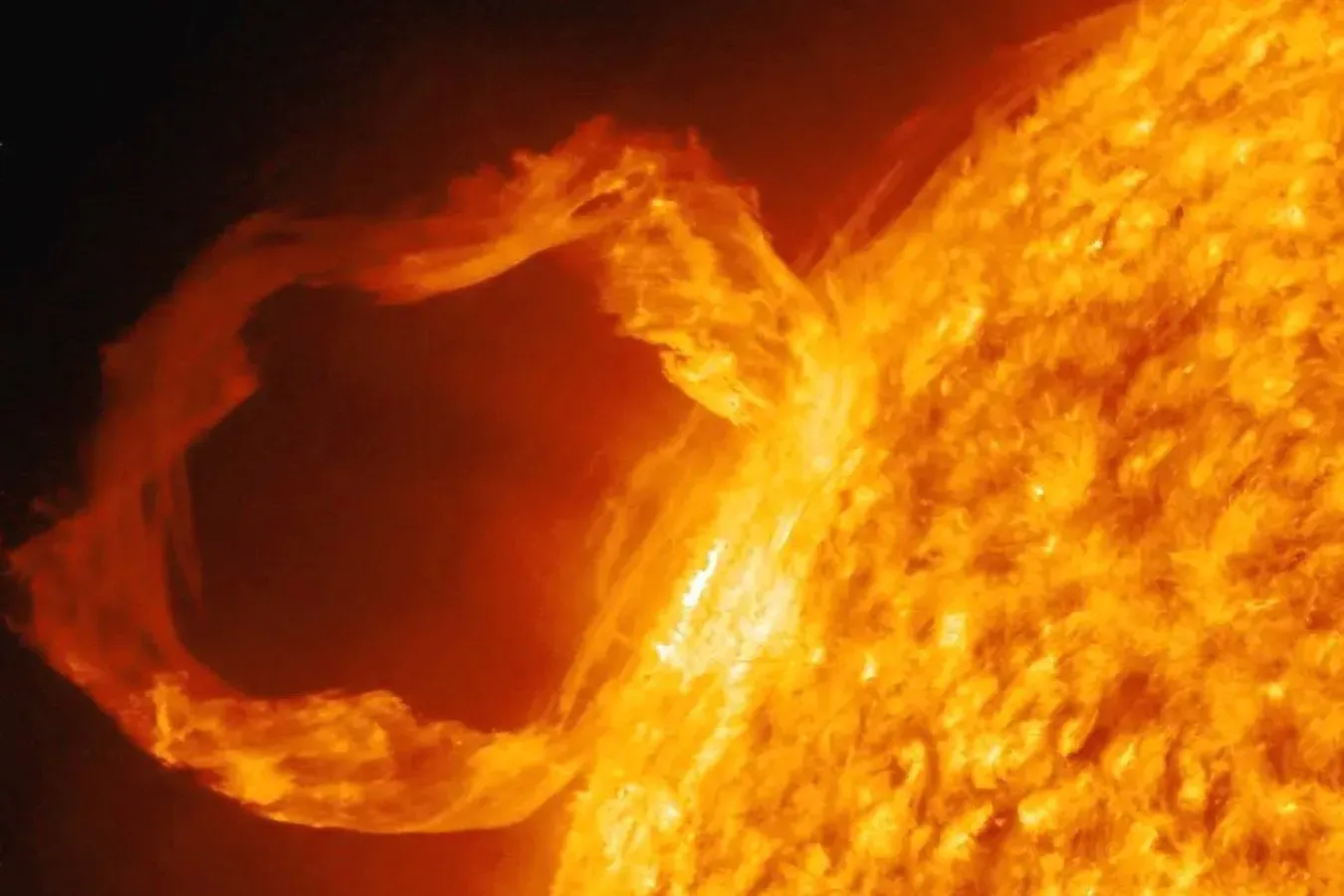
Scientists have successfully recreated tiny "solar flares in a lab setting using powerful lasers and a small piece of plastic. This experiment may hold the key to understanding the mysterious heat emanating from the outermost layer of the sun's atmosphere.
The corona, as it is known, reaches temperatures of several million degrees Celsius, a phenomenon that has puzzled researchers for decades. It's a conundrum that has been compared to walking away from a campfire and feeling the air grow hotter with each step, according to Wei Sun of the China Institute of Atomic Energy.
Sun and his team have now simulated some of the conditions on the sun in their lab experiment, observing how tiny bursts of electromagnetic radiation could be powering the corona's heat. These solar nanoflares" occur when magnetic fields within the corona suddenly rearrange themselves, releasing energy in the process.
The researchers believe that for these nanoflares to happen, specific conditions must be met, including the precise shape of the magnetic fields involved.
Researchers have been trying to understand how tiny solar flares, known as nanoflares, can occur on the surface of the sun. To replicate these events in a laboratory setting, scientists created a plasma - a hot mixture of charged particles - by firing four powerful lasers onto a small plastic target.
The resulting plasma patch was approximately 2 millimeters across and behaved similarly to its counterpart in the sun's corona. However, this experiment did not exactly recreate the conditions found on the sun. Instead, it provided an analogous model for studying nanoflares.
To investigate further, the researchers conducted two experiments with different target shapes. In one scenario, a flat plastic surface was used, while in another, a wavy target was employed. The results showed that when the plasma formed over the wavy surface, its magnetic fields rearranged and triggered a nanoflare.
This nanoflare caused a significant increase in temperature, reaching 799,726°C - nearly double the temperature achieved in the flat target experiment where no nanoflares occurred.
The researchers' findings have been supported by a computer simulation conducted by Rony Keppens at KU Leuven in Belgium. This simulation corroborated the team's interpretation of the experiment and lends further credence to their theory.
Keppens believes that coronal rain blobs could indeed contribute to the instabilities observed in the lab, making them a potential factor in the corona's heating. However, he notes that other plasma behaviors may also play a role, such as certain types of waves within it.
The team is now planning to upgrade their experiment to create more realistic three-dimensional plasmas and use more precise techniques for measuring its behavior. This will involve incorporating data from telescopes to make the laboratory measurements more comparable to real-world conditions on the sun.
Ultimately, the goal is to ensure that the lab results accurately replicate what occurs in space, with Sun emphasizing the importance of verifying this connection.
Facts based on reporting originally published by New Scientist.
You may republish this story, in full or in part, if you credit News Central Site and link to it (licence CC BY 4.0). Photos are not included.