Galaxy Cluster El Gordo Found at Seven Billion Light-Years Distance
A massive galaxy cluster has been discovered at a staggering distance from Earth, sparking intrigue among astronomers about its formation.
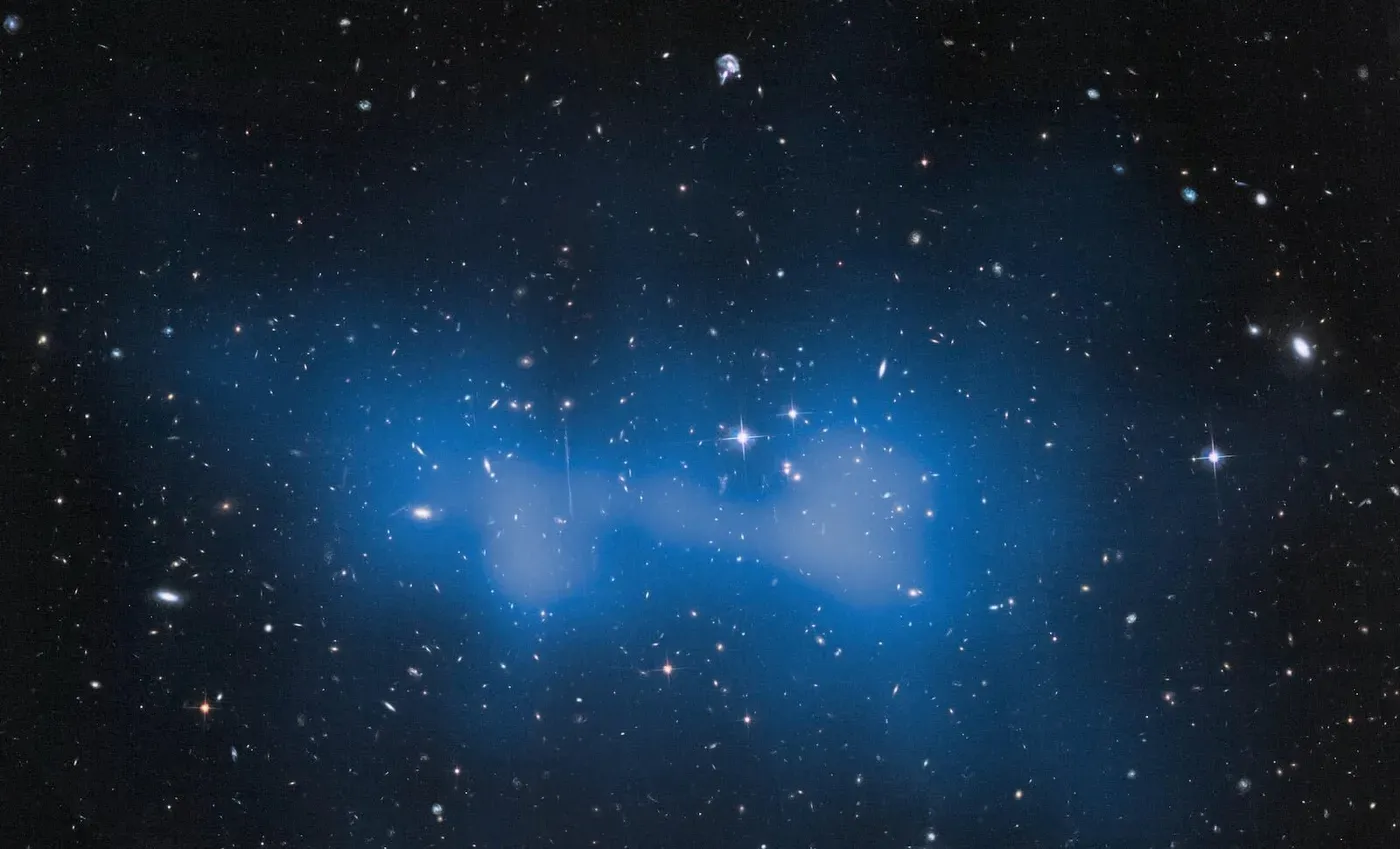
A massive galaxy cluster has been discovered at a staggering distance from Earth, sparking intrigue among astronomers about its formation. The supercluster, named El Gordo due to its immense mass of over two quadrillion solar masses, is located approximately seven billion light-years away. What sets it apart is its enormous size for the period in which it formed, leaving scientists puzzled.
El Gordo's extraordinary nature has led some researchers to question the standard model of cosmology, which struggles to explain how such a large supercluster could have emerged so early in the universe's evolution. The study of this anomaly aims to shed light on its origins and potentially challenge prevailing theories about dark matter and galaxy formation.
Dark matter is a mysterious substance that makes up the bulk of mass in the cosmos, yet it doesn't interact with light or regular matter through electromagnetic forces. This enigmatic property has led scientists to wonder whether dark matter can interact with itself at all. The answer could hold significant implications for our understanding of the universe's fundamental structure.
The study seeks to address this question by exploring an alternative explanation for El Gordo's formation: self-interacting dark matter. This concept challenges the conventional wisdom that dark matter behaves solely as a passive, collisionless background, influencing galaxy evolution through gravitational interactions alone.
Researchers hope that their investigation will provide insights into the properties of dark matter and its role in shaping the universe on large scales. The findings could have far-reaching implications for our understanding of cosmic structure formation and the standard model of cosmology, potentially paving the way for new avenues of research and exploration.
The concept of self-interacting dark matter has long been a topic of debate among scientists. While some theories suggest that dark matter particles interact with each other through elastic collisions, others propose an inelastic interaction. The latter would result in the loss of energy with each collision, potentially leading to a rapid cooling effect on the surrounding environment.
A new study proposes a two-state dark matter interaction as a potential solution to this problem. In this scenario, the interaction between dark matter particles is not fixed, but rather can be adjusted depending on the circumstances. This flexibility allows researchers to fine-tune the model and achieve the desired outcome of accelerated galactic clustering without overly warming the surrounding dark matter.
The proposed two-state interaction could help explain the formation of superclusters like El Gordo, which is thought to have formed through a process involving self-interacting dark matter. By tweaking the interaction between dark matter particles, scientists may be able to create models that better match observations of galaxy clusters and superclusters.
This approach has its roots in the study of regular matter, where elastic collisions are common. The behavior of air molecules in a room is a classic example, with their tendency to bounce off each other without losing much energy. By applying this concept to dark matter interactions, researchers hope to gain a deeper understanding of the role that self-interacting dark matter plays in the formation and evolution of galaxy clusters.
Researchers exploring the properties of dark matter have proposed a new model that could help explain its behavior in galaxy clusters. This two-state model posits that dark matter particles can exist in both a ground state and an excited state, allowing for elastic interactions similar to those seen with regular matter.
However, when collisions between dark matter particles occur at specific energies, they can transition from the ground state to the excited state, effectively removing kinetic energy from the interaction. This process enables dark matter particles to cluster together while also cooling down, which is a key factor in their role in galaxy formation and evolution.
Studies of El Gordo, a massive supercluster of galaxies, have provided evidence that supports this two-state model. Simulations of the collision regions within El Gordo indicate that a two-state self-interacting dark matter (SIDM) model with both elastic and inelastic collisions provides a better fit to observed data compared to noninteracting or purely elastic interactions.
Despite the promising results, there is still significant uncertainty surrounding the mass of El Gordo and the speed at which its constituent regions are colliding. If these parameters fall within a certain range, the two-state model may not accurately explain the observed phenomena, leaving room for further investigation and refinement.
Research suggests that dark matter may be more complex than previously thought, as a study on the merging cluster El Gordo has revealed new insights into its behavior.
The findings indicate that if certain parameters are met, the two-state model of self-interacting dark matter may not accurately explain observed phenomena, leaving room for further investigation and refinement.
Facts based on reporting originally published by Phys.org.
You may republish this story, in full or in part, if you credit News Central Site and link to it (licence CC BY 4.0). Photos are not included.