US Abrams Tanks Adopt Stealthy Approach in Germany Training Exercise
The 1st Armored Division's Abrams tanks were used in a more stealthy manner during a recent training exercise in Germany, carefully concealed from enemy reconnaissance drones.
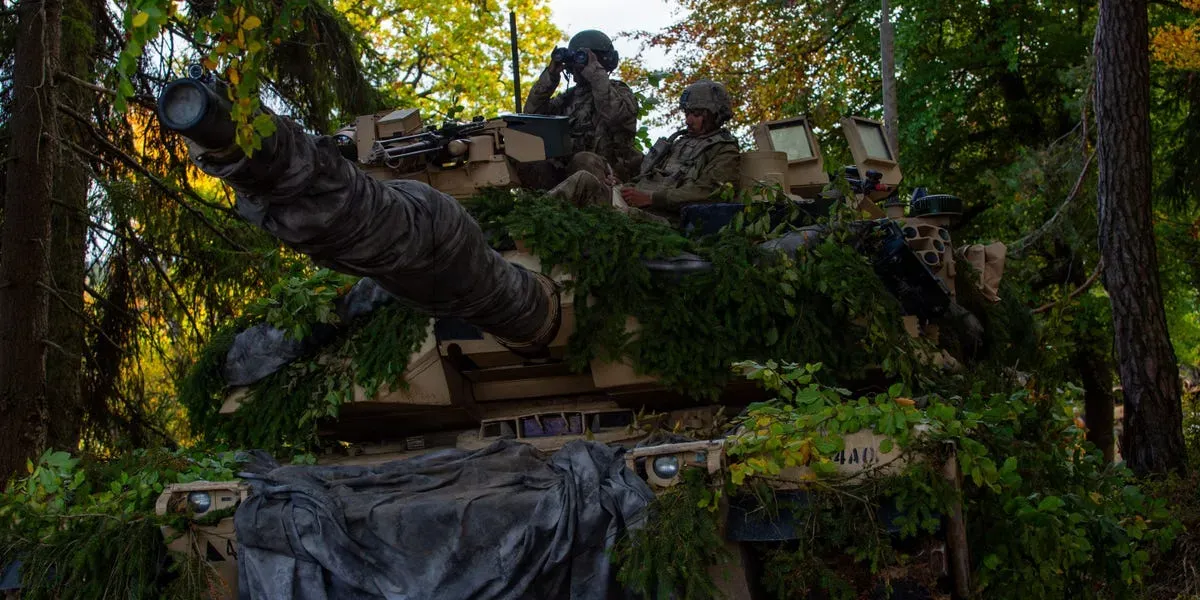
The US Army's Abrams tanks have been a cornerstone of military power for decades, but at a recent training exercise in Germany, they were taking a new approach to warfare.
Instead of charging into battle head-on, the 1st Armored Division's Abrams tanks were being used in a more stealthy manner, with their presence carefully concealed from enemy reconnaissance drones.
The Joint Multinational Readiness Center in Hohenfels, Germany was bustling with activity as Army personnel trained for various scenarios, but despite their massive size and heavy armor, the Abrams tanks themselves remained out of sight.
They were hidden along treelines and deeper in the forest, using cover to avoid being detected by enemy drones that filled the skies during the exercise.
The training environment was designed to mimic the battlefields of Ukraine, where drone proliferation has made it extremely difficult for armored vehicles to move freely without being seen.
In this new landscape of overhead surveillance and precision strikes, armored assets have taken heavy losses, raising questions about their continued relevance on modern battlefields.
The Ukraine conflict has revealed new vulnerabilities in armored vehicles on the modern battlefield.
Tanks and infantry fighting vehicles were once seen as crucial to Ukraine's defense strategy, but their effectiveness has been significantly diminished by the widespread use of drones.
In an effort to counter this threat, both sides have equipped their tanks with added protection, such as cage armor. However, this solution is far from foolproof and leaves armored assets exposed to drone attacks.
The scale of losses suffered by both Ukraine and Russia underscores the severity of the problem. Multimillion-dollar armored vehicles have been destroyed by drones costing just a few hundred dollars.
Drones have transformed the nature of combat, creating a vast "kill zone where soldiers and their vehicles are constantly at risk of being spotted and targeted whenever they move.
The expanded danger zone has made large-scale maneuver increasingly difficult across much of the conflict's front line.
As the US Army continues to grapple with the evolving nature of modern warfare, a stark reality has emerged: even friendly drones can pose a significant threat on the battlefield.
In a recent training exercise, a Ukrainian drone briefly appeared and flew off before it was confirmed as a friendly asset, but its presence served as a sobering reminder that enemy drones could be lurking in the shadows, waiting to strike.
The US Army's growing concern about drone threats is not unfounded, with increasing numbers of militaries around the world incorporating unmanned aerial vehicles into their arsenals. This trend has forced NATO allies like the US to reassess their tactics and strategies to counter these emerging threats.
In an effort to stay ahead of the curve, the US has been leveraging Ukraine's expertise in countering drone attacks, with Ukrainian soldiers participating in major exercises across Europe alongside American troops. These joint training sessions have provided valuable insights into the vulnerabilities of armored formations on the modern battlefield.
During a recent iteration of Combined Resolve, Ukrainian soldiers from the elite 412th Unmanned Systems Brigade, known as Nemesis, successfully challenged US armor, causing roughly 70% of the casualties suffered by an American brigade in the opening two days. The exercise highlighted the need for a fundamental shift in tactics to counter the threat posed by drones.
The training area was thoroughly covered by Ukrainian sensing and strike capabilities, rendering even routine practices like clustering vehicles in rear areas to refuel into large targets. This realization has prompted soldiers to rethink long-held assumptions about armored warfare, including the notion that logistics and maintenance can be safely conducted in the open.
As armored forces rethink their approach to warfare, decentralized logistics and terrain-aware tactics are emerging as key strategies to avoid being exposed to enemy attacks.
In a recent exercise, Combined Resolve, these principles were put to the test, but it became clear that implementation was still a work in progress. For instance, an M1 Abrams tank found itself unable to refuel due to indirect fire, forcing its crew to scatter and eventually leaving the vehicle vulnerable to attack.
The incident highlighted the risks of routine operations like refueling when enemy drones and sensors are present, making even mundane tasks hazardous for armored crews. This reality is prompting soldiers to reevaluate their assumptions about logistics and maintenance in open areas.
To counter this threat, armor crews are learning new tactics, such as using camouflage nets to conceal their vehicles, adapting their maneuvering techniques, and experimenting with nighttime resupply operations instead of daytime ones. These methods may seem basic, but they represent a fundamental shift in how armored forces operate.
In the heat of battle, survival is no longer just about avoiding enemy fire; it's also about minimizing exposure and staying one step ahead of the opposition. Armor crews are recognizing that hiding", even from drone surveillance, is not a guarantee of safety, as revealed during the exercise when the opposing force demonstrated that hiding in a treeline may only provide temporary protection.
As the Army continues to grapple with these challenges, it's clear that armored warfare is evolving, and traditional notions about logistics and maintenance are being rewritten. The key to success lies in adapting to this new landscape and developing strategies that prioritize stealth and agility over brute force.
The evolving nature of modern warfare demands that armored forces adapt to new challenges on the battlefield. A recent example of successful mechanized maneuver can be seen in Ukraine's Third Army Corps' counteroffensive efforts in the Donetsk region.
Ukrainian forces have successfully executed two major assaults behind Russian lines, according to reports from the Third Army Corps. The corps' commander, Gen. Andrii Biletskyi, initially expressed skepticism about the feasibility of such operations but was proven wrong by their success.
The Ukrainian armored crews involved in these operations underwent special training and had their vehicles equipped with additional gear to support their mission. This specialized approach allowed them to carry out complex maneuvers on a battlefield dominated by drones and other advanced technologies.
Support drones played a crucial role in these operations, operating both as surveillance assets and attack platforms. The use of armored vehicles has become increasingly sophisticated, requiring detailed planning and coordination among multiple units and assets.
The success of these operations suggests that mechanized maneuver is not yet obsolete, despite the challenges posed by modern battlefield conditions. However, carrying out such operations on a drone-saturated battlefield requires new strategies and tactics.
Armored forces must continue to adapt to the changing nature of warfare, prioritizing stealth and agility over brute force in order to achieve success on the modern battlefield.
The Army's continued investment in armor reflects its recognition of the enduring importance of these vehicles on the battlefield.
Capt. Kevin Rincon, troop commander of the multifunctional reconnaissance company, emphasized that armor will remain a vital component of military operations.
This perspective is underscored by the recent exercise at Hohenfels, where the rotating armored brigade was tasked with adapting to emerging threats and technologies.
By leveraging drones, electronic warfare, and counter-drone systems, the 1/1 ABCT demonstrated its ability to sense, track, and engage attacks from an opposing force.
The successful integration of these advanced technologies with traditional armor capabilities highlights the evolving nature of modern warfare.
The exercise showcased how emerging technologies can facilitate combined arms maneuver, enabling forces to attack, seize, and retain terrain more effectively.
However, this approach also presents challenges, particularly in countering enemies that possess significant overhead surveillance capabilities.
To overcome these obstacles, military commanders must develop strategies for integrating advanced technologies with traditional armor tactics.
This requires a nuanced understanding of the strengths and limitations of each component, as well as their potential synergies.
Facts based on reporting originally published by Business Insider.
You may republish this story, in full or in part, if you credit News Central Site and link to it (licence CC BY 4.0). Photos are not included.