Dinosaur Fossil Unearthed in UK Museum Collection
A previously unknown species of dinosaur has been identified from a fossil discovered on the Isle of Wight, England.
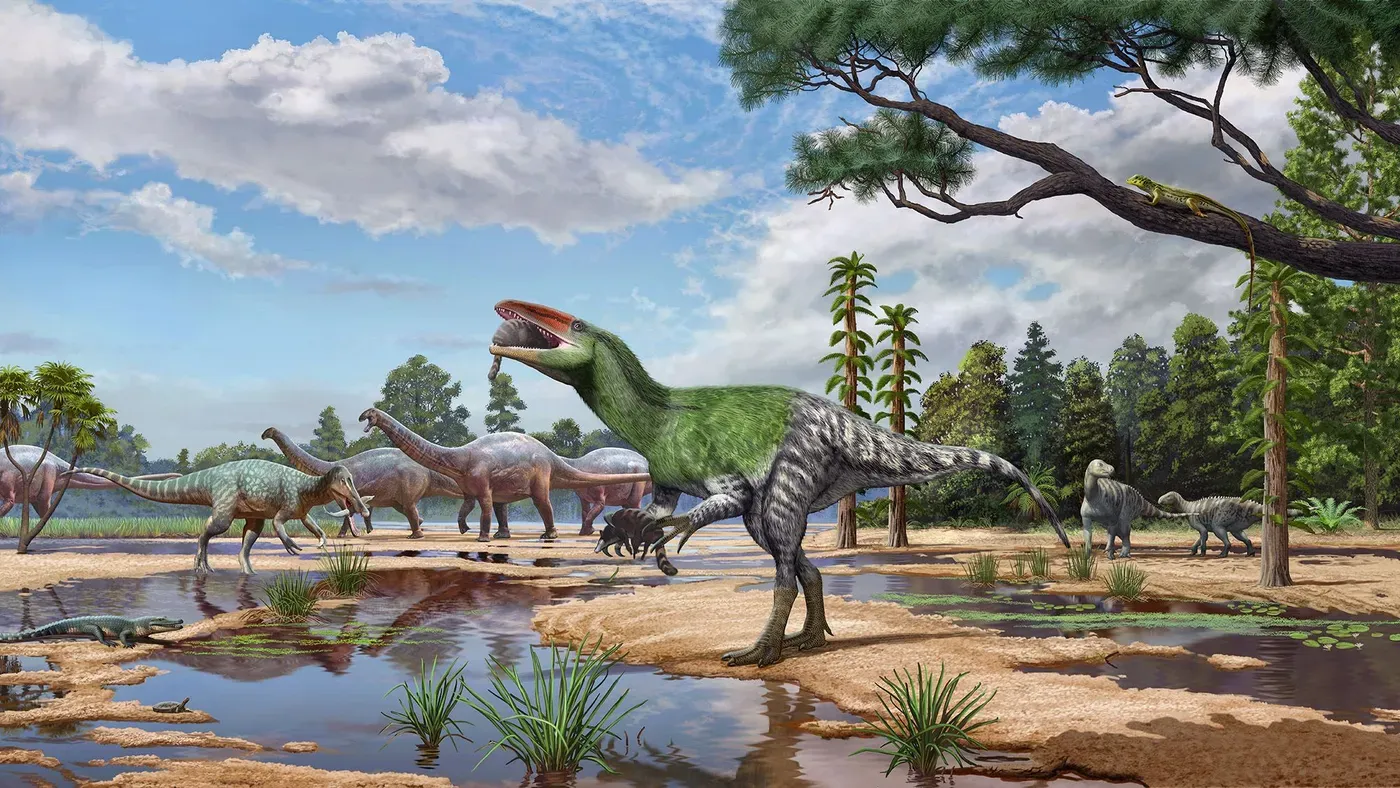
A long-lost fossil has been unearthed from a museum collection in the UK, revealing a previously unknown species of dinosaur that once roamed the Earth.
The fossil, which was discovered on the Isle of Wight in southern England, dates back to around 120 million years ago during the Cretaceous period. According to researchers, it belongs to a group of two-legged carnivores called megaraptors, which are related to tyrannosaurs but have distinct characteristics that set them apart.
One key feature of megaraptors is their powerful arms and large curved claws, which were likely used for attacking prey and defending themselves from predators. Unlike tyrannosaurs, which relied on their sharp teeth and strong legs to hunt, megaraptors seem to have relied more on their agility and grasping abilities to survive.
Researchers at University College London (UCL) have been studying the fossil and have confirmed that it is a new species of megaraptor, making it the first of its kind to be identified in Europe. The discovery fills an important gap in our understanding of the evolutionary history of this group of dinosaurs, which remains poorly understood.
The fact that the fossil was overlooked for nearly 100 years before being rediscovered has raised questions about what else may still be waiting to be discovered on the Isle of Wight, where many other dinosaur fossils have been found.
The fossil's journey began in 1924 on the Isle of Wight, where an amateur collector stumbled upon a dinosaur skull fragment. The specimen eventually found its way to London's Natural History Museum, but it lay dormant for nearly a century.
In recent years, researchers revisited the fossil as part of a study focused on dinosaur braincases. To gain a deeper understanding of the animal, they employed micro-CT scanning technology to examine the internal structure and create detailed 3D digital models of the space that once housed the dinosaur's brain.
The team compared the anatomy of the unknown specimen with other carnivorous dinosaurs, including tyrannosaurs, spinosaurs, and theropods. Several distinctive features emerged, including an almost oval opening where the spinal cord entered the skull and a unique hourglass-shaped ridge at the back of the braincase.
Computer-based evolutionary analyses revealed that the fossils fit within the Megaraptora family tree, supporting the notion that the skull represented a previously unseen species. The researchers combined Latin words to create a genus name that reflects the dinosaur's characteristics: Invictibellatrix amberina.
The name "Invictibellatrix is derived from the Latin words for unconquered" and "female warrior," while "amberina" refers to the presence of amber in the rocks associated with the fossil. This naming convention highlights the dinosaur's unusual combination of traits.
Megaraptors, including Invictibellatrix, inhabited the Earth between 125 million and 66 million years ago. These carnivores varied significantly in size, ranging from relatively small early members to massive predators like Maip macrothorax, which may have reached lengths of up to 33 feet and weighed as much as an elephant.
Based on comparisons with related dinosaurs, Invictibellatrix is estimated to have been around 10-13 feet long and stood approximately 5 feet tall. Its weight was likely between 440-660 pounds, making it one of the smallest known megaraptors.
The newly discovered fossil of Iguanacolossus amberina has sparked interest among paleontologists due to its unique characteristics and implications for our understanding of dinosaur migration patterns.
Its closest relative suggests that this species' claws may have reached lengths of 4 to 8 inches, making it a formidable predator. This would have been particularly intimidating to humans, who would have weighed about a third less than the megaraptor's body weight. The animal's size and sharp claws make it clear why it was not an apex predator in its time.
Scientists had long suspected that megaraptors originated from Asia before spreading to other parts of the world. However, this theory has been difficult to verify due to the lack of European fossils, leaving a significant gap in our knowledge of their migration route.
Researchers have now used evolutionary models to suggest that Iguanacolossus amberina descended from Asian megaraptors that dispersed into Europe around 130 million years ago. From there, they may have moved through Africa and further into the southern supercontinent Gondwana via temporary landbridges and connections across the shallow Tethys Ocean.
The new study's findings provide crucial evidence for our understanding of dinosaur migration patterns. According to Charlie Scherer, a co-author on the study, this discovery confirms that megaraptorans were present in Europe and reached Gondwana through a specific route, rather than island-hopping further south.
The discovery of the megaraptoran dinosaur has sparked further questions about its migration patterns and eventual disappearance from northern areas.
Researchers are still seeking to determine the specific route these animals took over millions of years, which would provide valuable insights into their evolution and distribution across different continents.
Climate changes or competition with other predatory dinosaurs may have contributed to the decline of megaraptors in northern regions, although this theory requires further investigation through additional research on fossils from similar periods.
The study's findings highlight the importance of working with historical museum collections, where many discoveries are still waiting to be uncovered and analyzed by researchers.
A remarkable discovery has been made in a UK museum drawer, where a 100-year-old fossil of a female dinosaur with long claws has been unearthed. The fossil is believed to be that of a species of theropod dinosaur, specifically a type known for its distinctive clawed feet.
The fossil's significance lies not only in its age but also in the fact that it provides a rare glimpse into the lives of female dinosaurs, which are often underrepresented in scientific studies.
Facts based on reporting originally published by Live Science.
You may republish this story, in full or in part, if you credit News Central Site and link to it (licence CC BY 4.0). Photos are not included.