Changes Observed in Mountain Clouds Under Climate Change
A new study has shed light on how supercooled clouds over the world's highest mountain ranges respond to climate change by analyzing long-term changes in cloud phases.
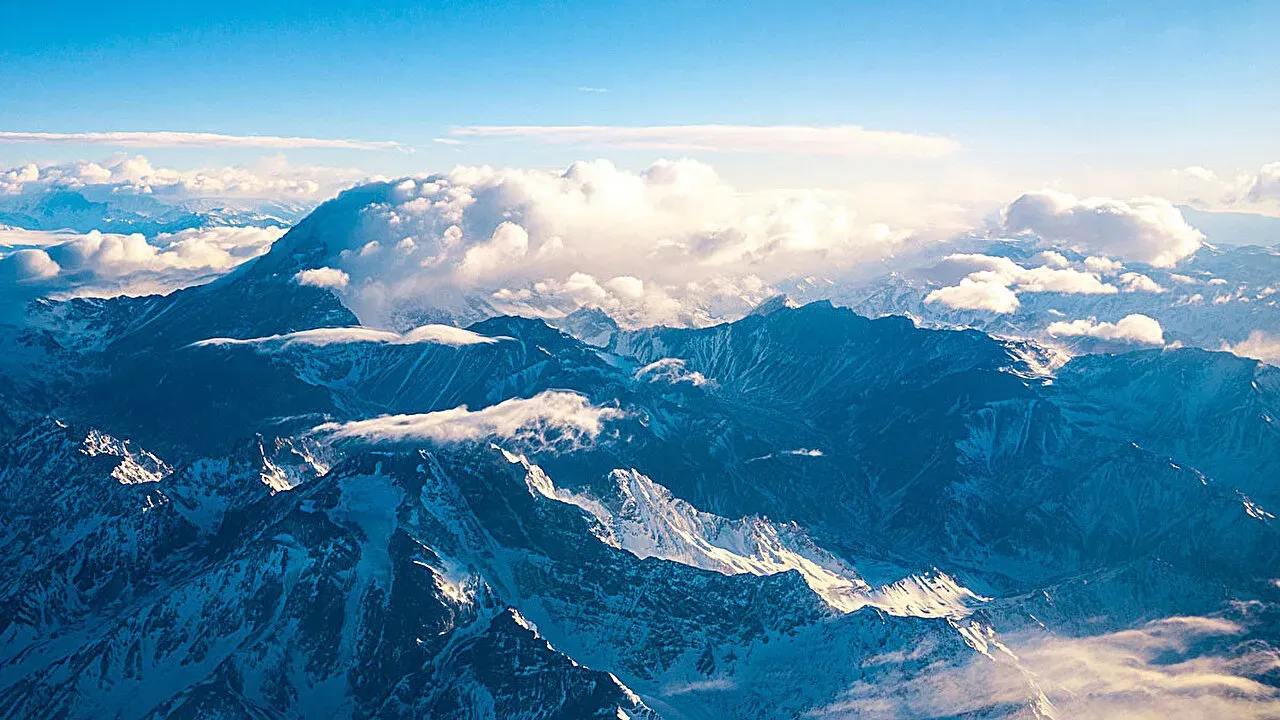
A new study has shed light on how supercooled clouds over the world's highest mountain ranges respond to climate change.
Clouds that form over mountains play a vital role in supplying water to millions of people living in these regions, but little is known about their long-term behavior under changing environmental conditions. Most research focuses on oceanic clouds, while studies of mountainous clouds typically examine specific physical properties rather than broader trends. The Tibetan Plateau, which provides water for hundreds of millions of people, is a critical area where understanding cloud behavior is essential.
Climate change is causing significant shifts in snowpack and precipitation patterns globally, making it crucial to study how clouds over mountains are adapting. A team of researchers led by Zhang has filled this knowledge gap by analyzing long-term changes in cloud phases in mountainous regions worldwide. Using satellite observations and climate data from 2003 to 2022, they examined cloud fraction, top temperature, and height over several major mountain ranges.
The study's findings are based on a comprehensive analysis of five key mountain ranges: the Tibetan Plateau, the European Alps, the Andes, the Appalachians, and the Rockies. The team employed satellite observations from the past two decades to gain insights into how these clouds are responding to climate change, laying the groundwork for further research into this critical area.
Clouds over mountainous regions are responding differently to climate change, depending on their location. While many areas have seen an increase in warm-liquid and ice cloud phases, there is a notable exception when it comes to supercooled clouds.
In regions where supercooled clouds do form, they exhibit distinct behavior based on their location. Over lowlands and lower-elevation mountains, these clouds tend to warm up before descending, indicating suppressed vertical development. This pattern suggests that the formation of supercooled clouds is being hindered in these areas.
However, at higher elevations, such as the Tibetan Plateau and the Andes, a different scenario unfolds. Supercooled clouds are able to further cool and ascend, rather than simply warming up and descending. This difference in behavior may be linked to variations in temperature profiles across these regions.
The distinct response of supercooled clouds at high elevations could be related to changes in atmospheric moisture content. In the Andes, for instance, colder and higher clouds are associated with greater amounts of moisture in the atmosphere.
High-elevation clouds around the world are responding differently to climate change than their lower-lying counterparts.
The findings suggest that these high-altitude clouds are not only reacting uniquely but also with greater intensity to rising temperatures. As a result, researchers believe further study is necessary to understand how changes in these icy cloud formations over regions like the Tibetan Plateau and the Andes could impact Earth's energy balance.
This research aims to improve regional radiative energy budgets by examining how high-elevation clouds absorb and reflect heat, which could have significant implications for our understanding of climate patterns.
Facts based on reporting originally published by Phys.org.
You may republish this story, in full or in part, if you credit News Central Site and link to it (licence CC BY 4.0). Photos are not included.