Discovery of massive black hole in distant galaxy
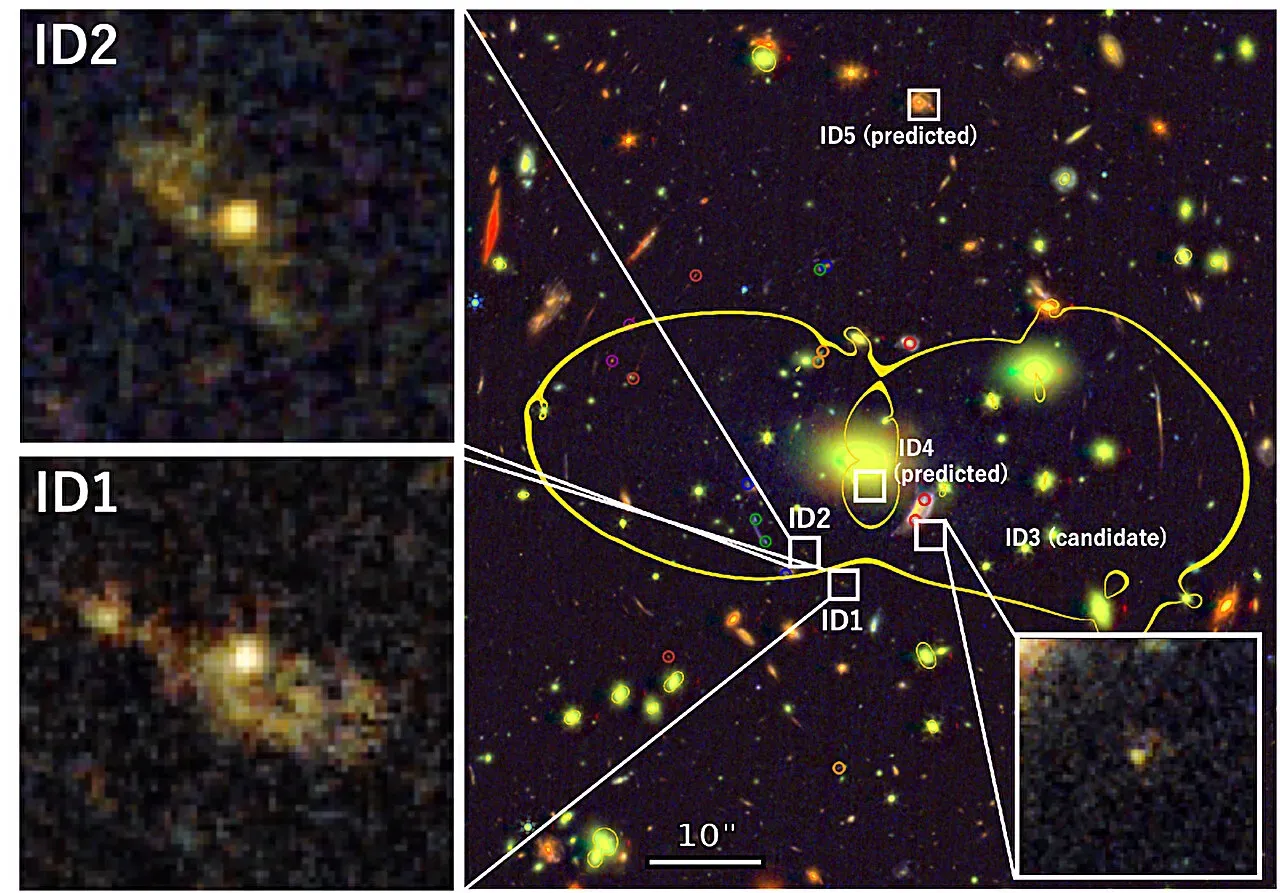
Astronomers using data from JWST and other telescopes have discovered a massive black hole in the distant galaxy MARTA 3887.
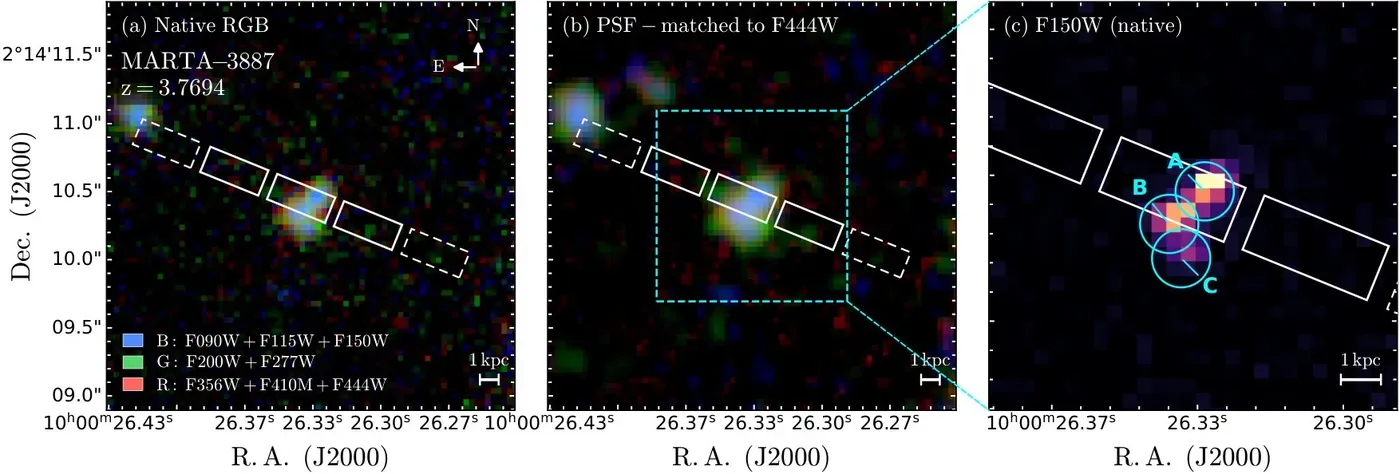
A possible black hole that grew faster than its host galaxy has been discovered by astronomers using a multiwavelength study of the distant galaxy MARTA 3887.
The study combined data from the James Webb Space Telescope (JWST), the Hubble Space Telescope, and the Very Large Telescope's MUSE instrument to identify the black hole, which is estimated to have a mass of around 3.3 million suns.
This massive black hole sits in a galaxy containing approximately 145 million solar masses in stars, raising questions about its origin story, as it is one of the first massive black holes thought to have formed in the universe.
In contrast to what has been observed in nearby galaxies, early black holes like this one are often too heavy compared to their host galaxies' stellar masses, suggesting that they may grow at a faster rate than the surrounding stars.
The discovery challenges current understanding of how black holes form and evolve in the early universe, highlighting the need for further research into these enigmatic objects.
The detection of overmassive black holes in the early universe has sparked debate among researchers about their formation and growth. A new factor that may impact this sample is the selection bias inherent in surveys that can only detect black holes that are particularly luminous or fast-moving.
This means that the samples obtained so far are likely to consist mainly of the largest black holes, which are merely the tip of a much larger iceberg. To gain a more comprehensive understanding of how black holes form and evolve, astronomers need to look for smaller, more typical ones as well. However, these fainter objects are notoriously difficult to detect.
Young galaxies with low metal content pose another challenge in distinguishing between black hole-powered gas and star-powered gas. The spectral line ratios used to make this distinction can become ambiguous, allowing extreme stars to masquerade as active galactic nuclei (AGNs).
To address these issues, researchers have adopted a multi-faceted approach that relies on multiple lines of evidence rather than relying on a single indicator. In the case of MARTA 3887, astronomers used spectroscopic observations from JWST to study the gas surrounding its central object.
The data revealed a broad hydrogen-alpha line, indicative of gas moving at approximately 1,270 kilometers per second (790 miles per second). This signal was unique to hydrogen and did not appear in other spectral lines, such as oxygen, which are typically associated with calmer gas. The presence of this characteristic signature suggests that the central object is indeed a black hole rather than an ordinary outflow.
The estimated mass of the central object is approximately 3.3 million times that of the sun. This puts it in a category of lower-mass black holes detected by the James Webb Space Telescope.
In comparison to its host galaxy's stellar mass, which totals around 145 million solar masses, the black hole accounts for roughly 2.3% of this total.
The relationship between the black hole's growth and the assembly of the surrounding stars is notably disproportionate. The team notes that this disparity is approximately 2 dex above what would be expected from nearby galaxies.
Characterized by its compact and clumpy structure, the galaxy itself has a low metal content, equivalent to just 10% of the sun's elemental composition, which is typical of young galaxies undergoing rapid star formation.
The researchers sought to understand how this phenomenon of a black hole growing faster than its host galaxy could occur. To investigate, they created simple growth models that assumed one black hole grew steadily from a seed without any mergers or changes in feeding rate.
These simulations revealed that if the black hole began growing very early on, when the universe was about 0.1 billion years old, it would need to feed at varying rates depending on its initial mass. For example, smaller seeds with masses of 100 suns would require a higher feeding rate, while larger seeds could grow more slowly.
The growth models showed that if the black hole's growth began later, during the recent star-formation burst, it would need to feed at an extremely high rate, which is unlikely. This suggests that a small initial seed would require strongly super-Eddington growth in order to reach its current mass.
While these findings are intriguing, the team emphasizes that they cannot rule out alternative explanations for the observed signal. An interacting supernova or a compact and thick outflow could potentially mimic the black hole's presence, although these scenarios are less likely according to their data.
The galaxy MARTA 3887 is emitting ultraviolet light at a rate that could be indicative of a black hole presence. This high-energy radiation may be seeping out into space through porous gas clouds within the galaxy itself. Such leaks would have played a crucial role in clearing the early universe's neutral hydrogen fog during cosmic reionization.
A significant portion of the Lyman-alpha light produced by MARTA 3887 is escaping, with about 44% of it making its way out into space. This high escape fraction suggests that the galaxy may indeed be leaking ultraviolet photons as well. However, the team behind this discovery has yet to directly measure the escape fraction of these high-energy particles.
The presence of a porous gas structure within MARTA 3887 is further supported by several lines of evidence. These findings imply that the galaxy's gas clouds are not dense and opaque, but rather permeable and able to allow radiation to pass through them. This property would enable ultraviolet light to escape more easily.
This discovery extends our understanding of actively feeding black holes in the early universe, particularly those residing within faint, metal-poor galaxies with low stellar masses. The growth rate of this potential black hole may have outpaced the formation of its host galaxy's stars, adding a new dimension to our knowledge of these enigmatic objects.
The discovery of a potential black hole in the early universe has left scientists pondering its growth rate and how it outpaced the formation of its host galaxy's stars. This enigmatic object is hidden within a clumpy, metal-poor galaxy at a redshift of approximately 3.8. According to research published on arXiv, this finding suggests that the growth rate of black holes in the early universe may have been more rapid than previously thought.
The implications of this discovery are significant, offering new insights into the formation and evolution of galaxies and their central supermassive black holes. The study's findings provide a unique perspective on the complex relationships between galaxy growth, star formation, and black hole activity in the distant past. This research contributes to our understanding of these mysterious objects and their role in shaping the universe as we know it today.
Facts based on reporting originally published by Phys.org.
You may republish this story, in full or in part, if you credit News Central Site and link to it (licence CC BY 4.0). Photos are not included.