Star Consumed Its Companion in Rare Phenomenon
Astronomers have witnessed a large star consuming its stellar companion for the first time in history.
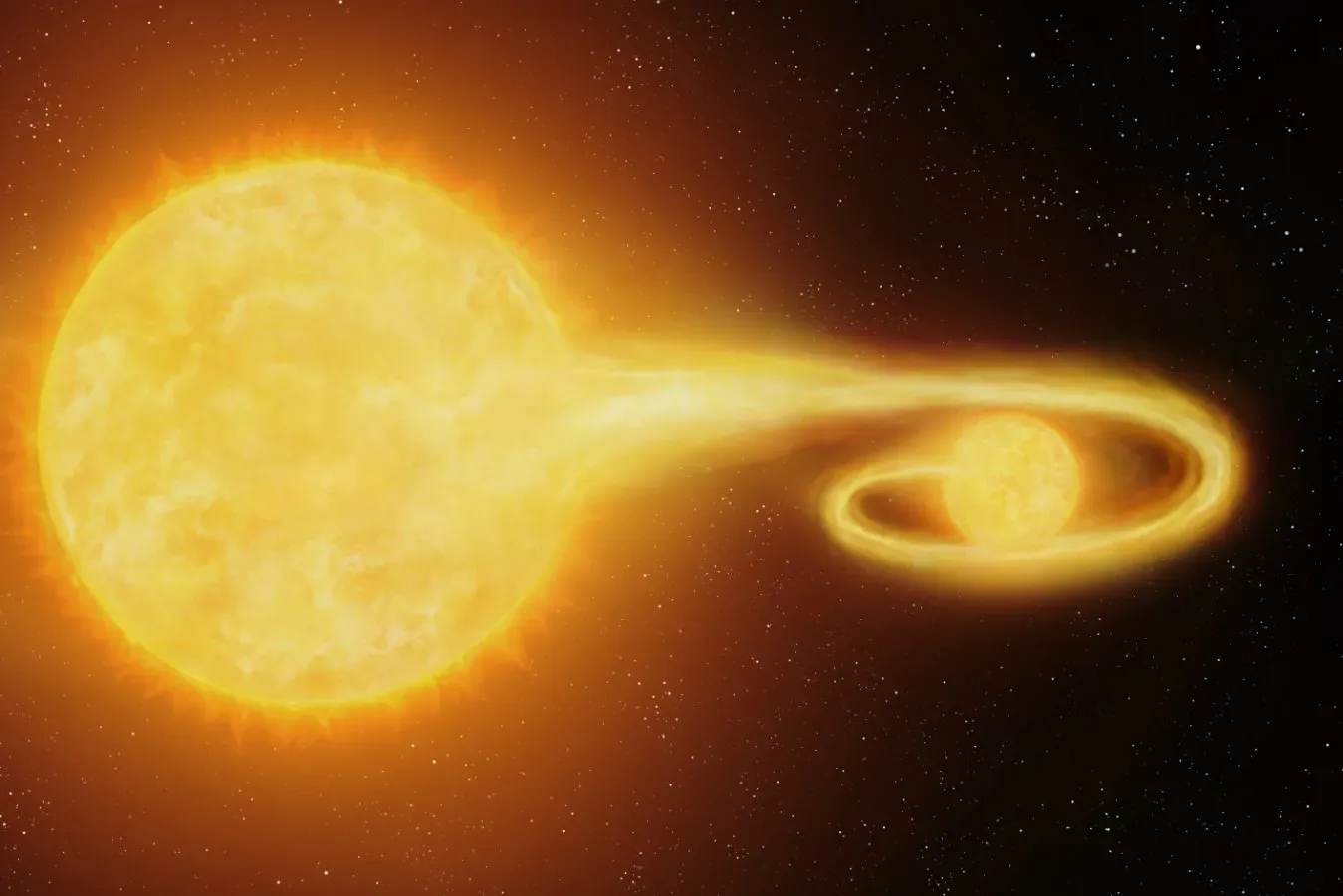
Astronomers have witnessed an extraordinary event: a large star consuming its stellar companion, a phenomenon that has been observed for the first time in history. This rare occurrence offers valuable insights into the evolution of stars, a process that scientists have been studying for decades.
Researchers initially reported in 2025 that a star in the Andromeda galaxy had been gradually brightening since 2018, but this finding was not unusual on its own. However, further observations revealed an extraordinary outburst in the same object later that year.
The SPHEREx space telescope serendipitously caught the stellar binary, which is now known as AT 2025abao, experiencing a massive expansion and brightness increase. Over the course of about a month, the star expanded at an incredible rate of 330 kilometres per second.
The sudden outburst was followed by further analysis using the James Webb Space Telescope (JWST), where Viraj Karambelkar at Columbia University in New York and his colleagues collected and examined all available data. They discovered that AT 2025abao was undergoing a previously unseen process, where "a red giant star expands and engulfs its smaller companion," according to Karambelkar.
The smaller companion spirals towards the core of the larger star and is eventually torn apart as it gets closer to the centre.
The common envelope phase is a pivotal moment in a star's life cycle, marking the point at which it begins to consume its companion. This phenomenon is rare and challenging to observe due to its brevity, lasting mere years amidst a star's billions-of-year lifespan.
Researchers have been able to capture all stages of this process, from the initial quiescent system to the moment when the smaller star, dubbed Small Bao, was torn apart at the core of its larger companion, Big Bao. The resulting outburst in 2025 served as a visual confirmation of this critical phase.
The common envelope phase is marked by a significant uncertainty, making it a crucial period in a star's evolution. According to experts, nearly one-third of stars will experience this phase at some point in their lifetime, with an even higher proportion if planets or other celestial objects are engulfed by the star.
"This series of events is called the common envelope phase," says Jason Nordhaus, who notes that it is "probably the most uncertain and critical phase in the evolution of a star."
The observation of a giant star consuming its companion has revealed unexpected details about this rare phenomenon.
One key discovery is that the common envelope phase, where the smaller star is engulfed by the larger one, lasts longer than previously thought. The energy released during this process is carried to the surface of the expanded red giant through convection, allowing scientists to better understand what's happening inside.
The findings contradict earlier assumptions about how energy is transferred during this phase, with researchers now acknowledging that their understanding of the physics involved was flawed.
Facts based on reporting originally published by New Scientist.
You may republish this story, in full or in part, if you credit News Central Site and link to it (licence CC BY 4.0). Photos are not included.