Nitrogen Cycle Discovery Reveals 12.8 Million Tonnes Deposited Annually into Oceans
Researchers have quantified the amount of organic nitrogen deposited from the atmosphere into the world's oceans, revealing an astonishing 12.8 million tonnes annually.
A significant discovery has been made about the global nitrogen cycle, highlighting a major component that was previously overlooked.
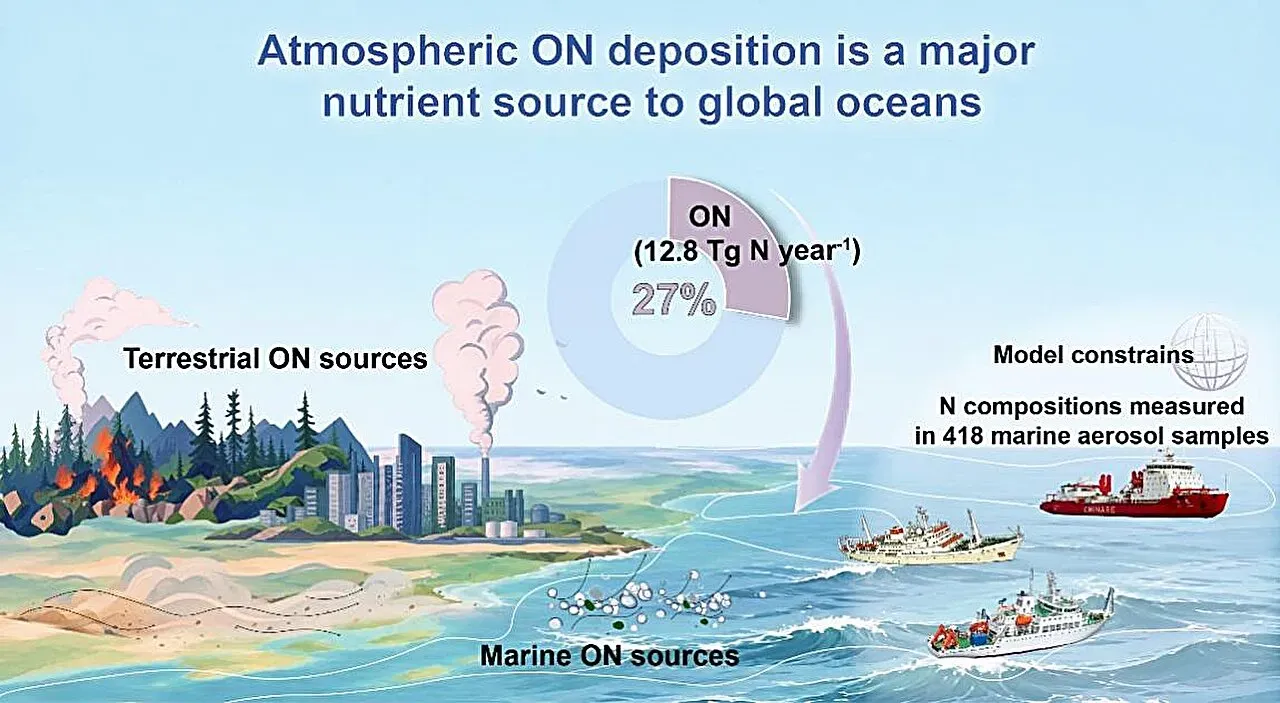
Researchers have quantified the amount of organic nitrogen deposited from the atmosphere into the world's oceans, revealing an astonishing 12.8 million tonnes annually. This represents approximately 27% of total nitrogen deposition in these waters. The study's findings indicate that in areas where nitrogen is scarce, such as the central Atlantic Ocean and Indonesian seas, this atmospheric organic nitrogen makes up roughly half of all nitrogen deposited.
The research team's work has far-reaching implications for our understanding of marine ecosystems and their impact on the climate. According to the study, these new insights will reshape how we view nutrient supply in ocean environments. The scientists' conclusions suggest that their findings could have significant effects on ocean ecosystems and global climate patterns.
A paper detailing this groundbreaking research has been published under the title "Atmospheric Organic Nitrogen is a Major Nutrient Source to Global Oceans." The study was led by two professors, Yu Jianzhen from the Hong Kong University of Science and Technology and Fu Tzung-May from the Southern University of Science and Technology.
The chemical complexity of atmospheric organic nitrogen (ON) has long hindered efforts to quantify its contribution to oceanic nutrient fluxes. This uncertainty stems from the difficulties in accurately measuring ON, a process often reliant on laborious and error-prone methods.
A team of researchers sought to address this knowledge gap by combining innovative measurement techniques with extensive open-ocean and polar marine observations. Their approach involved integrating an advanced atmospheric ON measurement method with global atmospheric chemistry modeling to estimate ON deposition.
"Our study demonstrates that atmospheric ON is far from a minor player in marine ecosystems," said Yu, highlighting the significance of this previously overlooked nutrient source. The researchers' cross-disciplinary collaboration enabled them to quantify the crucial biogeochemical link between the atmosphere and marine ecosystems.
The team's measurement method allows for simultaneous detection of both aerosol ON and IN, overcoming traditional approaches that often rely on subtracting IN from total nitrogen. This new analytical technique has already shown its potential in filling major gaps in global data sets.
The new analytical technique has been applied to a vast array of marine aerosol samples from research cruises around the world. The team analyzed data from 418 samples collected during 21 expeditions that covered diverse oceanic regions, including multiple journeys to the Arctic and Antarctic. This extensive dataset provides the most comprehensive information on atmospheric organic nitrogen (ON) available to date.
The researchers found significant variations in ON concentrations among different locations. In some areas, such as the remote Southern Ocean, levels were extremely low, while others, like the Yellow Sea along the Pacific coast, showed much higher amounts of ON. The study revealed that ON made up approximately 30% of total aerosol nitrogen on average.
The team used these measurements to refine a three-dimensional atmospheric chemistry model focused on ON. By doing so, they estimated that around 12.8 million tonnes of ON are deposited into the world's oceans every year. This analysis identified biomass-burning emissions as a major contributor to oceanic ON, accounting for nearly half of the annual total.
The study also highlighted other significant sources of ON to the oceans, including marine aerosol emissions and imines produced in atmospheric chemical reactions. These non-marine sources combined account for approximately 70% of all ON deposited into the world's oceans annually.
The study suggests that atmospheric organic nitrogen plays a significant role in supplying nutrients to global oceans. This external input can stimulate open-ocean productivity, making it an essential factor in marine nutrient dynamics.
Changes in these emissions may have significant effects on the ocean's nutrient balance, which could impact marine life and ecosystems. The research emphasizes the importance of considering terrestrial sources as part of the overall nutrient budget for the world's oceans.
These findings highlight the interconnectedness of atmospheric and oceanic systems, underscoring the need to account for all potential nutrient inputs when studying marine productivity and ecosystem health.
Facts based on reporting originally published by Phys.org.
You may republish this story, in full or in part, if you credit News Central Site and link to it (licence CC BY 4.0). Photos are not included.