Gravitational Lensing Reveals Early Galaxy Structure
Astronomers have used gravitational lensing to identify a galaxy called Misty Moons in the early universe.
Astronomers have made an exciting discovery using one of the most powerful tools in their arsenal: gravitational lensing. This phenomenon occurs when a massive galaxy cluster sits between the observer and a distant object, bending and magnifying its light like a giant natural magnifying glass. As a result, galaxies that would otherwise be too faint to detect become visible.
Using this effect, researchers have identified a galaxy nicknamed Misty Moons, which existed in the early universe when it was less than 500 million years old. The galaxy is located at a redshift of roughly 11 to 12 and its light has been magnified by the gravity of a foreground galaxy cluster. This allowed scientists to reconstruct the internal structure of Misty Moons.
The James Webb Space Telescope (JWST) has been instrumental in finding galaxies from the early universe, with some dating back just a few hundred million years. Some of these galaxies appear unusually bright and have high levels of nitrogen, yet they are surprisingly small. Astronomers believe that the brightness of these galaxies may hold important clues about globular clusters and star formation patterns.
Researchers think that the brightness of these early galaxies could be related to the presence of globular clusters, which are dense collections of stars that form around supermassive black holes at the centers of galaxies. Understanding how these clusters formed and evolved in the early universe can provide valuable insights into the history of galaxy evolution.
The discovery of Misty Moons is a significant find, providing astronomers with a unique glimpse of the early universe when it was still in its formative stages. The galaxy's internal structure, reconstructed using gravitational lensing, offers scientists a fascinating opportunity to study the formation and evolution of galaxies in the distant past.
The study of early star formation is often hindered by the difficulty in examining individual star clusters in distant galaxies. These ancient galaxies are typically small and far away, making it challenging to resolve their components. However, a natural phenomenon can help astronomers overcome this obstacle - when a massive galaxy cluster acts as a gravitational lens, the distant object appears brighter and magnified.
This allows researchers to pick out individual clumps within the galaxy and examine their properties in greater detail. Given that early galaxies were forming stars at a high rate, it is likely that their star clusters would be extremely dense, containing heavy elements in low abundance. The cluster formation efficiency (CFE) is a measure used by scientists to understand what fraction of a galaxy's newly formed stars end up in bound star clusters.
Researchers have found that the CFE correlates with the star formation rate in galaxies. This means that early galaxies, which were forming stars at a rapid pace, might have had a very high CFE. However, studying individual star clusters within these distant galaxies is no easy task.
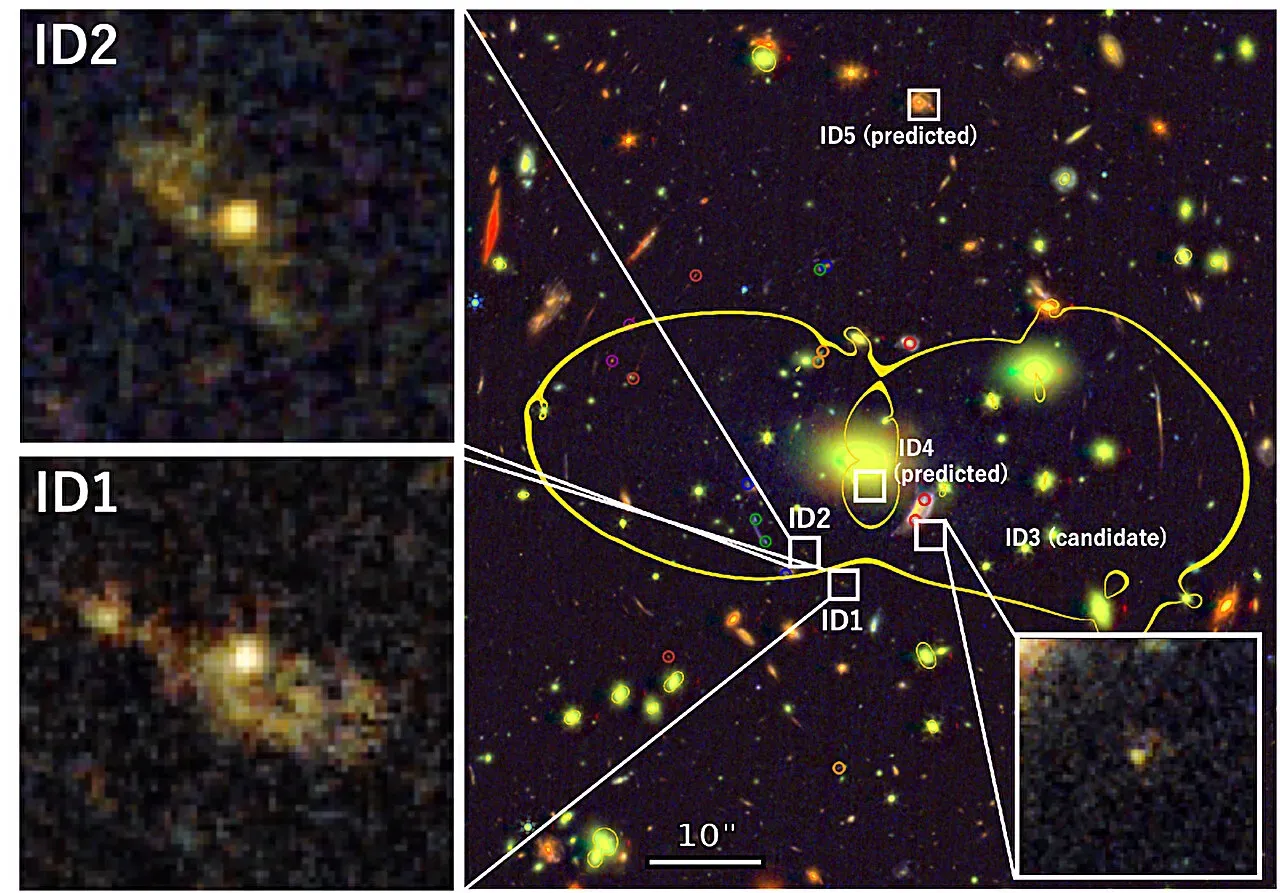
A team of astronomers led by Minami Nakane of the University of Tokyo has made a significant discovery in this regard. They identified a strongly magnified and clumpy galaxy in the JWST's NIRCam images of the field of galaxy cluster MACS0257-2325, which were taken in 10 color filters.
The images were complemented by older Hubble images captured with three filters. The galaxy, nicknamed Misty Moons, appeared as two distinct blobs (ID1 and ID2) that belong to the same galaxy. These blobs vanished at shorter wavelengths.
The estimated redshift of around 11-12 places the galaxy at a cosmic time of approximately 370 million to 410 million years after the Big Bang. This remarkable discovery offers scientists a unique opportunity to study early star formation in galaxies and gain insights into their internal structures and evolution.
The researchers used two independent lens models to reconstruct the internal structure of Misty Moons. These models predicted that five images of the galaxy would be visible. However, it was discovered that only three of these images are clearly visible.
One of the most striking features of the observed images is their brightness. The two brightest lensed images appear roughly 20-30 times brighter than they would without magnification. A third potential image has also been identified, although it is not as clear.
To better understand the structure of Misty Moons, the team smoothed and enhanced the images to make small bright spots stand out. This revealed multiple clumps in each of the two main images. Specifically, four clumps were found in ID1 and three in ID2.
Removing the effects of gravitational lensing allowed researchers to compare the structures of the two images. They discovered that the two images share the same underlying structure, suggesting a unified origin for the observed features.
Each of these clumps contains approximately 10 million solar masses of young stars, estimated to be around 40-70 million years old. This age range is consistent with local nuclear star clusters and young massive clusters. In fact, it's even possible that these clumps are proto-globular clusters.
The discovery has significant implications for our understanding of early star formation in galaxies. The data suggests that at least 80% of the galaxy's stellar mass is concentrated within these compact regions. This finding contrasts with observations of local dwarf galaxies, which tend to have more uniform distributions of stars.
Misty Moons' star formation rate is remarkably high, producing stars at a density of 100 to 10,000 times that of local dwarf galaxies.
This intense star formation likely drives the clump-dominated mode observed in Misty Moons. The galaxy's high rate of star birth stands in contrast to some massive local galaxies, which have similarly high rates but fewer stars grouped into clusters.
The central regions of Misty Moons are bright and compact, suggesting that actively feeding supermassive black holes may contribute to the galaxy's light output. If this is the case, some of the observed star formation could actually be due to accretion onto a massive black hole rather than new stars being born.
Despite these similarities with local galaxies, Misty Moons' overall structure and evolution are distinct from those of its local counterparts. The team's findings highlight the complexities and nuances of galaxy formation in the early universe.
The galaxy known as Misty Moons has provided scientists with a unique opportunity to study the early stages of star formation in the universe.
Galaxy formation is a complex process that involves the gravitational collapse of gas and dust within a galaxy's disk, leading to the creation of new stars. The team's research suggests that this process can be influenced by various factors, including the presence of dark matter and the distribution of gas within the galaxy.
Facts based on reporting originally published by Phys.org.
You may republish this story, in full or in part, if you credit News Central Site and link to it (licence CC BY 4.0). Photos are not included.