Western Large Tree Finches Show Unexpected Genetic Similarity to Small Tree Finches
A new study has found that western large tree finches have a unique genetic mix that combines DNA from different ancestral lineages.
Research on Darwin's finches has long highlighted the importance of beak variation in exploiting different food sources on the Galápagos Islands. However, a lesser-studied aspect of these birds is their tree-dwelling relatives, which have been overlooked until now.
A new study from Texas A&M College of Veterinary Medicine and Biomedical Sciences and international collaborators has shed light on the genetic makeup of western large tree finches. These birds appear to be morphologically distinct, but a closer look at their DNA reveals an unexpected twist.
Contrary to what their appearance might suggest, most of the DNA in western large tree finches is actually more similar to that of small tree finches than expected. There is one notable exception: a region associated with beak and body size, which shows a strong resemblance to that of larger tree finches.
Scientists have identified this unique genetic mix as a "genetic mosaic," where different ancestral lineages contribute to the bird's overall DNA composition. This phenomenon suggests that interbreeding can lead to novel combinations of traits, allowing for greater diversity in appearance and feeding habits even among closely related birds.
The study's findings, published in Nature Communications, offer valuable insights into the role of interbreeding and natural selection in shaping biodiversity. The discovery has significant implications for our understanding of evolutionary processes in action.
The discovery has sparked new interest in the concept of genetic mosaicism among researchers, who are now re-examining their understanding of species and populations with mixed genomes.
Genetic variants acquired from one species can be beneficial for adapting to a different environment, as seen in the example of Baltic herring, which gained valuable traits from Pacific herring. This exchange of genetic material allows populations to better survive in various environments.
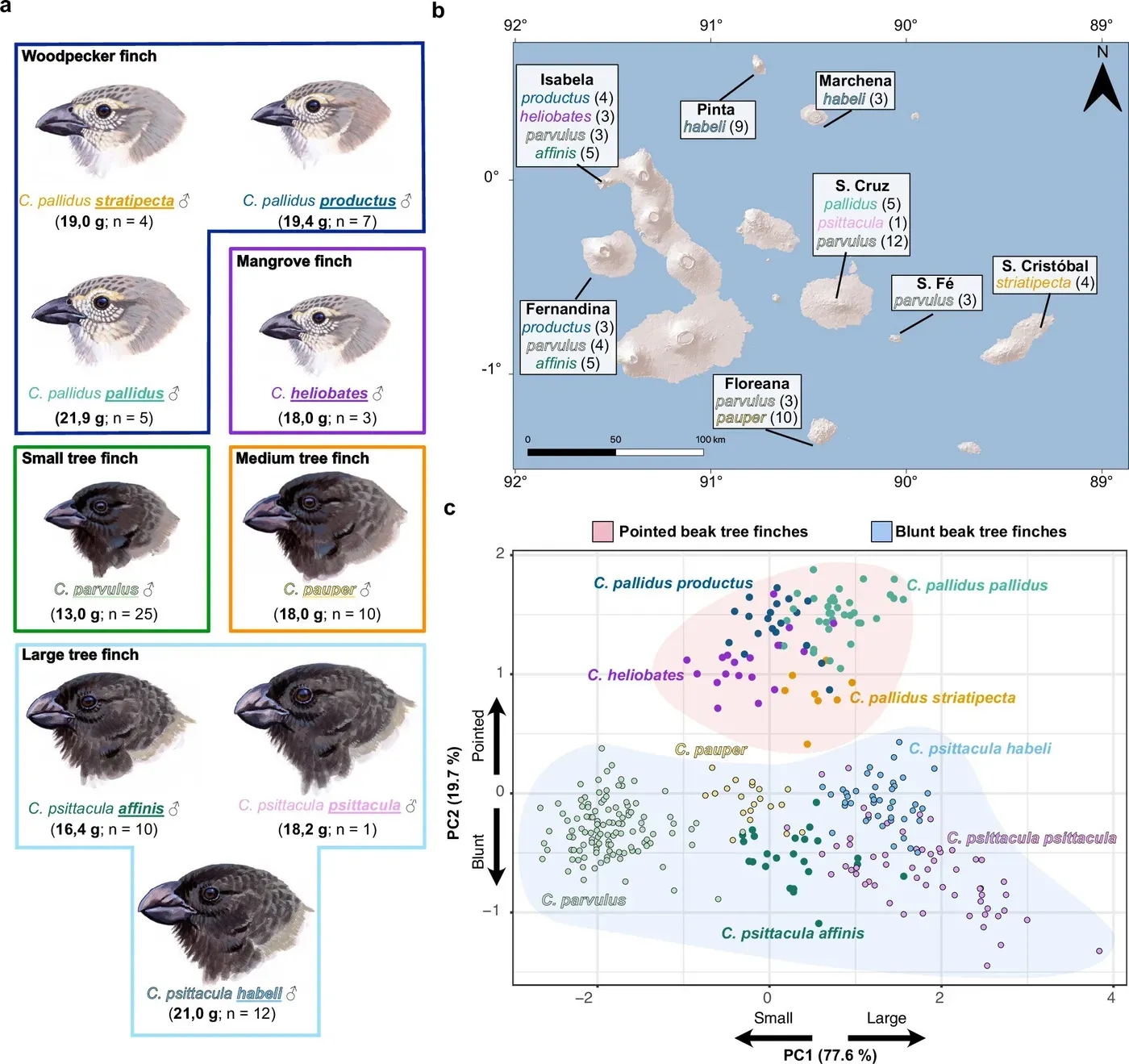
By combining whole-genome sequences from hundreds of birds with physical measurements from museum specimens, researchers were able to investigate whether similarities in appearance reflected close evolutionary relationships between species. The analysis revealed some surprising findings about the diversity among Darwin's finches.
Small tree finches and western large tree finches living on the same islands showed a striking contrast between their genetic makeup and physical characteristics, despite being closely related. These differences allowed them to exploit different food sources, highlighting the importance of adaptability in species survival.
The supergene G03, which influences beak and body size in Darwin's finches, was found to play a significant role in distinguishing small tree finches from western large tree finches. This complex genetic mechanism is characterized by a cluster of genes that affect multiple traits when inherited as a block.
The genetic mosaic pattern observed in western large tree finches on Isabela and Fernandina islands reveals a complex blend of traits from two distinct bird populations.
This intricate mix of characteristics can be likened to a Lego structure, where most pieces resemble those of the small tree finch but one key piece, representing the G03 variant, bears resemblance to the large tree finch.
It is proposed that this variant entered the population through interbreeding between small and large tree finches, allowing hybrids with larger beak and body size to exploit food sources previously inaccessible to small tree finches, thereby favoring traits suited to those resources under natural selection.
According to Andersson, the combination of hybridization and natural selection has given rise to distinct forms of birds that have adapted to different ecological conditions. This process is key to understanding the genetic diversity observed in these bird populations.
The differences in beak and body size may also influence mate choice, potentially reducing interbreeding between groups and contributing to the establishment of two closely related populations with unique physical traits and food preferences.
The study of Darwin's finches has revealed a complex genetic mosaic that contributes to their diverse physical traits.
Researchers have found that a single block of inherited DNA, known as G03, contains four genes that contribute to variations in beak and body size among the birds.
By examining additional data from Darwin's finches alongside comparative data from domestic chickens, scientists hope to understand how each of these individual genes affects the overall physical characteristics of the birds.
The discovery of this genetic mosaic could help explain why one inherited block of DNA can produce such significant differences in a bird's appearance and behavior.
Facts based on reporting originally published by Phys.org.
You may republish this story, in full or in part, if you credit News Central Site and link to it (licence CC BY 4.0). Photos are not included.