Data Centers' Air Quality Impacts Extend Thousands of Miles Away from Their Locations
Researchers at MIT have found that data centers are causing negative air quality impacts in regions thousands of miles away from where they're situated.
The rapid expansion of data centers has serious health implications that go far beyond their physical locations. According to researchers at MIT, these facilities are causing negative air quality impacts in regions thousands of miles away from where they're situated.
Data centers require massive amounts of electricity to function, and this demand is driving up emissions from power plants across the country. The team's estimates suggest that 650 premature deaths occurred in the US alone due to air pollution linked to data center operations in 2023.
Some Midwestern states are particularly vulnerable to these effects, despite being far removed from major data centers. These regions experience high rates of premature deaths per capita attributable to data centers, highlighting a concerning trend that's not limited by geographical boundaries.
The researchers have developed a modeling framework to track how electricity demand from data centers propagates through the power grid and contributes to air pollution in different areas. This model takes into account various atmospheric conditions that influence the formation of fine particulate matter, a pollutant linked to serious health problems.
The study's findings highlight the need for a broader perspective on the environmental impact of data centers, extending beyond their immediate surroundings.
According to Noelle Selin, a professor at MIT, people often focus on the local effects of data centers, but her research indicates that air quality impacts can be widespread across entire regions. Even those living far from these facilities should consider the potential risks, she warns.
Data centers are increasingly becoming a significant contributor to energy demand and emissions in the US, with the Lawrence Berkeley National Laboratory estimating that they accounted for around 4% of total US energy demand in 2023. This proportion is likely to have increased as new data centers continue to be built at a rapid pace.
The study's focus on regional health impacts underscores the importance of considering the broader effects of data center operations, beyond just their immediate surroundings. The research highlights the need for a more comprehensive understanding of how these facilities affect public health on a larger scale.
Selin and her co-authors, including Yuang (Albert) Chen, an MIT graduate student, have published their findings in Environmental Research Letters, shedding light on the previously overlooked regional air quality impacts of data centers.
The researchers took a different approach by tracing the emissions and health impacts of data centers on air quality.
This involved identifying which generators respond to the increased electricity demand caused by data centers running continuously, 24 hours a day.
Generators that typically supply additional power when needed are often natural gas plants, but their response can vary depending on location and time of day, according to Chen.
The team's modeling approach allows them to pinpoint which generators contribute to data center electricity demand within each region being studied.
Their model simulates the production and transmission of electricity by each generator every hour, providing detailed data on emissions.
The researchers combined their data on air pollution from data centers with a chemical transport model to simulate how pollutants move through the atmosphere across different regions. This allowed them to track the formation and spread of pollutants over long distances.
Using evidence from epidemiological studies, they then translated these findings into premature mortality rates due to additional air pollution caused by data center operations. The results showed that emissions from data centers led to a significant number of premature deaths in 2023.
The model estimated that these emissions were responsible for approximately 650 premature deaths last year, with about half of those attributable to particulate matter and the other half to smog. This represents around 5.3% of all electricity-related mortality in the country.
According to Selin, it's not surprising that data centers contribute to air pollution-related fatalities, but what is notable is where these deaths occur. "It's a different story" when it comes to data centers, she notes, implying that there are unexpected patterns at play.
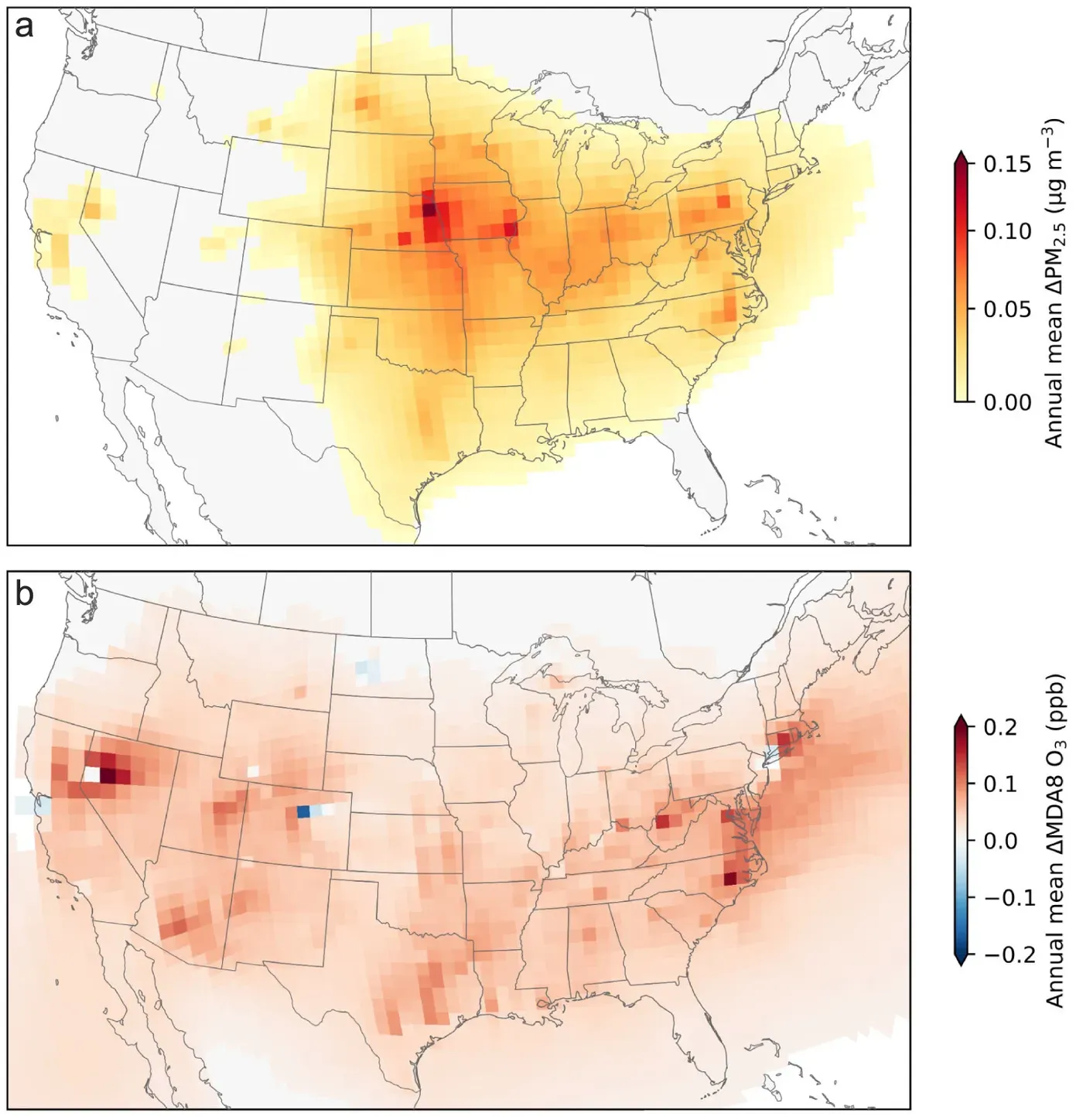
The study found that while some states like Iowa, Nevada, and South Dakota had high premature mortality rates due to data center emissions, the majority of electricity demand was concentrated in northern Virginia and Texas.
The mix of power sources in different regions can have significant implications for air quality when new data centers are brought online. According to experts, turning on a large data center can necessitate using high-emissions power plants to meet increased demand.
As pollutants are released into the atmosphere, atmospheric conditions allow them to be transported long distances to neighboring states, affecting their air quality. This is particularly evident in regions like the Midwest, where agricultural activities contribute to higher levels of particulate matter PM₂.₅.
The impact of data center emissions on air quality can extend far beyond the immediate vicinity of the facilities. States such as Nebraska and Iowa, which rely heavily on agriculture, experience enhanced formation of PM₂.₅ due to additional atmospheric ammonia from fertilizer use. The estimated health impacts also reach states with relatively few data centers, including Kansas, South Dakota, Missouri, and Arkansas.
Rural populations are disproportionately affected by the poor air quality associated with data center electricity demand. According to researchers, these areas experience significantly higher mortality risks compared to urban populations. This highlights the importance of considering air quality when planning data center siting and operations.
The study's findings suggest that data centers' electricity demand has a significant impact on air quality across vast distances. This is particularly concerning for areas far from the actual data center locations where pollutants can travel through atmospheric pathways.
Air pollution generated by data centers in one region can affect people living hundreds of miles away, with potential health consequences. As such, it's essential to consider the long-distance effects of data center operations when deciding on their placement and management.
Facts based on reporting originally published by Phys.org.
You may republish this story, in full or in part, if you credit News Central Site and link to it (licence CC BY 4.0). Photos are not included.