Unprecedented Material Properties Observed in Polymer Under Stress
A team led by Chenfeng Ke has made a breakthrough discovery about the behavior of materials under stress, developing a smart material that exhibits unprecedented properties such as memory and adaptability.
A team led by Chenfeng Ke has made an unusual discovery about the behavior of materials under stress. While most substances tend to weaken over time, this group's innovative polymer appears to grow stronger with repeated bending and straining.
According to Ke, their smart material exhibits properties that are unprecedented in the field: it can remember, adapt, learn, and even grow. The implications of such a discovery are vast and exciting, as researchers consider potential applications for this remarkable substance.
The breakthrough was achieved through a combination of sugar crystals and polyethylene glycol, a compound commonly used in laxatives and other health products. This biodegradable blend forms a hydrogel, which is a flexible material capable of absorbing and retaining large amounts of water.
The hydrogel exhibits remarkable properties when subjected to repeated bending. Instead of deteriorating, its strength and resilience increase. This phenomenon was observed during experiments where the material was flexed numerous times, a process that could potentially be mimicked in various real-world applications.
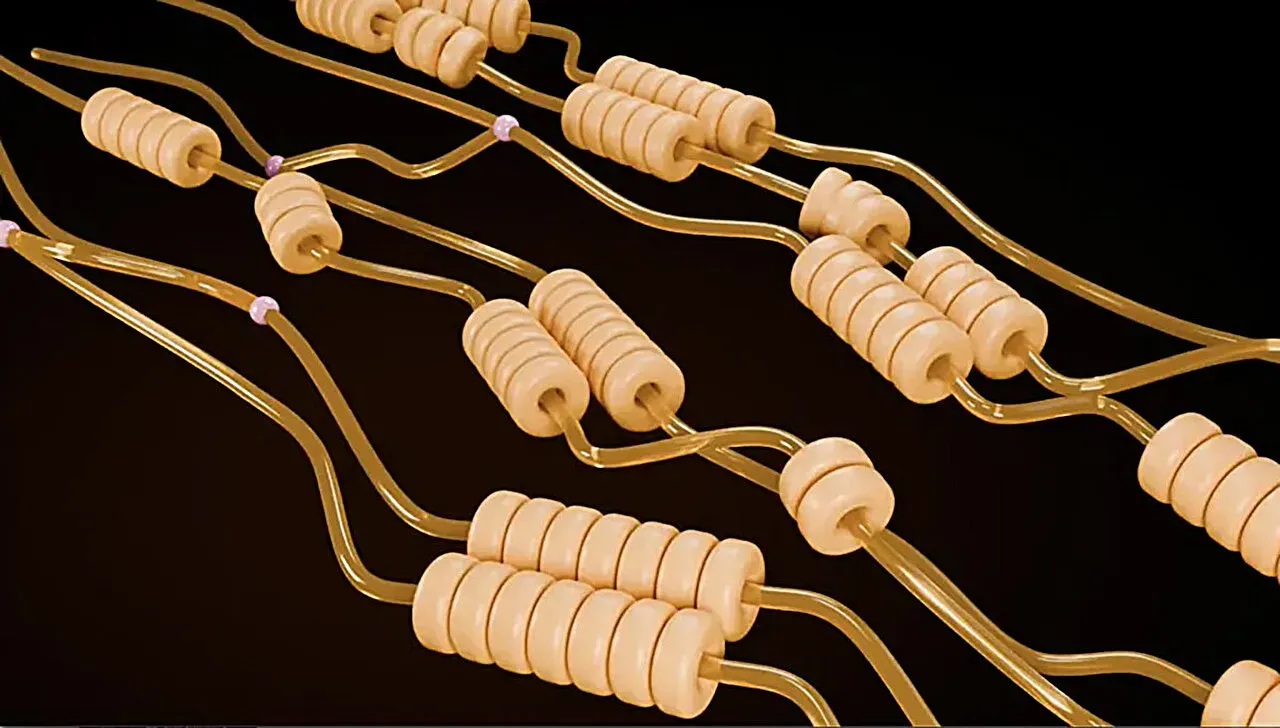
At the heart of this hydrogel's exceptional performance lies cyclodextrin, a sugar-based compound with unique properties. When the polymer is stretched or bent, the cyclodextrin molecules slide into position to reinforce areas under strain, effectively adapting to the changing conditions. This dynamic response allows the material to maintain its integrity even in the face of repeated deformation.
The hydrogel's ability to mimic biological materials has significant implications for medical applications. By emulating the properties of collagen, a protein found in skin and other connective tissues, this polymer could potentially be used to protect and repair damaged tissues. This approach draws inspiration from nature, where many remarkable smart materials can be found.
Surgeons and orthopedic device manufacturers may find this material particularly appealing due to its biocompatibility with biological tissues. Its composition of sugar and polyethylene glycol makes it an attractive option for medical applications.
The potential uses for this sugar-based hydrogel are numerous and varied, with applications in medical fields such as supporting artificial joints or repairing damaged tissues. In both cases, areas that don't experience stress or strain would remain soft and pliable, allowing the material to adapt to different situations.
According to Ke, a chemist who has been working on this project, the material doesn't need to be rigid to function effectively in the body. "If you're putting material into a body, you don't necessarily want it to be completely rigid," he explained, emphasizing the importance of flexibility and adaptability.
Ke acknowledges that his expertise lies in chemistry rather than medicine or medical device development, which is why he's eager to collaborate with experts from WashU Medicine and other institutions. We want to work with these specialists to explore the possibilities of this material, he said, hoping that their research will attract interest from investors and potential users.
The team has so far produced small quantities of the new polymer, in tens of grams at a time, but they're confident that production can be scaled up once the concept is proven. With successful demonstrations under their belt, Ke and his team are now exploring ways to expand their research and make the material more widely available.
The research team has successfully demonstrated that their sugar-based hydrogel material can be strengthened through repeated bending, rather than being worn down by it.
This counterintuitive property suggests a range of potential applications for the material, which could be used to create self-healing structures or adaptive systems that respond to changing conditions.
Facts based on reporting originally published by Phys.org.
You may republish this story, in full or in part, if you credit News Central Site and link to it (licence CC BY 4.0). Photos are not included.