Earthquake Strikes Southern Africa in Area Thought to Be Immune to Tectonic Activity
A new study has found a rift zone in eastern Botswana's Kalahari Craton, contradicting long-held assumptions about continental stability.
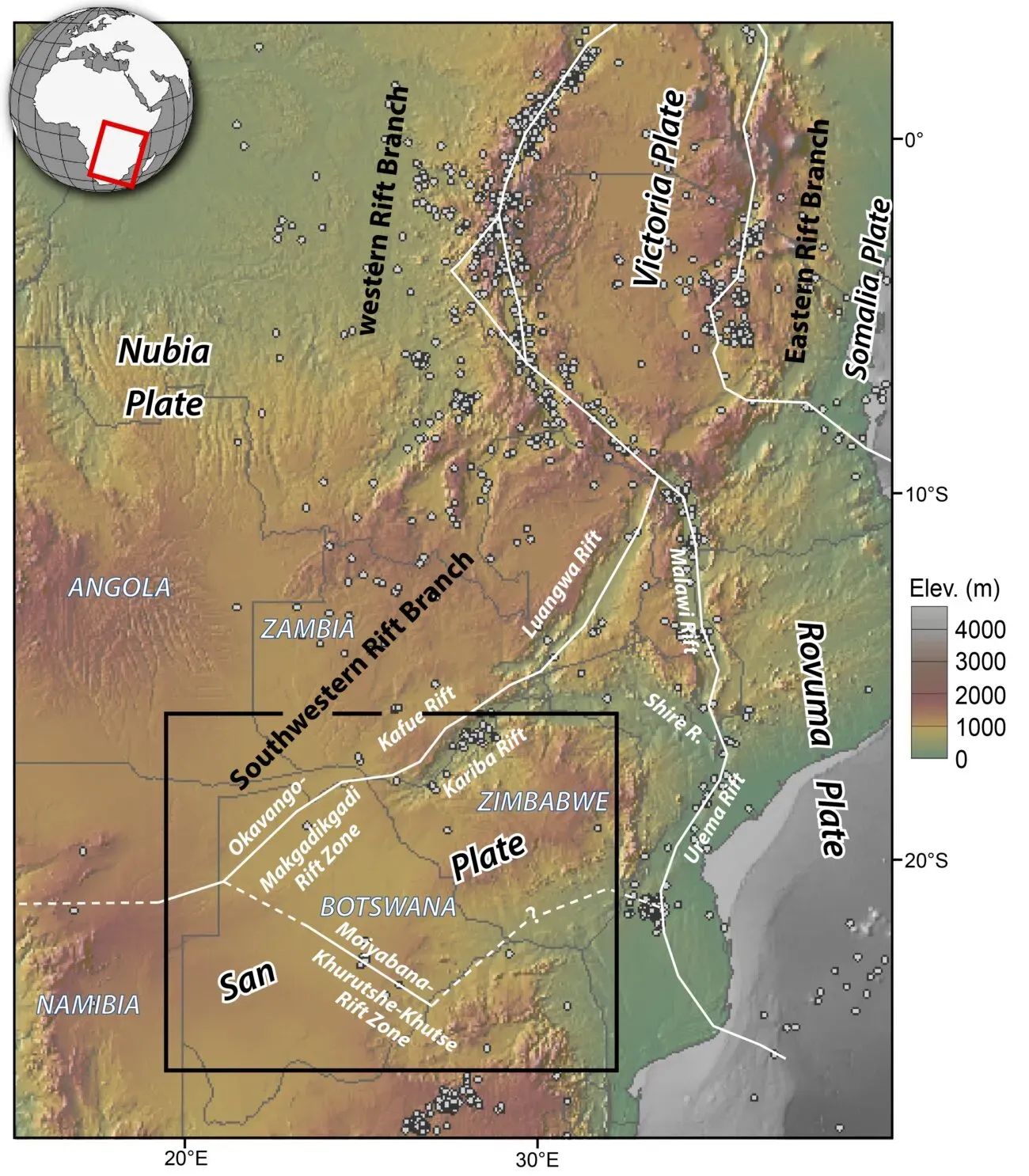
A powerful earthquake struck southern Africa in April 2017, sending shockwaves from the middle of the Kalahari Craton in eastern Botswana. This ancient landmass is comprised of blocks of crust estimated to be up to 3.7 billion years old, considered too rigid and thick to tear apart by geologists.
However, a new study has revealed that the craton is indeed being pulled apart by a rift zone, contradicting long-held assumptions about continental stability. The research, led by scientists at the Botswana International University of Science and Technology and the Lamont-Doherty Earth Observatory, challenges the notion that such regions are immune to tectonic activity.
According to the study, published in the journal Tectonics, this rift zone has attempted to fracture the craton before. The findings indicate that even the oldest continental cores can be susceptible to geological reactivation and subsequent fracture.
The earthquake that occurred in 2017 was a significant event, as it happened in an area where no one expected tectonic activity to occur. Folarin Kolawole, co-author of the study and structural geologist at Lamont-Doherty Earth Observatory, notes that this region is characterized by "an active fault slipping," which contradicts previous assumptions about continental stability.
The research highlights the complex geological history of the Kalahari Craton, with implications for our understanding of continental evolution. The study's findings will be explored further in subsequent articles, shedding light on the intricate processes shaping the Earth's surface over millions of years.
The East African Rift System is slowly stretching apart at its southern tip, where a new rift has been discovered. This rift is in an early stage of development and could potentially split a continent open if successful, creating a new ocean.
For decades, scientists believed the southern end of this system was located in the Okavango Rift Zone of northern Botswana, identified by geologist Christopher Scholz and colleagues in the 1970s. However, studies of the 2017 earthquake revealed that it actually reaches much farther south, into the craton itself.
The discovery is surprising because rifts usually form around mountain belts, which are weaker zones where ancient cratons once collided. Instead, this new rift has broken across a craton, challenging long-held assumptions in geoscience.
"It's counterintuitive, says Kolawole, highlighting the unusual nature of this finding. It basically challenges age-old thinking on how rifts form and propagate through continents.
The team focused its research on the Khurutshe Fault, which cuts a 50-mile-long scarp across the Kalahari landscape about 50 miles south of the 2017 earthquake. In some areas, the land on one side of the fault is as much as 400 feet higher than the other.
Researchers in Botswana excavated trenches alongside a major highway to study an ancient fault line that appears to be reactivating. They also analyzed data from water pipeline excavations and groundwater boreholes drilled across the region. These multiple lines of evidence all pointed to a common conclusion.
The team's findings suggest that when a fault slips, one side of the land drops, creating a low spot where sediment accumulates and forms a wedge-shaped deposit. This process occurs as the fault moves, with sediments piling up against it over time. The researchers discovered that this exact phenomenon has occurred twice in the same area: during the Jurassic period, about 180 million years ago, and again today.
Excavations at the site revealed more details about the ancient fault's history. Beneath layers of windblown sand, the team encountered hard, compacted sandstone from the Jurassic period, riddled with white calcite deposits that resemble a spider web network. These calcite veins were likely formed by hot fluids rising through cracks in the rock, much like those found at Yellowstone's geothermal springs.
The fault's past activity has left behind a distinctive signature on the surrounding rocks. Some of the surfaces have been smoothed and scored by the repeated slipping motion along the fault line. This evidence suggests that the ancient fault was not just a static feature of the landscape but an active process that shaped the region over millions of years.
Further analysis of the rock formations has provided valuable insights into the geological history of the area. The team's findings have significant implications for our understanding of how faults behave and interact with their surroundings.
The ancient Kalahari Craton is home to a newly reawakened fault system, one that has been dormant for millions of years. A team of researchers has found evidence that this rift first formed during the Jurassic period, when Africa's landmass was undergoing significant stretching.
A key characteristic of the Khurutshe fault is its location within the craton itself. The Kalahari Craton is an ancient and stable part of the African continent, but even these old blocks have inherent weaknesses that can be exploited by tectonic forces. The fault has offset young sand deposits that were laid down relatively recently.
The rift's history suggests that it was initially formed during a period of widespread stretching in Africa. However, it failed to develop further and remained dormant until the East African Rift System began pulling on it once more. Exactly when this reactivation occurred is not yet clear.
The researchers believe that existing weaknesses within the craton played a crucial role in the rift's development. Volcanic activity did eventually reach the area during the Jurassic, but faulting had already begun to occur before magma weakened the crust sufficiently to initiate the rift. This finding suggests that the rift exploited pre-existing zones of weakness rather than being caused solely by volcanic activity.
The Khurutshe fault is still in its early stages of development, and it's not a new feature on the African landscape. The researchers note that breaking through to a new plate boundary can be a persistent process, requiring multiple attempts before success is achieved.
The discovery has significant implications for the way southern Africa's tectonic plates are mapped.
Some scientists have suggested that the region south of the Okavango Rift forms a single stable microplate known as the San Plate.
However, an active rift with large earthquakes and fresh fault lines is located squarely within this supposed stable plate.
We cannot assume that the plate is coherent," Kolawole notes, indicating that the San Plate may not be as solid as previously thought.
The researchers propose that the San Plate could be slowly breaking into two smaller plates, which they call the North San Plate and the South San Plate.
The breakup of a tectonic plate is a gradual process that unfolds over millions of years, if it happens at all.
According to GPS measurements, the rifts in southern Africa are opening far more slowly than those found in other parts of Africa, such as Malawi, Kenya, and Ethiopia.
Slow-moving rifts can stall or fail altogether, but Kolawole points out that plate boundaries often start slow before accelerating later on in their life cycle.
Studying this rift as it begins to form offers a rare glimpse into the process of new plate boundaries emerging, potentially leading to Africa's eventual split.
The African continent is home to some of the oldest landmasses on Earth, and scientists have discovered a rare phenomenon within one of these ancient territories. An ancient failed rift that had previously gone dormant is now reawakening, offering researchers a unique opportunity to study the process of new plate boundaries emerging.
This event has significant implications for Africa's geological future, potentially leading to its eventual split into separate landmasses. The rift's formation and growth will be closely monitored by scientists, who are eager to gain insights into the complex processes that shape our planet's surface.
Facts based on reporting originally published by Phys.org.
You may republish this story, in full or in part, if you credit News Central Site and link to it (licence CC BY 4.0). Photos are not included.