Breakthrough in understanding tiny whirlpools in exotic fluid achieved by University of Cambridge scientists
Researchers led by Sebastian Morris have observed for the first time how quantum vortices form and dissolve as a cloud of atoms cools to near absolute zero.
A breakthrough in understanding the behavior of tiny whirlpools in an exotic fluid has been achieved by scientists at the University of Cambridge. Using innovative imaging techniques, researchers led by Sebastian Morris have observed for the first time how these quantum vortices form and dissolve as a cloud of atoms cools to near absolute zero.
The experiment involved creating a Bose-Einstein condensate (BEC), an unusual fluid where individual atoms across the entire cloud share the same quantum state. According to current theories, when this happens, tiny vortices should emerge from the disordered gas and gradually unravel as it settles into its new state. This process is known as "Vinen turbulence, which has now been directly observed.
The unique behavior of a BEC allows quantum properties that are usually confined to individual particles to manifest on a much larger scale. Unlike traditional fluids, where rotation can occur freely, in a BEC any movement is concentrated into thin, thread-like vortices, each carrying a specific amount of circulation.
These vortices play a crucial role in understanding the behavior of quantum fluids and their potential applications. By observing how they form and decay, scientists can gain valuable insights into the underlying physics of these exotic states of matter, which may have significant implications for various fields of study.
Physicists have long theorized that vortices in a BEC can be described by Vinen turbulence," which predicts that newly formed BECs will contain chaotic tangles of these threads that gradually untangle as they relax.
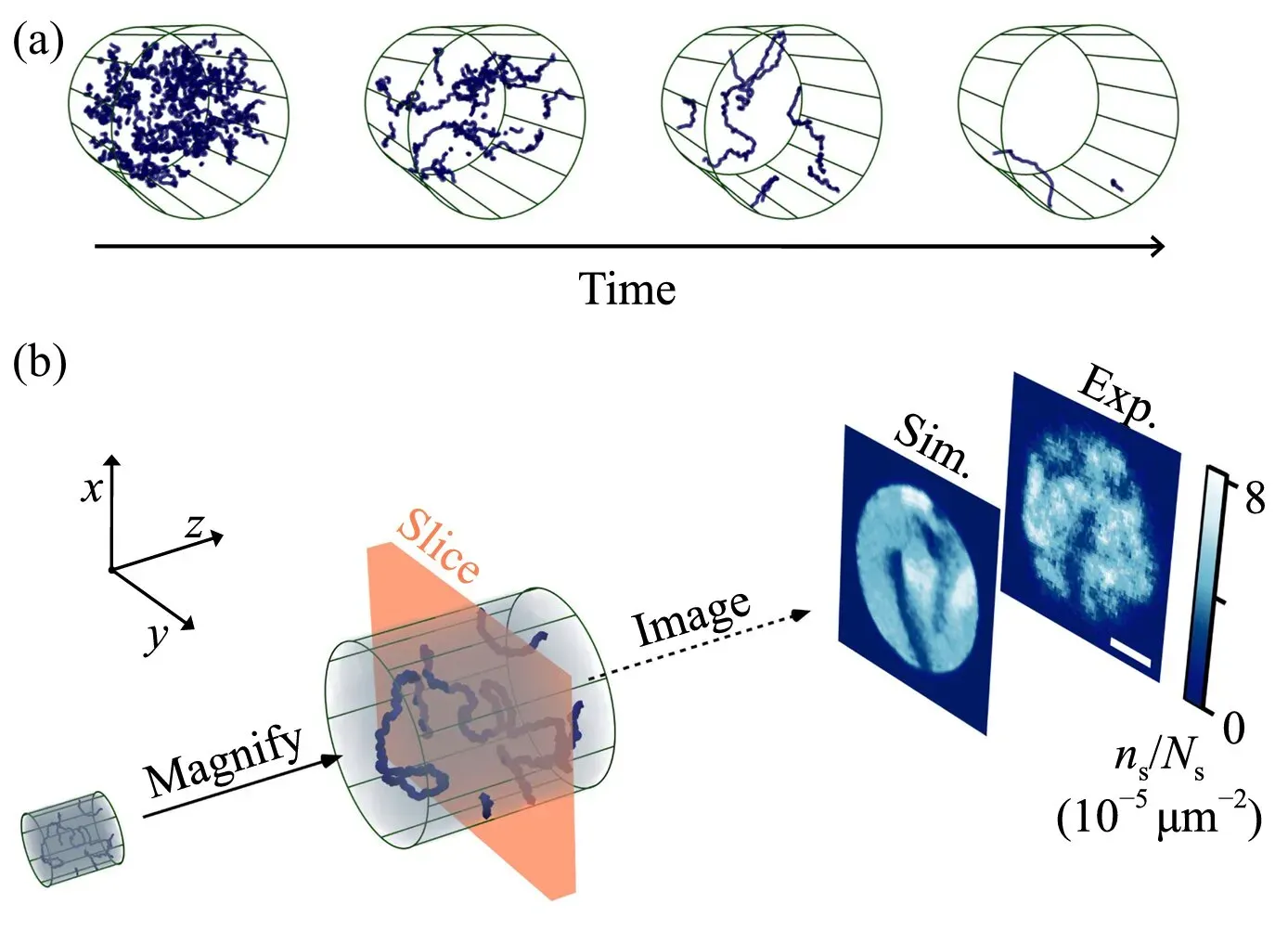
To test this theory directly, researchers turned to ultracold gases and began with a BEC of potassium atoms contained within a uniform, cylinder-shaped trap of light. By disturbing the gas and then switching on interactions between its constituent atoms, the team was able to induce relaxation in the system.
As the BEC relaxed, vortices became visible as dark streaks in photographs taken at different moments during this process. These images captured the threads of vortices passing through a thin slice of the enlarged cloud.
The researchers repeated their observations many times to estimate the total length of vortex threads packed into each unit of volume within the gas, allowing them to test the theoretical law describing how this quantity should shrink over time.
As the ultracold gas relaxed, its vortex density began to fall at a rate predicted by Vinen turbulence theory. This decline was consistent with denser tangles of vortices decaying faster due to interactions between neighboring vortices.
A notable observation emerged when the decay slowed down as remaining vortices were lost at the trap's walls. The team found that the decay rate did not depend on the strength of atomic interactions, which was an unexpected result given the complexity of ultracold gas behavior.
The researchers made a surprising discovery when they accounted for differences in particle mass and compared their findings to measurements in superfluid helium. Despite being vastly different at the microscopic level, the two fluids showed striking similarities in vortex decay rates.
As the atoms began to exhibit growing quantum coherence, vortices became increasingly visible, providing further evidence of the intricate dance between disorder and order in exotic fluids like BECs.
As researchers continued to observe the ultracold gas, they noticed a peculiar phenomenon - the formation of vortices that began to unravel in a complex dance of quantum behavior. This was evident as the atoms started to exhibit growing quantum coherence, with visible patterns emerging from the seemingly chaotic fluid.
The intricate web of vortices provided further insight into the interplay between disorder and order in exotic fluids like Bose-Einstein condensates. The study's findings shed new light on the dynamics of far-from-equilibrium systems, where unexpected patterns can arise from the interactions of individual particles.
Facts based on reporting originally published by Phys.org.
You may republish this story, in full or in part, if you credit News Central Site and link to it (licence CC BY 4.0). Photos are not included.