Slate Abandons Original Battery Plan for Electric Pickup
The company has switched to a single lithium-iron-phosphate battery pack from Gotion after initially planning to use a nickel-manganese-cobalt battery from SK On.
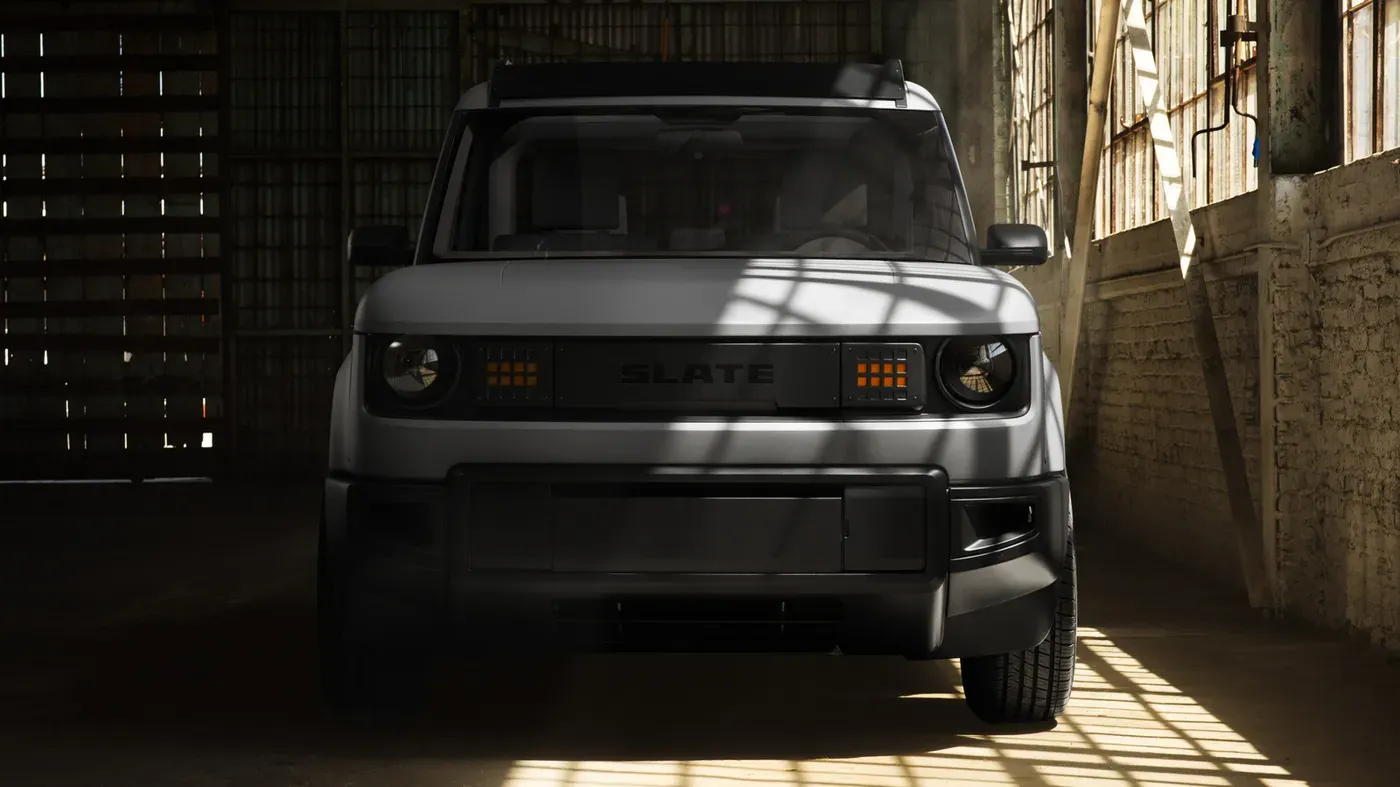
Slate has made a significant change to its electric pickup's battery configuration. The company initially planned to use a nickel-manganese-cobalt (NMC) battery from SK On in the base model, but this is no longer the case.
The original plan was for the base model to be powered by a 52.7kWh NMC battery with an estimated range of 150 miles. Those who opted for the upgraded version were supposed to receive an 84.3kWh pack that would provide around 240 miles of range.
However, Slate has abandoned this plan in favor of a single lithium-iron-phosphate (LFP) pack from Gotion, manufactured in Manteno, Illinois. This new battery configuration extends the truck's range to a projected 205 miles and helps maintain the company's advertised starting price of $24,950 (plus a $1,450 destination fee).
It is worth noting that this estimate is based on an EPA test cycle and not a finalized EPA rating. Slate has confirmed that the base truck will use LFP batteries.
The switch to LFP was likely influenced by changes in government policies regarding electric vehicles. The federal clean-vehicle tax credit had requirements for the origin of battery components and critical minerals, which made US-made NMC cells from SK On a more suitable choice than an LFP supply chain concentrated in China.
The federal credit's elimination for vehicles acquired after September 30, 2025, has removed one reason Slate had to design its truck around those sourcing requirements.
The availability of Lithium Iron Phosphate (LFP) batteries had improved significantly by 2025, allowing Slate to reconsider its sourcing requirements. According to Chris Barman, Slate's CEO, a supplier that was previously considered did not have the capacity needed and could not meet federal tax-credit rules restricting battery materials linked to certain China-linked entities.
However, Gotion has now been able to produce LFP batteries in Illinois, approximately 90 miles from Slate's factory in Warsaw, Indiana. This is a significant improvement over the originally planned supply arrangement with SK On, which would have required transporting modules from Commerce, Georgia, some 710 miles away. The reduced logistics costs are a major advantage for Slate.
The use of LFP batteries instead of NMC also offers cost savings due to their composition. Unlike NMC, which contains nickel, manganese, and cobalt in its cathode, LFP uses iron and phosphate. This makes LFP cheaper to produce while still providing a reliable source of power.
Slate was eager to incorporate the new battery technology into its design, with Barman stating that it would enable the company to maintain its target price point while providing more range for customers. The new prismatic cells are also designed to stack directly into the battery pack, making better use of available space under the truck.
The Slate Truck's switch to lithium iron phosphate (LFP) batteries has resulted in a lower overall cost for the vehicle. However, this decision comes with some compromises - LFP batteries store less energy per unit of size and weight compared to nickel manganese cobalt (NMC) batteries.
The increased battery capacity from 52.7kWh to 65kWh, combined with aerodynamic and thermal improvements, has enabled a significant boost in range. The current Slate Truck now boasts an estimated 205 miles on a single charge, up from the original 150 miles. This increase in range is not solely due to the chemistry change.
The power output of the vehicle has also been affected by the switch to LFP batteries, with the engine now producing 181 horsepower compared to the previously announced 201 horsepower. Despite this reduction, Slate still claims an 8-second 0-to-60-mph run. The battery and power train warranty for the truck remains at 10 years or 110,000 miles.
Facts based on reporting originally published by Engadget.
You may republish this story, in full or in part, if you credit News Central Site and link to it (licence CC BY 4.0). Photos are not included.