Quantum computers face challenges due to complex error patterns
New studies suggest that errors in quantum computers are more intricate than initially thought, forcing a re-evaluation of existing theories.
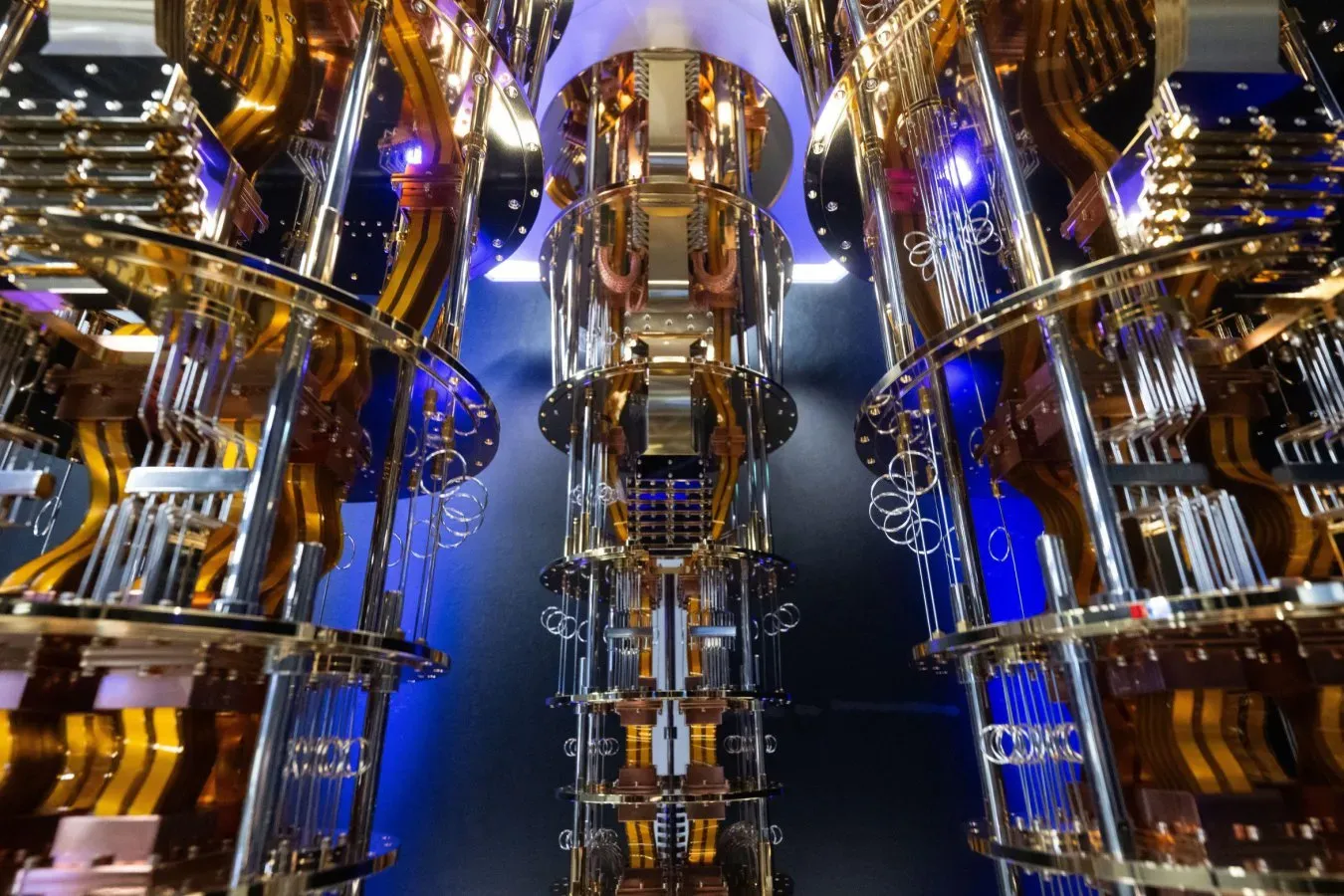
Quantum computers have made significant progress in recent years, but their potential still lies dormant due to a major hurdle - correcting errors that these devices inherently make. Researchers have been working on developing methods to tackle this issue, known as quantum error-correction (QEC).
However, new studies suggest that the landscape of errors is far more complex than initially thought, posing significant challenges for making quantum computers practical. This complexity has caught researchers off guard, forcing them to re-examine their earlier assumptions about how errors occur in quantum computers.
Quantum computing began with theoretical investigations into how these devices could work and what types of computations they would be able to perform reliably. At that time, no actual quantum computer existed, so researchers relied on mathematical theory to predict the behavior of qubits - the building blocks of quantum computers.
Now that quantum computers do exist, data about their errors is rapidly accumulating, revealing new insights into the nature of these errors and challenging earlier assumptions. One key area of focus has been the Markov assumption, which held that qubit errors are memoryless and uncorrelated in time.
Memory effects pose a significant challenge for the reliable operation of quantum computers because they can cause qubits to produce different results when performing the same task at different times, depending on what their environment "remembers.
This phenomenon is akin to a mathematical equation that yields one result immediately and another later on, introducing unpredictability into calculations. Quantum computers rely on precise control over qubit behavior, making memory effects particularly troublesome.
The Markov assumption had been a cornerstone of quantum error correction strategies, positing that qubit errors are rare or non-existent, allowing for longer program execution times. However, recent findings have cast doubt on this assumption.
Experiments have consistently shown that memory effects persist in various settings, with researchers at the Karlsruhe Institute of Technology and Stuttgart University developing a measurement technique to uncover long-lived defects in superconducting qubit environments.
These defects can act as memories" that compromise the Markov assumption, according to Ioan Pop and his colleagues.
Researchers at Google's Willow quantum computer have been studying error correction methods, but a recent analysis has revealed some unexpected complexities. In 2025, a team led by John Fidel Kam found that certain errors were difficult to correct and matched a theoretical model where the Markov assumption didn't hold.
These findings suggest that the qubits' environment may not be as predictable as previously thought. The qubits' surroundings are non-Markovian, meaning they can influence the system in ways that don't follow traditional patterns. This has significant implications for error correction methods used in quantum computing.
Another study by Gregory Quiroz and his colleagues at Johns Hopkins University found that incorporating non-Markovian effects into their model greatly improved its accuracy when simulating an IBM quantum computer accessed through a cloud platform. Their results showed that this approach outperformed traditional noise models, achieving better representation of the system seven times over.
IBM and Google declined to comment on these findings, but experts are already warning about potential consequences as quantum computers continue to advance. As qubits increase in number, previously minor effects may become more significant, posing new challenges for error correction methods.
Researchers are now exploring how certain parts of a qubit's environment can remember past interactions and respond accordingly. This raises the possibility of yet another type of error that current approaches fail to account for, further complicating the task of developing reliable quantum computers.
Researchers are re-examining the possibility of error correction in quantum computers due to concerns that current approaches may be inadequate for certain types of noise.
This has led some experts to suggest that correlated noise, which arises from memory effects, might not be properly accounted for in existing models.
Mathematical theorems have proposed that a quantum computer could achieve fault-tolerance, despite correlated errors, but these results are still speculative and require further investigation.
The implications of this uncertainty are significant, as it would undermine the promise of quantum computers to run arbitrarily long computations.
Amit Hagar at Indiana University Bloomington notes that the situation is not necessarily binary, with standard error-correction methods potentially working for certain types of computation but failing for others.
Hagar suggests that firms building quantum computers now bear a greater burden of proof, as their claims are no longer based solely on theoretical assumptions but require empirical evidence to support them.
Quantum computer error correction may be more complex than previously thought, according to researchers who have discovered that errors in these devices are often correlated rather than independent events.
This means that correcting errors in quantum computers will not be as simple as using traditional error correction codes, which can adapt to non-Markovian errors but still need to adjust to the specific characteristics of each device.
The measurement technique developed by researchers may help identify memory effects in devices and enable teams to devise strategies for avoiding them, while adjusting conventional computer algorithms could also mitigate correlated errors.
Facts based on reporting originally published by New Scientist.
You may republish this story, in full or in part, if you credit News Central Site and link to it (licence CC BY 4.0). Photos are not included.