New world discovered beyond Neptune in our solar system
A possible new dwarf planet has been discovered beyond Neptune in our solar system, estimated to be larger than half of Pluto.
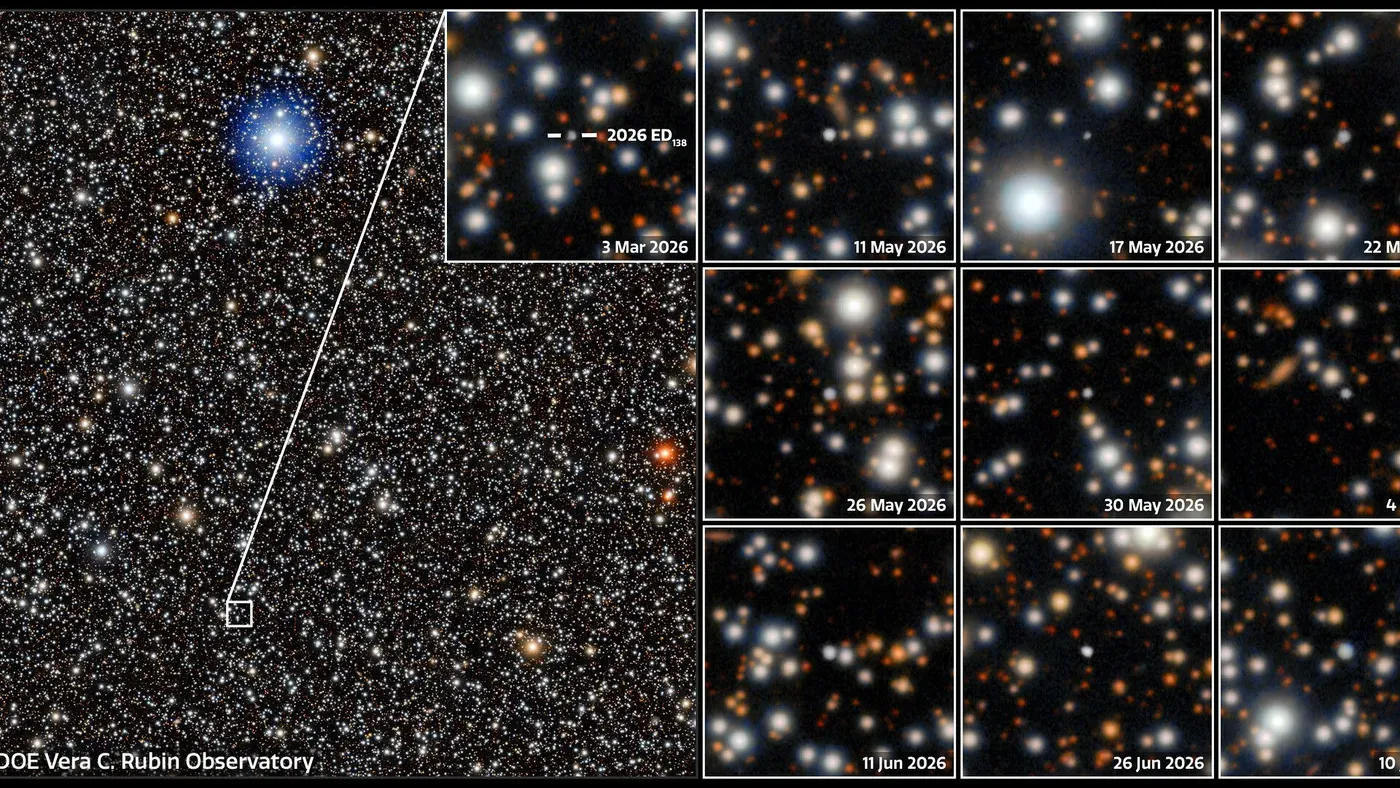
A possible new world has been discovered beyond Neptune in our solar system, and it could be one of the largest and brightest objects ever found in that region.
If confirmed as a dwarf planet, this miniature world would bring the total number of officially recognized solar system dwarf planets to six.
The object, designated 2026 ED138, is estimated to have a diameter greater than half that of Pluto, which is currently the largest known dwarf planet.
This discovery was made possible by the Vera C. Rubin Observatory's advanced technology, which allowed researchers to see past the millions of stars in the inner Milky Way galaxy.
The Rubin Observatory's advanced technology has enabled researchers to scan the entire southern sky every few nights, producing millions of nightly alerts for objects that have changed brightness or position.
This capability makes the observatory exceptional in identifying moving objects within our solar system and beyond, including transient events like supernova explosions.
In its early stages of operation, the Rubin Observatory had only just begun its 10-year mission to scan the sky when it detected an unusual object, now known as ED138, which stood out in the data collected so far.
Holman's software algorithms process the vast amounts of data generated by the observatory, comparing billions of observations to determine if they are detecting the same moving object, a task that requires sophisticated code.
By running data from Rubin through this code, researchers identified an unusually large object, which prompted further investigation into its characteristics and behavior.
The discovery of thousands of Kuiper Belt objects has provided valuable insights into the early solar system's formation, with these space rocks serving as frozen time capsules holding crucial information about the past.
These celestial bodies are significant because they can offer clues to the formation and evolution of our solar system, making them a vital area of study for astronomers.
Researchers have been using data from the Rubin Observatory to analyze objects in the Kuiper Belt, which is a region beyond Neptune's orbit where many small, icy bodies reside.
The International Astronomical Union has officially recognized five dwarf planets: Pluto, Ceres, Eris, Haumea, and Makemake. However, astronomers studying this area often identify at least nine potential dwarf planets, with several more candidates whose properties remain unknown.
While the exact number of dwarf planets is still a topic of debate among astronomers, it's clear that these objects play a crucial role in understanding our solar system's structure and history.
Identifying dwarf planets in the Kuiper Belt is challenging due to their remote locations and slow movement from Earth's perspective.
The most promising candidates have high surface reflectivity and diameters exceeding 370-500 miles (600-800 km). The object known as ED138 stands out with its estimated size, which ranges between 370-930 miles (600-1,500 km) in diameter.
For context, Pluto, the largest recognized dwarf planet, measures approximately 1,477 miles (2,377 km) across. Ceres, the smallest IAU-recognized dwarf planet, has a diameter of around 595 miles (958 km).
Further observations will help scientists determine ED138's actual size and density, ultimately deciding if it meets the criteria to be classified as a dwarf planet.
Facts based on reporting originally published by Live Science.
You may republish this story, in full or in part, if you credit News Central Site and link to it (licence CC BY 4.0). Photos are not included.