New Trojans Spotted in the Outer Reaches of the Solar System
Astronomers at the Vera C. Rubin Observatory have discovered two ancient Trojan asteroids trailing Neptune around the sun.
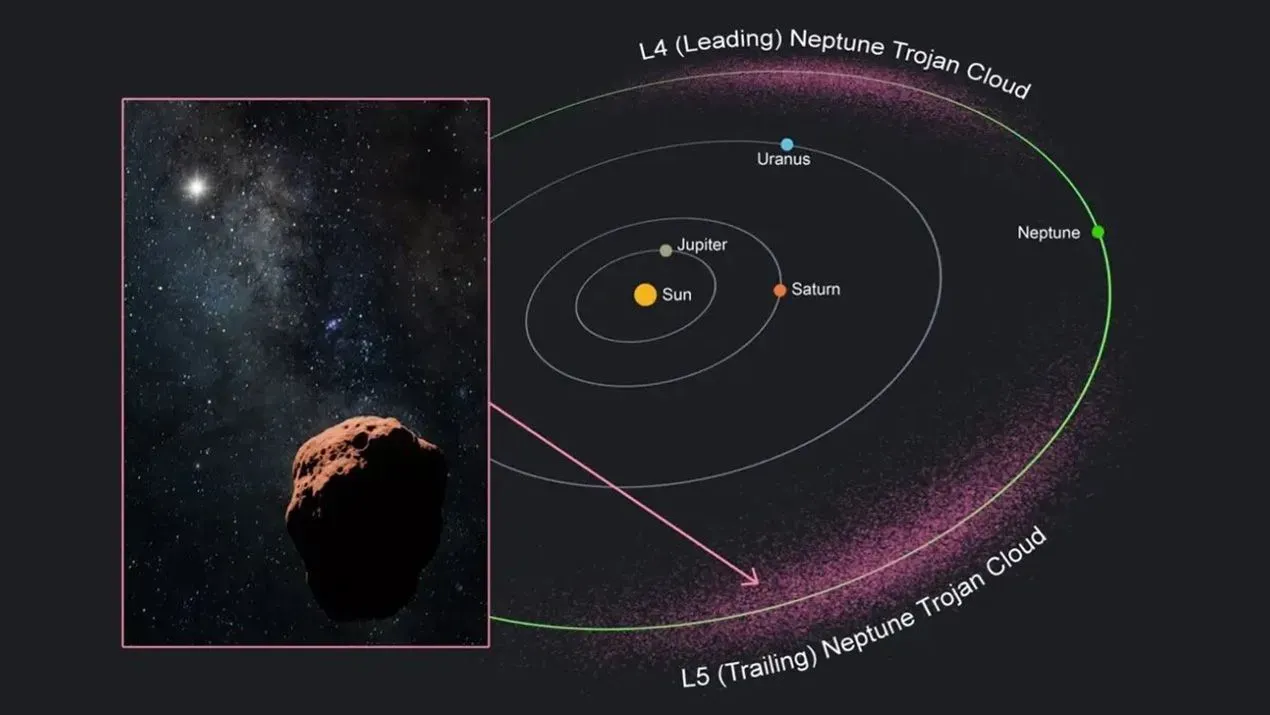
Astronomers at the Vera C. Rubin Observatory have made a groundbreaking discovery: two ancient Trojan asteroids trailing Neptune around the sun. This find marks the first new Trojans spotted in 15 years and is an exciting development for our understanding of the early solar system.
The study, published on October 15th in The Astrophysical Journal Letters, shows that these ancient asteroids have been orbiting the sun, following the same path as Neptune. This behavior is due to a delicate balance between the gravitational forces of the sun and Neptune, which "locks" them into position at specific points called Lagrange points.
These Lagrange points are located roughly 60 degrees ahead of and behind Neptune in its orbit around the sun. The Trojans that occupy these positions are icy, rocky bodies thought to be remnants from the solar system's early days as planetary building blocks. Detecting such asteroids in the outer reaches of the solar system is a challenging task.
Researchers believe that these ancient asteroids offer valuable insights into the formation and evolution of our solar system. With only a few Trojans known to exist for billions of years, this discovery could be significant, especially when compared to Jupiter's Trojans, which are much more abundant, with over 15,000 discovered so far.
The presence of Trojans in our solar system is not exclusive to Jupiter and Mars, as other planets like Neptune also host these asteroids.
In fact, research conducted in 2005 estimated that Neptune has a significantly larger number of Trojans than Jupiter, with the exact figure being up to ten times more.
Despite this, astronomers have only been able to spot a small number of Neptunian Trojans, with just 28 identified so far. However, not all of these asteroids are long-term members of the L5 group, with only two meeting this criterion.
One major challenge in detecting Neptunian Trojans is their extreme faintness, making them difficult to spot even with advanced telescopes.
The Rubin Observatory is well-equipped for discovering Neptune Trojans due to its exceptional vision capabilities, allowing it to detect objects that are 100 billion times dimmer than Venus.
This unique ability proved crucial in spotting a rare swarm of asteroids from the solar system's early days, which were trailing Neptune around the sun. The discovery was made during the Rubin Science Validation Survey, a three-month test run conducted in mid-2025 before the start of the Legacy Survey of Space and Time (LSST).
The survey inadvertently captured the region of the sky containing Neptune's L5 Trojans, leading to the detection of these asteroids within just three weeks. The researchers were able to photograph the objects and then used computer models to determine their orbits.
These simulations revealed that the two confirmed Trojans will continue to follow Neptune for an astonishing billion years. Furthermore, the results suggest that the asteroids' trajectories have remained stable for several billion years, implying that they may have been traversing these routes since the early solar system's formation.
The researchers also identified a third object in Rubin's data, but its orbit was only stable in some simulations, classifying it as a candidate Trojan rather than a confirmed one.
The discovery of two confirmed Trojans trailing Neptune around the sun has shed new light on the solar system's early days. The asteroids' highly tilted orbits suggest that they were captured by Neptune as they passed by, much like the previously discovered L5 asteroids. This implies a complex and dynamic history for the giant planet.
Researchers believe that understanding the properties of both Jovian and Neptunian Trojan asteroids will provide valuable insights into the solar system's infancy. The migration of giant planets to their current positions is thought to have occurred during this period, and studying these objects can help clarify what happened. Further investigation may also reveal more about the early solar system.
The Large Synoptic Survey Telescope (LSST) is expected to play a significant role in uncovering additional Neptunian Trojans, with its repeated surveys of the sky likely to reveal many more of these hypothesized asteroids over the next several months. This will provide scientists with valuable data and help them better comprehend the solar system's early evolution.
Facts based on reporting originally published by Live Science.
You may republish this story, in full or in part, if you credit News Central Site and link to it (licence CC BY 4.0). Photos are not included.