Jupiter, Saturn, Uranus and Neptune could destroy each other sooner than we thought, simulations hint
A new study suggests that the four outer planets could develop irregular orbits as the sun exhausts its fuel and expands into a red giant.
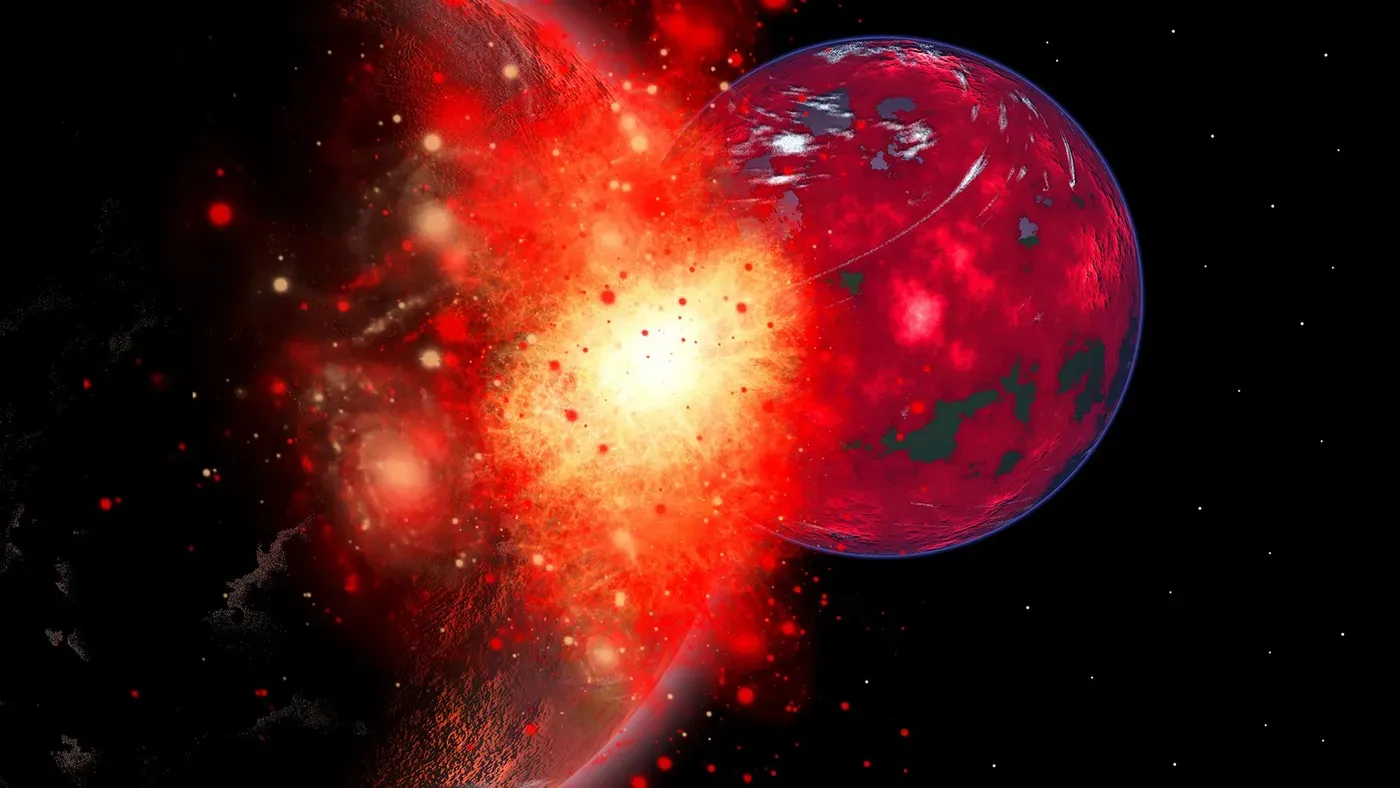
Scientists have long assumed that the four giant planets in our solar system - Jupiter, Saturn, Uranus and Neptune - would remain largely unchanged for hundreds of billions of years to come. However, a new study suggests this may not be the case.
According to simulations, these outer planets could develop irregular orbits as the sun exhausts its fuel and expands into a red giant. This transformation is expected to occur in about 5 billion years when the sun runs out of hydrogen in its core. As it balloons outward, the star will swell to 100 times its current size.
The four outer planets are currently thought to be safe from this phase, with some research suggesting they would even move further away from the sun as gas is released into space. A study published in 1998 found that the sun's expansion would push these planets outward, potentially doubling their orbital radii.
However, new simulations indicate a very different outcome. When the sun reaches its red giant phase and begins to shed mass, it could send the four outer planets careening into each other. This catastrophic collision could destroy the planets within just three billion years of the sun's transformation.
This research has significant implications for our understanding of exoplanets and their potential orbits around certain stars. If these findings hold true, they may challenge current theories about planetary formation and evolution in the universe.
The stability of our solar system has been a topic of interest among astronomers, and recent findings suggest that it may be more fragile than previously thought.
New research indicates that the gravitational balance between Jupiter, Saturn, Uranus, and Neptune could be disrupted by the sun's mass loss in its final stages.
This disruption is caused by the sun ejecting large amounts of plasma into space, which creates a recoil effect similar to a gun firing a bullet. The sun's speed would increase significantly over time due to multiple small pushes from these explosions.
Researchers have observed this phenomenon in other star systems, where white dwarfs have experienced kicks in their orbits due to massive plasma ejections. These explosions could become more frequent as the sun approaches its dying days.
The implications of this research are significant, as it challenges current theories about planetary formation and evolution. The gravitational balance of our solar system may be more susceptible to disruption than previously thought.
Astronomers have begun to study the effects of these plasma ejections on the outer solar system's stability. Their findings could provide new insights into the long-term evolution of our cosmic neighborhood.
The simulations revealed significant changes in the outer solar system when the sun's mass loss was not gradual but rather occurred in distinct blobs. This led to a radical transformation of the giant planets' orbits, making them more unstable and unpredictable.
To investigate this phenomenon, researchers created computer models that simulated the effects of the sun's mass loss on the outer planets. They considered three possible scenarios: a smooth loss of mass, a gradual ejection of blobs throughout the red giant phase, and a sudden release of blobs during its final stages.
The team also experimented with varying the mass of each ejected blob to see how it would impact the solar system. This led to some surprising results, as the simulations showed that even small changes in the sun's mass loss could have significant effects on the outer planets' orbits.
In one of the scenarios, where the sun lost mass in distinct blobs during its red giant phase, the researchers found that the giant planets were thrown into chaos. Their orbits became more elliptical and unstable, with some even being ejected from the solar system entirely.
The simulations revealed a dramatic outcome: 96% of the scenarios where massive objects were ejected from the system ended in catastrophic collisions between the planets themselves.
This apocalyptic scenario played out within a remarkably short timeframe - often less than a few hundred million years after the sun had exhausted its fuel and become a white dwarf, or even during the red giant phase if the collision was particularly intense.
The study's findings have significant implications for our understanding of planetary systems around white dwarf stars, suggesting that such worlds may be inherently unstable and prone to destructive collisions.
Facts based on reporting originally published by Live Science.
You may republish this story, in full or in part, if you credit News Central Site and link to it (licence CC BY 4.0). Photos are not included.